Saturday, April 25, 2026
No Result
View All Result
LJ News Opinions
  • Home
  • U.S.
  • Politics
  • World News
  • Business
  • Entertainment
  • Sports
  • Technology
  • Health
  • Opinions
  • Home
  • U.S.
  • Politics
  • World News
  • Business
  • Entertainment
  • Sports
  • Technology
  • Health
  • Opinions
No Result
View All Result
LJ News Opinions
No Result
View All Result
Home Technology

How to prevent the Gulf Stream from collapsing? CLOSE the Bering Strait, experts say

by LJ News Opinions
April 25, 2026
in Technology
0
Share on FacebookShare on Twitter


Scientists have come up with a radical proposal to help prevent a key ocean current from collapsing – but it could disrupt a key shipping route. 

The Atlantic Meridional Overturning Circulation (AMOC) is a vast network of ocean currents which drives warm water northwards through the Gulf Stream.

There is a growing concern that, due to global warming, the AMOC could weaken or even shut down, with some studies even warning of an oncoming collapse this century.

This would likely cause temperatures in the UK to plummet, with winters becoming up to 7°C (12.57°F) colder on average.

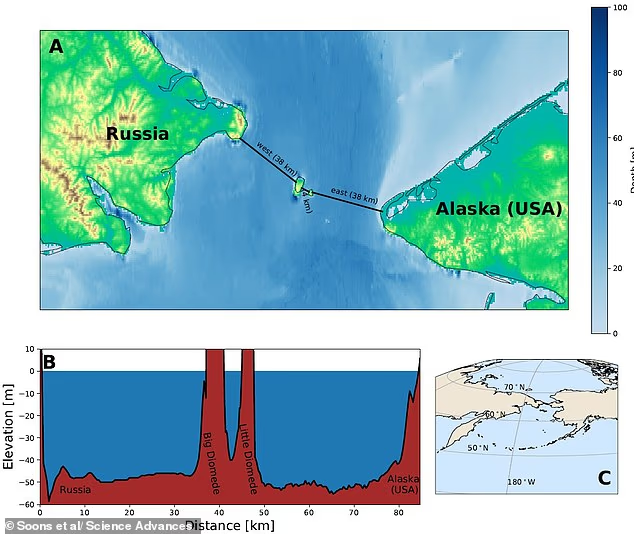
But experts believe there’s a way to prevent this happening – and it involves closing the Bering Strait, a 53–mile (82km)–wide international waterway separating Russia and Alaska.

A constructed closure of the Bering Strait would alter the balance of freshwater in the system, acting as a stabiliser to prevent it from collapse, they said.

‘A possible collapse would have a major impact on the global climate, particularly Europe’s, and could be practically irreversible,’ the researchers wrote in the journal Science Advances. ‘Constructing this closure could be a feasible climate intervention strategy to prevent an AMOC collapse.’

However, this strait serves as a critical shipping route connecting Asia and Europe – providing an important shortcut for cargo, energy resources and research vessels.

The proposed closure consists of three separate dams that connect mainland Russia to Alaska via two small islands called the Diomedes

The researchers compared their proposal to the Saemangeum Seawall in South Korea, which is 20 miles (33km) long

The researchers compared their proposal to the Saemangeum Seawall in South Korea, which is 20 miles (33km) long

For their study the team, from Utrecht University in the Netherlands, used models to simulate how the AMOC would respond in different scenarios.

The key idea in their paper is that the AMOC is very sensitive to how much freshwater is in the system.

The current depends on dense, cold and salty water sinking in the North Atlantic.

Having the Bering Strait open means that fresh Pacific water can flow northwards, diluting the current’s salinity and weakening it.

But closing it would result in a saltier North Atlantic, ensuring the AMOC stays ‘on’ instead of collapsing.

To do this, they propose building a mega–dam across the strait that would completely block water exchange between the Pacific and Arctic Ocean.

This 50–mile (80km) long dam would include a raised barrier above sea level around 330 feet (100m) wide at the top.

The authors argue it is technically feasible because the strait is shallow and relatively narrow, and is comparable to existing projects such as land reclamation or major seawalls.

Studies suggest that the collapse of AMOC could lead to a new 'Ice Age' in the Northern Hemisphere as temperatures over Europe plumet and ice encroaches from the Arctic just like the disaster movie 'The Day After Tomorrow' (pictured)

Studies suggest that the collapse of AMOC could lead to a new ‘Ice Age’ in the Northern Hemisphere as temperatures over Europe plumet and ice encroaches from the Arctic just like the disaster movie ‘The Day After Tomorrow’ (pictured)

What will happen if the Gulf Stream collapses?

  • Temperatures across Europe plummet as the Gulf Stream fails.
  • Winters in the UK become up to 7°C (12.57°F) colder on average.
  • Agriculture may become unsustainable across parts of Northern Europe.
  • Ice sheets may encroach from the Arctic, potentially covering parts of Scotland.
  • Temperatures in the Southern Hemisphere will rise, leading to violent storms and droughts over Africa.
  • Temperatures over the Antarctic could increase by more than 10°C (18°F).
  • Antarctic ice sheets and glaciers will melt, leading to rising sea levels and widespread flooding.

The team said their proposal would only be effective if implemented before the AMOC becomes too weakened.

But they warned that this project would have a ‘large impact’ on local ecosystems.

‘Particularly in this regard, we do want to stress that carbon dioxide mitigation efforts are the preferable option to prevent an AMOC collapse,’ they wrote.

‘But if this is not realised, this study showed that a man–made timely closure of the Bering Strait can prevent a collapse of the AMOC under particular climate forcing scenarios. ‘

In the event of an AMOC collapse the Gulf Stream – which is an important part of the system – would also suffer significant, catastrophic effects.

This would mean less warm water reaches Europe, triggering extensive cooling.

Earlier this month, scientists from the University of Bordeaux warned the AMOC is on track to weaken 50 per cent by the end of this century.

Experts previously thought AMOC would only reduce in strength by around 32 per cent over this time period.

This has raised concerns that the world may be unprepared for the rapid climate changes that this dramatic weakening will bring.

In their paper, the researchers said this will trigger ‘significant modifications’ to the global climate in the future.

The slowdown could lead to ‘extensive drying’ in Africa’s drought and famine–stricken Sahel region, according to the experts.

Meanwhile, temperatures in the Northern Hemisphere will plummet as the Gulf Stream fails to bring warm water up from the Tropics.

How does global warming affect global currents?  

Scientists think melting glaciers could cause the collapse of the Atlantic Meridional Overturning Circulation or AMOC, the system of ocean currents.

Described as ‘the conveyor belt of the ocean’, the AMOC transports warm water near the ocean’s surface northwards – from the tropics up to the northern hemisphere.

When the warm water reaches the North Atlantic (Europe and the UK, and the US east coast), it releases the heat and then freezes. As this ice forms, salt is left behind in the ocean water.

Due to the large amount of salt in the water, it becomes denser, sinks, and is carried southwards – back towards the tropics – in the depths below.

Eventually, the water gets pulled back up towards the surface and warms up in a process called upwelling, completing the cycle.

Scientists think AMOC brings enough warmth to the northern hemisphere that without it, large parts of Europe could enter a deep freeze.

Prior studies have already shown that due to climate change, the AMOC is weakening (meaning the movement of heat is slowing down)

The engine of this conveyor belt is off the coast of Greenland, where, as more ice melts from climate change, more freshwater flows into the North Atlantic and slows everything down. 

Why could the AMOC collapse? 

Scientists think melting glaciers could cause the collapse of the AMOC, the system of ocean currents.

Described as ‘the conveyor belt of the ocean’, the AMOC transports warm water near the ocean’s surface northwards – from the tropics up to the northern hemisphere.

Prior studies have already shown that due to climate change, the AMOC is slowing down.

The engine of this conveyor belt is off the coast of Greenland, where, as more ice melts from climate change, more freshwater flows into the North Atlantic and slows everything down.

Source link

Tags: dailymailsciencetech
LJ News Opinions

LJ News Opinions

Next Post

2026 NHL Conn Smythe Trophy Odds: Colorado's Nathan MacKinnon Favored

Recommended

‘Send me a sexy pic,’ Rep. Tony Gonzales messaged staffer amid allegations of affair, texts show

2 months ago

Identity theft myths debunked during national awareness week

3 months ago

Popular News

    Connect with us

    LJ News Opinions

    Welcome to LJ News Opinions, where breaking news stories have captivated us for over 20 years.
    Join us in this journey of sharing points of view about the news – read, react, engage, and unleash your opinion!

    Category

    • Business
    • Entertainment
    • Health
    • Opinions
    • Politics
    • Sports
    • Technology
    • U.S.
    • World News

    Site links

    • Home
    • About us
    • Contact

    Legal Pages

    • Privacy Policy
    • Cookie Privacy Policy
    • Terms of Use
    • Disclaimer
    • California Consumer Privacy Act (CCPA)
    • DMCA
    • About us
    • Advertise
    • Contact

    © 2024, All rights reserved.

    No Result
    View All Result
    • Home
    • U.S.
    • Politics
    • World News
    • Business
    • Entertainment
    • Sports
    • Technology
    • Health
    • Opinions

    © 2024, All rights reserved.