A giant phantom jellyfish was caught on video during a deep-sea exploration by the Schmidt Ocean Institute off the coast of Argentina in the southern Atlantic Ocean. This phantom jellyfish can grow to be as long as a school bus, the Institute said.
According to Texas A&M at Galveston, a new species of moon jellyfish named Aurelia profunda has been identified in the waters of the Gulf, marking it a significant discovery for marine life.
The discovery of Aurelia profunda increases the number of known moon jellyfish species in the Gulf from three to four.
SEE IT: WILDLIFE SERVICE OFFICIALS SEIZE 1,600 POUNDS OF ILLEGAL SHARK FINS IN ALASKA
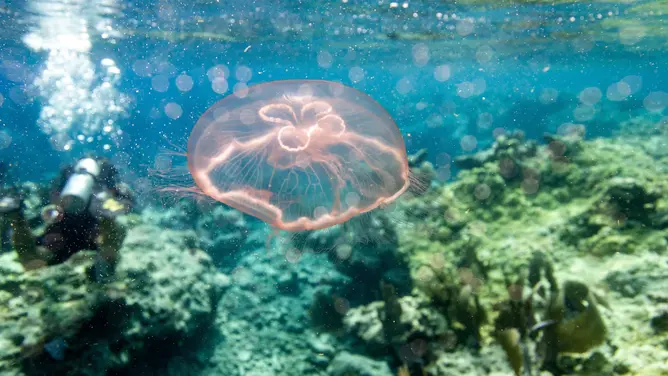
The name ‘moon jellyfish‘ comes from their translucent, moon-shaped bells, which are the large, rounded tops of the jellyfish.
A Moon jellyfish (Aurelia aurita) swims around a coral reef in Key West, Florida on July 13, 2023. The coral reef, the largest in the continental US, is considered a barrier reef and is around 350 miles (563.27 km) wide from the Dry Tortugas National Park to the St. Lucie Inlet in Martin County, Florida.
(Photo by Joseph Prezioso / AFP)
The discovery occurred during an offshore expedition near Louisiana, when former A&M Galveston doctoral student Alexandra Frolova Ruthenbeck came across a jellyfish that stood out.
SEE IT: NEW GUITAR-SHAPED SHARK SPECIES DISCOVERED, ALONG WITH 866 OTHER MARINE WILDLIFE
“I saw something pulsing in the water column near the boat lights. We scooped it up, and it was a beautiful moon jellyfish carrying many larvae,” Ruthenbeck recalled in the Texas A&M at Galveston report.
She added that it was the only jellyfish they saw during the entire five-day cruise.
The single specimen collected offshore “proved to be a biological gold mine,” the report said.
Since the jellyfish carried larvae, scientists were able to document the entire life cycle of the new species in the lab.
EMPEROR PENGUINS DECLARED ENDANGERED SPECIES AMID THE DECLINE IN SEA ICE
Dr. Maria Pia Miglietta, an associate professor of marine biology at Texas A&M at Galveston, told local reporters that this discovery is “just the tip of the iceberg.” She noted that the 2026 find suggests many more species are still waiting to be discovered in the Gulf.
With more to learn from this breakthrough, future research will examine the damaging effects that rising ocean temperatures could have on these jellyfish.
With that, this finding underscores how much of the ocean remains a mystery.