From Succession to Wall Street, many corporate dramas see the most ruthless characters rise to the top.
Now, a study has revealed that this isn’t just a cheesy TV trope.
Experts from the University of British Columbia have found that bosses actively favour manipulative employees if they think they can advance their own career goals.
‘If you have agentic or self–serving goals, hiring a dark personality candidate could actually be useful,’ explained Dr Karl Aquino, co–author of the study.
‘If you have more communal goals, then you don’t want to hire that person.’
However, while favouring manipulative employees might have advantages in the short–term, the experts warn of ‘significant long–term costs’.
‘While there are advantages to having these kinds of people in the organization, it’s possible that it could be costly in the long run as they may do things that get the organization in trouble,’ Dr Aquino added.
‘Organizations may regret it, and the people they hire may well stab them in the back.’
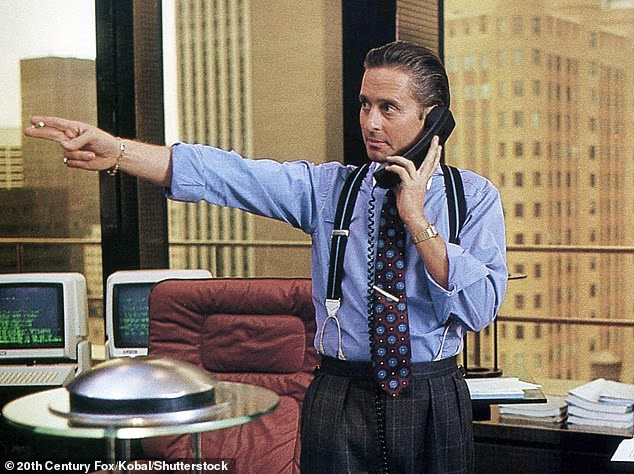
From Succession to Wall Street, many corporate dramas see the most ruthless characters rise to the top. Now, a study has revealed that this isn’t just a cheesy TV trope. Pictured: Michael Douglas as Gordon Gekko in Wall Street

Experts from the University of British Columbia have found that bosses actively favour manipulative employees if they think they can advance their own career goals
While people with dark personality traits can negatively impact organizations, they’re still found across most industries.
In their new study, the team set out to understand why that is the case.
Across several experiments, the researchers surveyed more than 1,200 managers.
In one experiment, the managers were asked to review fictional job candidates who had identical qualifications, but handled workplace situations differently.
The results revealed that candidates who displayed manipulative or self–interested tactics were rated more positively by managers who prioritised their own career advancement.
In another experiment, the managers were asked to reflect on their favourite, and least favourite real–world employees.
Here, the results showed that managers who prioritised personal gain were significantly more likely to rate their preferred employees as having dark traits.
According to the researchers, this suggests that employees with dark traits may be more willing to take on tasks others avoid.

While people with dark personality traits can negatively impact organizations, they’re still found across most industries. In their new study, the team set out to understand why that is the case. Pictured: Matthew Macfadyen as Tom Wambsgans in Succession
For this reason, managers see them as useful for work that could harm their own reputation – such as disciplining staff, or conducting layoffs.
‘Throughout history and in organizations, there are people who have to do dirty, bad things that a lot of people don’t want to do, and perhaps dark personalities are better able to do those than those who lack these traits,’ Dr Aquino explained.
‘A leader recognizes a place for people who seem to violate conventional norms of what it is to be a good person.’
The news comes shortly after scientists from the University of Illinois at Urbana–Champaign revealed the jobs that attract the most psychopaths.
For their study, the team enlisted more than 600 participants, who were quizzed about their dark personality traits, as well as their interest in eight career areas.
The results revealed a ‘clear pattern’.
People with psychopathic traits were more drawn to hands–on and practical work activities.
In terms of specific careers, this includes mechanics and engineers.
Yan Yi Lance Du, the study’s lead author, said: ‘The need for power and status can be a fundamental drive behind the careers people pursue.’
WOULD YOU KNOW HOW TO SPOT A PSYCHOPATH?
Psychopaths display different traits depending on their disorder.
Common signs include superficial charm, a grandiose notion of self-worth, the need for stimulation and impulsiveness, pathological lying, the ability to manipulate others and a lack of remorse and empathy.
But despite the popular association, not all psychopaths become killers.
Experts claim people usually find psychopaths intriguing, but can’t put their finger on why.
This is down to incongruous behaviour because psychopaths tend to do a lot of acting to deceive, or mimic normal reactions, sometimes changing their views and reactions quickly.
For example, Self-professed psychopath Jacob Wells said that upon meeting someone, he tries to become ‘the most interesting person they know’ and presumably adopts suitable interests and responses to do this.
His response also gives away another common trait – a grandiose notion of self-worth – in that he can be the most interesting person in the room.
Psychopaths occasionally tend to exhibit unconvincing emotional responses, with slip-ups including tone of voice or body language.
This may be because they are unable to understand emotions such as fear and love, but can mimic them.

Psychopaths display different traits depending on their disorder, but common signs include superficial charm and the ability to manipulate others. Despite the popular association, not all psychopaths become killers (stock image)
Generally psychopaths’ ’emotions’ are shallow and short-lived and there is a manipulative ulterior motive to showing them.
For example, Mr Wells said he offers to do favours and tells false secrets to people to gain their complete trust.
He also displays insincere charm – another trait associated with psychopaths.
He says: ‘I keep secrets, and tell them fake secrets to further gain their trust, and once they trust me enough, I ask for favours, reminding them of the favours I did them. I can get literally anything from them, which is incredibly useful.’
Psychopaths typically display an incredible ability to manipulate others and sometimes take pleasure in doing so.
Psychopaths often have an air of superiority about them, perhaps shown by Mr Wells’ belief he can spot other psychopaths
Even expert Dr Hare, who came up with the Hare Psychopathy Checklist-Revised (PCL-R) used as a diagnostic tool to determine where someone lies on the psychopathy spectrum, warns that anyone can be duped during a short interaction with a psychopath.