Thursday, April 23, 2026
No Result
View All Result
LJ News Opinions
  • Home
  • U.S.
  • Politics
  • World News
  • Business
  • Entertainment
  • Sports
  • Technology
  • Health
  • Opinions
  • Home
  • U.S.
  • Politics
  • World News
  • Business
  • Entertainment
  • Sports
  • Technology
  • Health
  • Opinions
No Result
View All Result
LJ News Opinions
No Result
View All Result
Home Technology

Huge GREEN fireball streaks across the sky over Britain – as baffled viewers mistake it for a rogue firework

by LJ News Opinions
April 13, 2026
in Technology
0
Share on FacebookShare on Twitter


  • Did you see it? Send your photos and videos to [email protected]

By SHIVALI BEST, SCIENCE & TECHNOLOGY EDITOR

Published: 05:06 EDT, 13 April 2026 | Updated: 10:34 EDT, 13 April 2026

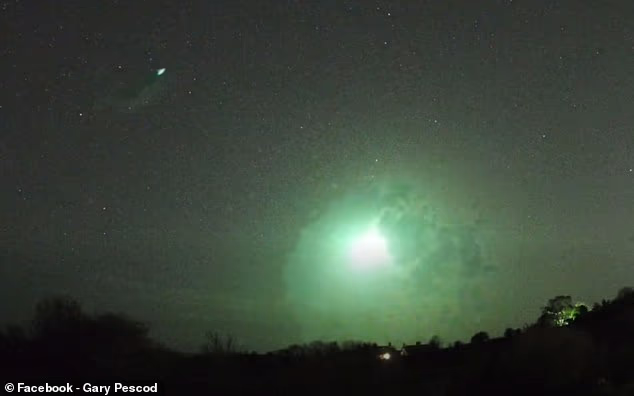
A huge green fireball streaked across the sky over Britain last night. 

Doorbell cameras across the UK captured the object at around 00:30 BST. 

’00:26 anyone see that big meteor burn up just now?’ North Yorkshire Weather Updates asked on Facebook. 

Hundreds of viewers have replied, with many revealing they mistook it for a rogue firework. 

‘I saw that. It was bright green. It was massive. I thought it was a firework at first it seemed so close,’ one user replied. 

Another said: ‘Yes I saw it walking home in Derbyshire. Looked like a firework the colours it was giving off. Glad I read this…wasnt sure what Id seen.’

And one joked: ‘Yep my bathroom lit up I thought I was hallucinating… lol.’

While the fireball may have been slightly alarming, there’s a simple explanation – it’s a meteor. 

Incredible footage has revealed the moment a huge green fireball streaked across the sky over Britain last night

Keith Spirit captured a photo of the fireball as it zoomed through the skies over Northumberland last night

Keith Spirit captured a photo of the fireball as it zoomed through the skies over Northumberland last night

Videos filmed across the UK show the fireball zooming towards the Earth, before bursting into bright green. 

Thankfully, it then disappeared, suggesting most of it burned up before reaching the ground. 

‘Saw that from the M62 and I’m still buzzing! Can’t believe how bright it was!’ one viewer wrote on Facebook. 

Another said: ‘Camera on edge of the moors in Winterburn just caught it.’

And one quipped: ‘see we go round the moon and now we have space rocks been thrown at us,’ in reference to NASA’s Artemis II mission. 

Fireballs that explode in the atmosphere are technically referred to as bolides. 

‘During the atmospheric entry phase, an impacting object is both slowed and heated by atmospheric friction,’ NASA explained. 

‘In front of it, a bow shock develops where atmospheric gases are compressed and heated. 

Videos filmed across the UK show the fireball zooming towards the Earth, before bursting into bright green. Thankfully, it then disappeared, suggesting most of it burned up before reaching the ground.

Videos filmed across the UK show the fireball zooming towards the Earth, before bursting into bright green. Thankfully, it then disappeared, suggesting most of it burned up before reaching the ground.

‘Some of this energy is radiated to the object causing it to ablate, and in most cases, to break apart. 

‘Fragmentation increases the amount of atmosphere intercepted and so enhances ablation and atmospheric braking. 

‘The object catastrophically disrupts when the force from the unequal pressures on the front and back sides exceeds its tensile strength.’

Around the world, thousand of fireballs occur daily. 

However, most are unnoticed because they happen over oceans, uninhabited regions, or during the day.

Explained: The difference between an asteroid, meteorite and other space rocks

An asteroid is a large chunk of rock left over from collisions or the early solar system. Most are located between Mars and Jupiter in the Main Belt.

A comet is a rock covered in ice, methane and other compounds. Their orbits take them much further out of the solar system.

A meteor is what astronomers call a flash of light in the atmosphere when debris burns up.

This debris itself is known as a meteoroid. Most are so small they are vapourised in the atmosphere.

If any of this meteoroid makes it to Earth, it is called a meteorite.

Meteors, meteoroids and meteorites normally originate from asteroids and comets.

For example, if Earth passes through the tail of a comet, much of the debris burns up in the atmosphere, forming a meteor shower.

Share or comment on this article:
Huge GREEN fireball streaks across the sky over Britain – as baffled viewers mistake it for a rogue firework


Source link

Tags: Artemis IIdailymailearthFacebookNASAsciencetech
LJ News Opinions

LJ News Opinions

Next Post

Dallas Wings select Azzi Fudd of UConn No. 1 in WNBA draft with a $500,000 payday waiting

Recommended

Ex-NFL star RG III pinpoints ‘moment Trump won the election’

1 year ago

Israel strikes Syria after Druze clashes

1 month ago

Popular News

    Connect with us

    LJ News Opinions

    Welcome to LJ News Opinions, where breaking news stories have captivated us for over 20 years.
    Join us in this journey of sharing points of view about the news – read, react, engage, and unleash your opinion!

    Category

    • Business
    • Entertainment
    • Health
    • Opinions
    • Politics
    • Sports
    • Technology
    • U.S.
    • World News

    Site links

    • Home
    • About us
    • Contact

    Legal Pages

    • Privacy Policy
    • Cookie Privacy Policy
    • Terms of Use
    • Disclaimer
    • California Consumer Privacy Act (CCPA)
    • DMCA
    • About us
    • Advertise
    • Contact

    © 2024, All rights reserved.

    No Result
    View All Result
    • Home
    • U.S.
    • Politics
    • World News
    • Business
    • Entertainment
    • Sports
    • Technology
    • Health
    • Opinions

    © 2024, All rights reserved.