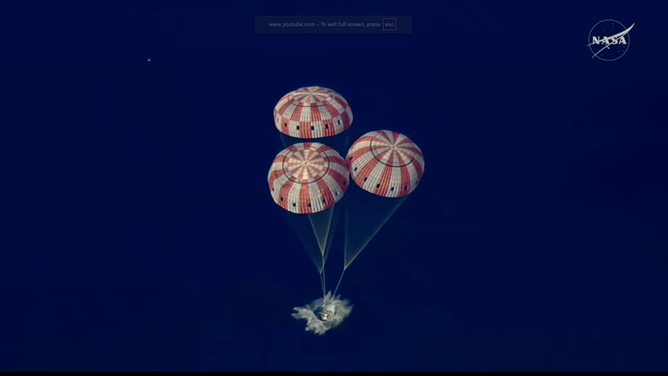
SPLASHDOWN 🚀: The Artemis II crew has splashed down in the Pacific, capping off a historic 10-day mission that carried humans farther from Earth than ever before.
SAN DIEGO, Calif. – The Artemis II mission flight has come to a close off the coast of San Diego, California in a historic splashdown, marking the end of the one inspiring journey, but the beginning of a new chapter of human space travel.
After an intense journey around the moon and back, the Orion capsule splashed down in the Pacific Ocean at 8:07 p.m. ET, off the coast of California – and was immediately met by recovery teams from NASA and the U.S. Navy in position to welcome the Artemis II crew back to Earth with open arms.
Artemis II launched from Kennedy Space Center in Cape Canaveral, Florida, on April 1, 2026, at 6:35 p.m. ET, bringing the total mission duration to 9 days, 1 hour, 32 minutes, and 15 seconds.
Artemis II splashes down in the Pacific Ocean off the coast of California on April 10, 2026, after a historic mission around the moon.
(NASA)
A Dive Medical Recovery Team made up of four U.S. Navy members will enter the capsule to conduct initial health exams on the Artemis II crew, before assisting them to inflatable rafts. The four astronauts will then be airlifted by Navy helicopters to the USS John P. Murtha for post-flight evaluations.
Once post-flight evaluations are complete aboard the USS Murtha, the crew will be flown to the San Diego Naval Air Station to board a NASA plane to fly back to Mission Control at Johnson Space Center in Houston, Texas.
“As NASA Administrator, I couldn’t be more proud of the entire workforce. The years, the efforts, the late nights, all the hard work from across the country that contributed to this incredible moment right now,” NASA Administrator Jared Isaacman said after the successful splashdown.
The Orion capsule re-entered Earth’s atmosphere at 400,000 feet at approximately 7:53 p.m. ET, blazing through the sky traveling at roughly 24,500 mph, with friction heat raising the external temperature of the capsule to a sweltering 5,000 degrees.
After the successful splashdown, reports from inside the capsule reported that all four astronauts, Commander Reid Wiseman, pilot Victor Glover, and mission specialist Christina Koch from NASA, and mission specialist Jeremy Hansen from the Canadian Space Agency, are in excellent health.
“These were the ambassadors from humanity to the stars that we sent out there right now, and I can’t imagine a better crew than the Artemis II that just completed a perfect mission,” Administrator Isaacman said.
The Orion capsule deployed NASA’s iconic orange-and-white parachutes at approximately 8:03 p.m. ET to prepare for the gentle splashdown. The sophisticated 11-parachute orchestra was deployed over three phases starting at roughly 22,000 feet, allowing the capsule to have a graceful return to Earth.
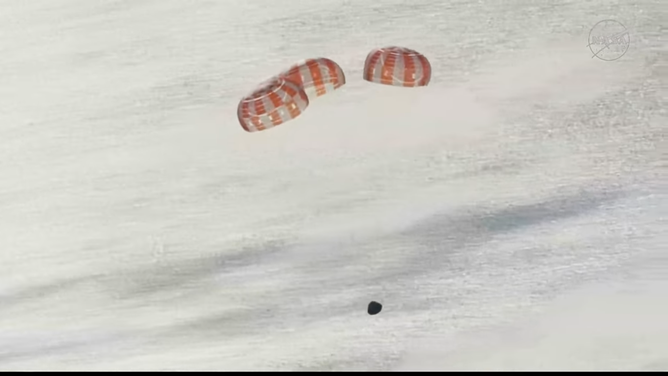
The iconic orange and white parachutes deployed from Artemis II that made for a graceful splashdown in the Pacific Ocean on April 10, 2026.
(NASA)
After the successful extraction of the Artemis II crew, the focus of the recovery team shifts to the Orion capsule itself.
Recovery teams will secure the capsule in the same manner as NASA and U.S. Navy crews did over three years ago in the Artemis I splashdown.
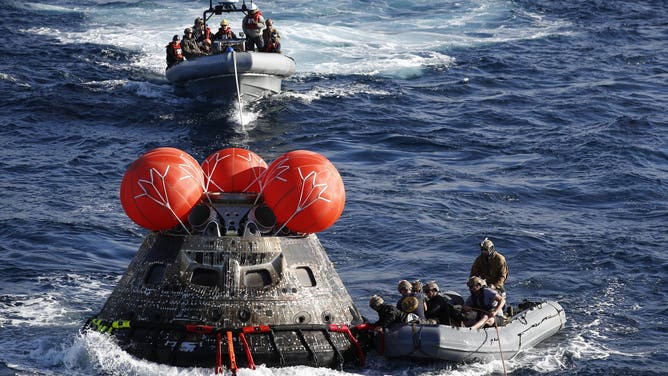
ARTEMIS I FILE PHOTO: U.S. Navy divers attach winch cables to NASA’s Orion Capsule of the successful uncrewed Artemis I Moon Mission for capture by the U.S.S. Portland on December 11, 2022 in the Pacific Ocean off the coast of Baja California, Mexico.
(Photo by CAROLINE BREHMAN/POOL/AFP via Getty Images / Getty Images)
Once the spacecraft is shutdown and the hatch is closed, the capsule is towed using a winch line deployed from the back of the USS John P. Murtha, where the Orion capsule is towed into a weld deck area.
In the final milestone of splashdown recovery, water is then drained from the weld deck area and the capsule is secured.
HISTORIC MISSION: ‘NASA IS BACK IN THE BUSINESS OF SENDING ASTRONAUTS TO THE MOON’
With a successful splash down, the 10-day lunar flyby mission has come to a close, forever etching Artemis II into the history books of spaceflight.
After 53 years, NASA has once again successfully sent astronauts to the moon, making history on its daunting journey.
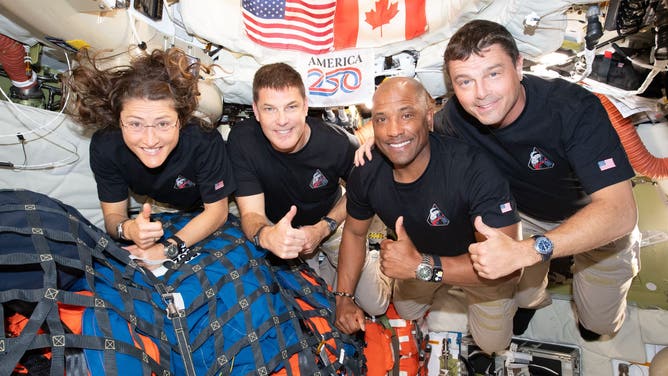
The Artemis II crew – (from left) Mission Specialist Christina Koch, Mission Specialist Jeremy Hansen, Pilot Victor Glover, and Commander Reid Wiseman – pause for a group photo inside the Orion spacecraft on their way home.
(NASA / Getty Images)
The Orion spacecraft, coined “Integrity”, brought humanity further into deep space than ever before – traveling 252,756 miles from Earth.
After traveling roughly 695,000 miles over 10 days, Artemis II has returned home, bringing back a collection of timeless memories—and never-before-seen images of the Moon—from its inspiring voyage.
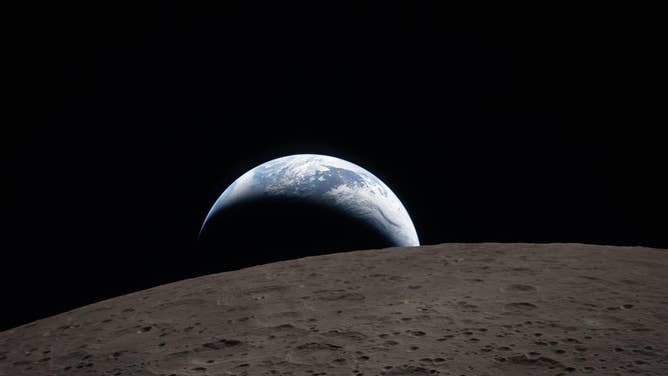
Earthset was captured through the Orion spacecraft window at 6:41 p.m. EDT, April 6, 2026, during the Artemis II crew’s flyby of the Moon. A muted blue Earth with bright white clouds sets behind the cratered lunar surface. The dark portion of Earth is experiencing nighttime. On Earth’s day side, swirling clouds are visible over the Australia and Oceania region. In the foreground, Ohm crater has terraced edges and a flat floor interrupted by central peaks. Central peaks form in complex craters when the lunar surface, liquefied on impact, splashes upwards during the crater’s formation.
(NASA / FOX Weather)
ARTEMIS PROGRAM: A NEW ERA OF HUMAN SPACEFLIGHT
This is just the beginning.
NASA’s Artemis Program aims to land American astronauts on the surface of the moon this decade and maintain U.S. superiority in exploration and discovery.
NASA’S ARTEMIS PROGRAM: PAVING THE WAY FOR HUMANKIND’S RETURN TO THE MOON AND BEYOND
With a successful splashdown, Artemis II has built upon the success of Artemis I, bringing humans to deep space and to the moon for the first time since 1972.
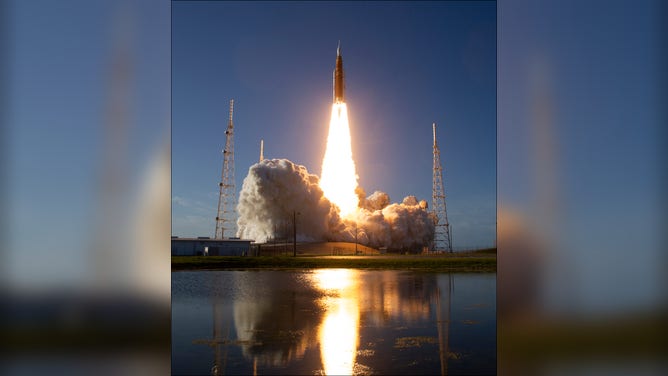
NASA’s Artemis II Space Launch System rocket carrying the Orion spacecraft lifts off from Launch Complex 39B at Kennedy Space Center on April 1, 2026 in Cape Canaveral, Florida.
(@nasahqphoto / X)
Founded on the idea of further pursuing human expansion across the solar system, the Artemis Program isn’t stopping at the moon – with its eyes set on Mars.
“It’s a huge moment for everybody. We are back in the business of sending astronauts to the moon, and bringing them back safely,” NASA Administrator Isaacman said. “This is just the beginning. We are going to get back into this with frequency, sending missions to the moon, until we land on it in 2028 and start building our base. “
With Artemis II complete, NASA has reached another key milestone—pushing forward its mission to return humans to the Moon and extend exploration beyond.