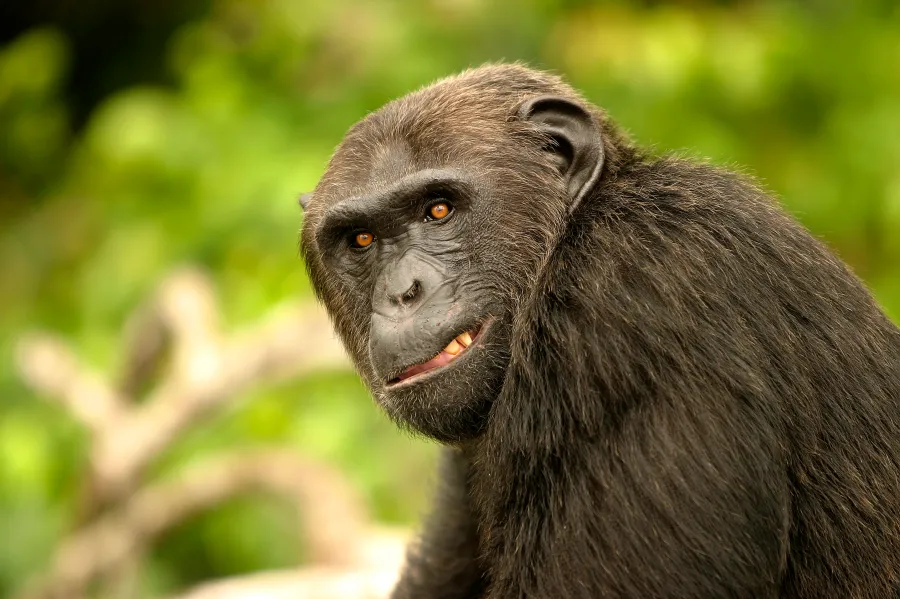
Researchers observed the dynamic shift from a cohesive society to two opposing groups, followed by years of lethal violence.
Scientists have observed something resembling a rare “civil war” among the largest known group of wild chimpanzees, according to a study published in the journal Science on Thursday.
The findings draw on nearly three decades of observations of the approximately 200 Ngogo chimpanzees living in Kibale National Park, Uganda. Researchers observed the dynamic shift from a cohesive society to two opposing groups, followed by years of lethal violence.
Group conflict between animals has been well documented, “However, lethal conflict among groups of animals that were once socially affiliated has not previously been observed outside of humans,” according to the study.
What did the scientists observe in the chimpanzees?
The researchers observed that the chimpanzees had overlapping social subgroups, known as the Western and Central clusters, who had been living harmoniously for decades. That changed in 2015, when the Western cluster was observed to be running away from the Central cluster, and a pattern of avoidance between the clusters emerged.
By 2018, the groups were permanently split, socially, geographically and reproductively. Scientists estimate, based on genetic evidence, that this kind of “permanent fissions in chimpanzees” occurs only once every 500 years.
Between 2018 and 2024, researchers observed Western chimpanzees kill at least seven adult males and 17 infants in the Central cluster.
“What’s especially striking is that the chimpanzees are killing former group members,” said Aaron Sandel, the study’s lead author and associate professor of anthropology at the University of Texas, Austin, according to UT News, “The new group identities are overriding cooperative relationships that had existed for years.”
Why do scientists think the chimpanzees started fighting?
Researchers point to several factors that may have contributed to the split, including a large group size, competition for food and reproductive partners, changes in the male hierarchy, and the deaths of six chimpanzees right before the avoidance between groups began.
The study’s findings challenge a “prominent line of research” that suggests “ethnicity, religion, language, and other cultural markers anchor group identities and motivate cooperation within groups and hostility toward outsiders,” according to the study.
“If relational dynamics alone can drive polarization and lethal conflict in chimps without language, ethnicity or ideology, then in humans, those cultural markers might be secondary to something more basic,” Sandel said.