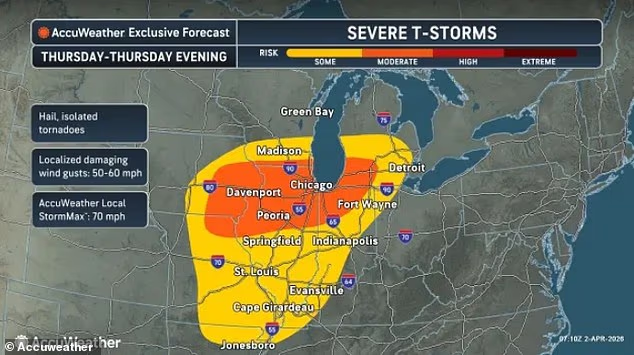
Multiple states could be at risk of a tornado touching down this week, as forecasters warn that the infamous Tornado Alley has been slowly shifting towards millions of Americans living in the eastern US.
Meteorologists at AccuWeather said that a multi-day storm is expected to batter at least eight states throughout the Southern Plains, Midwest and Great Lakes, including Texas, Oklahoma, Kansas, Missouri, Illinois, Indiana, Ohio and Michigan.
Severe thunderstorms are predicted to strike the Midwest on Thursday, bringing wind gusts over 50 mph, hail and the chance for tornadoes near major cities including Chicago, St. Louis, Indianapolis, Milwaukee and Detroit.
The extreme weather will spread south on Friday, with AccuWeather warning of downpours causing flooding, wind gusts over 60 mph and isolated tornadoes from central Texas to southwestern Wisconsin, central Illinois and Indiana and western Ohio.
AccuWeather Senior Meteorologist Bill Deger said: ‘This multiday severe weather pattern will bring rounds of storms and flooding downpours from the Plains and Midwest all the way to the I-95 corridor by Easter Sunday.’
‘Millions of people traveling for spring break and the holiday weekend face the risk of delays on the tarmac and on the highways.’
The new tornado warning comes as meteorologists say the traditional corridor for destructive tornadoes in the South has started moving eastward over the last 40 years.
Known as Tornado Alley, the old hotspot for extreme weather in Texas, Oklahoma, Kansas and Nebraska is now threatening millions each year in states such as Mississippi, Alabama, Tennessee, Kentucky, Arkansas, Illinois, Indiana, Missouri and Iowa.
Meteorologists warn that isolated tornadoes may strike in at least eight states this week

Pictured: A monster tornado hit Indiana in March 2026. Scientists warn that the infamous Tornado Alley has shifted eastward from the South
Researchers from both AccuWeather and the National Weather Service have conducted studies on this apparent shift, which has been blamed on warmer temperatures and more moisture in the air farther east in recent decades.
Tornado season in the US typically stretches from March to June, reaching its peak in May. Tornadoes are violently rotating columns of air that are usually attached to thunderstorms which swirl down to the ground.
They can vary in strength and destructiveness, from weak ones that cause minor damage to trees and roofs, all the way up to powerful monsters that can completely destroy well-built homes, flip cars and uproot trees in seconds.
Hundreds of twisters touch down each year, with AccuWeather revealing that over 900 were reported in March through May 2025. Now, the weather agency’s newest predictions for April 2026 show the highest risk of tornado threats moving into Iowa, Illinois, Missouri, Kentucky, Tennessee, Mississippi, Alabama and Arkansas.
AccuWeather Chief Meteorologist Jonathan Porter explained in a statement: ‘When you look at the trends in where tornadoes have occurred in recent years, it’s very clear that there have been more tornadoes farther south and farther east away from what people have typically known as the Tornado Alley across the Plains.’
A 2024 study in the Journal of Applied Meteorology discovered a clear shift in the states being hit by tornadoes after 1985, with more twisters landing outside of Tornado Alley.
Between 1951 and 1985, the highest number of tornadoes were recorded in the classic Great Plains, in states such as Oklahoma, Kansas and northern Texas.
Since then, researchers found Tornado Alley has seen annual twister reports drop by up to 40 percent in certain areas. Meanwhile, tornadoes have surged by 25 percent in Mississippi, Tennessee and parts of the Ohio Valley.

Homes and cars were destroyed by a tornado passed through Aroma Park, Illinois on Wednesday, March 11, 2026

Meteorologists warn that multiple states outside of Tornado Alley are at the highest risk of seeing twisters in April 2026
The research also noted that tornadoes were happening less often in the hot summer months and increasing in cooler periods during fall and winter.
Cold-season tornadoes from September through February spiked from 20 percent of all tornadoes to 28 percent by 2020.
Moreover, most of the additional cold-season tornadoes were in the eastern US.
The National Weather Service also cited a previous study in npj Climate and Atmospheric Science, which found that the ingredients for severe tornadoes, including wind shear, energy in the air and storm conditions producing major thunderstorms, were moving out of Tornado Alley and shifting towards millions living in the Ohio Valley.

Nearly 1,000 tornadoes were reported between March and May 2025. Significantly fewer have been predicted in 2026

Tornado reports from 2025 show increasing numbers in the eastern US, including in Ohio and Pennsylvania
Although forecasters warned that tornado risks are moving towards a more heavily populated section of the US, fewer twisters are expected to hit the country this year.
AccuWeather’s severe weather predictions have called for up to 500 fewer tornadoes in 2026 compared to last year.
However, Porter warned that a tornado can touch down in any state regardless of where Tornado Alley is moving.
‘It’s important to understand about the tornado hazard that there is a risk anywhere in the US, and you have to have a simple plan about what you and your family or your business will do if you’re immediately threatened by a tornado,’ Porter advised.
‘Sometimes, you only have a matter of a couple of minutes to react, so I always tell people a little bit of planning goes a long way. Simply talk with your family about the safest part of your house to take shelter,’ the expert continued.
‘If your family is not all at home when severe weather strikes, agree on a place to meet if communications are down or if your home is unreachable.’