The war in Iran is fuelling climate change, a new study has revealed.
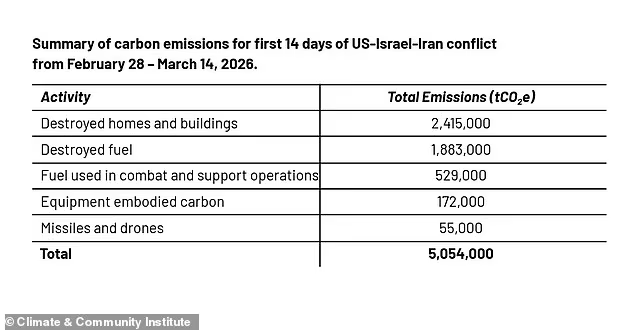
From 28 February to 14 March, the conflict released more than five million tons of greenhouse gases, according to experts from the Climate & Community Institute.
To put that into context, that’s more than the annual emissions from the entire country of Iceland.
For their study, the team estimated the emissions for five major categories of activity during the war.
Their results revealed how the destruction of homes and buildings has had the biggest impact, contributing an estimated 2.4 million tons of CO2.
This was followed by destroyed fuel, which contributed more than 1.8 million tons of CO2 across the two-week period.
‘We estimate that the total oil destroyed at oil storage facilities across the Gulf region and those in oil tankers to be between 2.5 and 5.9 million barrels,’ the researchers explained.
Other sources of emissions include fuel used in combat, missiles and drones, and equipment loss.
From 28 February to 14 March, the conflict released more than five million tons of greenhouse gases, according to experts from the Climate & Community Institute
For the study, the team set out to estimate the emissions from five activities during the first 14 days of the conflict.
These were: destroyed homes and buildings, destroyed fuel, fuel used in combat and support operations, equipment embodied carbon, and missiles and drones.
Topping the list are destroyed homes and buildings, which have been responsible for 2,415,000 tonnes of CO2, according to the analysis.
‘Airports, military structures, homes, and commercial buildings have either been destroyed or damaged in the conflict,’ the team explained.
‘This includes 16,191 residential units, 3,384 commercial units, 77 medical centres and 69 schools.’
Destroyed fuel is the next biggest contributor, responsible for 1,883,000 tonnes of CO2 in the first two weeks of the war.
The team said: ‘Israel has bombed several oil storage facilities in Iran including those in Tehran, Shahran, and Aghdasieh.
‘Iranian drone strikes have also caused fires and damage to oil refineries and storage facilities in Oman, Saudi Arabia, Bahrain and Kuwait.

In terms of fuel used in combat, the researchers estimate this was responsible for 529,000 tonnes of emissions. Pictured: an Israeli Air Force F-15 fighter jet
‘Iranian forces have also struck at least 5 oil tankers in the Strait of Hormuz since the conflict began.’
In terms of fuel used in combat, the researchers estimate this was responsible for 529,000 tonnes of emissions.
‘The US and Israel have relied on aerial bombardments to strike at targets in Iran,’ they said.
‘F-15s, F-35 and even B-12 bombers have been used in this conflict.
‘Based on the over 6,000 targets struck so far in the conflict and the number of missiles required to achieve those strikes, we estimate that about 2,500 flights each lasting about 3 hours have been completed.’
When it comes to equipment loss, this is estimated to have been responsible for 172,000 tonnes of CO2.
The team explained: ‘The US has lost four aircraft so far in this conflict, consisting of 3 F-15 fighter jets and 1 KC-135 refueling aircraft.
‘Iran is reported to have lost 28 aircrafts since the conflict began.

The destruction of homes and buildings has had the biggest impact, contributing an estimated 2.4 million tons of CO2. Pictured: a house destroyed by an Iranian missile strike in Zarzir, northern Israel
‘This includes fighter jets like F-14, SU-22 and SU-24, and military transport aircraft such as IL-76 and Boeing 747.
‘In addition, aircrafts, Iran has lost about 21 of its naval vessels and about 300 missile launchers.’
Finally, the researchers estimate that 55,000 tonnes of CO2 were released as a result of missiles and drones.
‘This war has been intensive in the use of missiles and drones,’ they added.