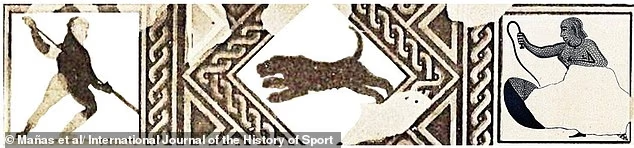
Historians have uncovered the first direct evidence of female gladiators battling fearsome beasts in the arena.
For the first time ever, an image showing a ‘huntress’ fighting a leopard in a Roman arena has been found.
It reveals fascinating details about their gruesome battles to the death – including that the women were often topless during their fights.
The mosaic was originally found in Reims, France, in 1860, but most of it was destroyed during bombing in WWI.
Luckily, the archaeologist who discovered it had captured it in a drawing, which he published in a book.
It received little attention – until now, thanks to a researcher from the University of California.
‘Women fighting beasts in arena games are attested by the written sources, but no visual source is known to show their image,’ author Alfonso Mañas wrote in the International Journal of the History of Sport.
‘Evidence is presented proving that she (the person in the mosaic) is a woman, and she is a beast fighter.’
A section of the mosaic showing the female huntress (right) chasing a leopard towards another fighter, a man (left)

It reveals fascinating details about their gruesome battles to the death – including that the women were often topless during their fights
Reims, where the mosaic was originally found, once played a major role in the Roman Empire and was a key administrative, economic and cultural hub with a population of up to 100,000.
The artwork, which dates back to the third century, likely belonged to a wealthy individual who sponsored beast–fighting events.
When archaeologists first studied the mosaic in 1862, they were unable to clearly define who the figure was.
It was suggested that ‘it could be a woman’, with reference to tied–up hair and a prominent shape on the chest.
Others guessed the individual was perhaps a ‘paegniarius’ – an arena clown who used a whip to fight others.
But Mr Mañas argues that the gender and role of the individual is obvious, thanks to the inclusion of breasts and her ‘feminine’ facial features.
‘The evidence of the breasts, especially the right one, is clear,’ he wrote. ‘That it is a woman is also supported by the fact that she is the only person with a whip represented without a shirt.
‘Being the only woman in the mosaic, she is depicted with a bare torso to show that she is a woman.’

A drawing of the mosaic, made by the archaeologist who first uncovered it. The partial depiction of the woman can be seen in the right–hand column, three rows up from the bottom
Rather than a prisoner condemned to death, Mr Mañas believes she was a beast hunter as she holds a weapon.
It’s likely she had either volunteered to be a beast hunter or had been convicted of a crime and sentenced to be trained and fight animals to gain her freedom.
The huntress, also known as a ‘venatrix’, differed from traditional female gladiators who fought other humans for entertainment.
‘It seems that female beast hunters would (nearly) always fight topless, with bare breasts, because contrariwise spectators from the stands would have had problems to notice that they were actually women,’ Mr Mañas said.
‘To arouse an erotic effect on those spectators, to excite them sexually, was one of the aims sought by their performance.’
He said that since the lower body of the woman is missing, it is impossible to know whether she was fully naked.
Regardless, she was likely of low social status as women of higher social position would never have appeared topless in an arena, the study reads.
‘I think that women were regular participants in arena events and that they’re underrepresented in surviving textual and visual evidence,’ Alison Futrell, a professor of history at the University of Arizona, told Live Science.

The flat chests of other figures in the mosaic make it obvious they are men, the author argued. It’s likely women fought topless to make their gender obvious to spectators

In a famous Pepsi advert, female warriors played by Beyonce (pictured), Britney Spears and P!nk are brought into the arena to battle to the death
Although this is the only surviving image of a Roman huntress, there are at least two known surviving sculptures of female gladiators.
Those images also depict the women topless and without helmets to help show their gender.
Historical records indicate that traditional female gladiators were banned throughout the Roman empire in 200 AD.
This mosaic suggests that the ban did not extend to those who fought animals – perhaps because this was less controversial.