Friday, April 24, 2026
No Result
View All Result
LJ News Opinions
  • Home
  • U.S.
  • Politics
  • World News
  • Business
  • Entertainment
  • Sports
  • Technology
  • Health
  • Opinions
  • Home
  • U.S.
  • Politics
  • World News
  • Business
  • Entertainment
  • Sports
  • Technology
  • Health
  • Opinions
No Result
View All Result
LJ News Opinions
No Result
View All Result
Home Technology

Spring has officially sprung! The sun shines directly over the equator as the Vernal Equinox arrives – meaning winter is finally over

by LJ News Opinions
March 21, 2026
in Technology
0
Share on FacebookShare on Twitter


By SHIVALI BEST, SCIENCE & TECHNOLOGY EDITOR

Published: 07:40 EDT, 20 March 2026 | Updated: 07:48 EDT, 20 March 2026

It’s time to pack away your jumpers and gloves – spring has officially sprung!

At precisely 14:46 GMT today we have the Vernal Equinox, marking the exact moment when the centre of the sun crosses the plane of Earth’s equator.  

From today, observers anywhere on Earth will see the sun’s path in the sky continue its movement further north every day.  

That will last until the summer solstice (21 June), after which the sun begins travelling south. 

The arrival of the Vernal Equinox means we can finally wave goodbye to winter, and say hello to spring. 

‘Equinoxes are associated with the changing seasons,’ NASA explained. 

‘In March, Northern Hemisphere observers welcome the longer, warmer days heralded by their vernal, or spring, equinox. 

‘But Southern Hemisphere observers note the shorter days – and longer, cooler nights – signaled by their autumnal, or fall, equinox. Come September, the reverse is true.’

At precisely 14:46 GMT today we have the Vernal Equinox, marking the exact moment when the centre of the sun crosses the plane of Earth’s equator

The equinox – from Latin, meaning equal (equi) night (nox) – occurs twice every year.

In 2026, the equinoxes will occur on 20 March at exactly 14:46 UTC, and again on 23 September, at 00:05 UTC.

During the event, the sun shines equally on both the Northern and Southern Hemisphere. 

For this reason, it’s the only times of the year when the North and South Poles are simultaneously lit by sunlight!

While you might assume that the length of day and night on the equinox is equal, this isn’t actually the case.   

‘The date for that split depends on your latitude, and may occur a few days earlier or later than the equinox itself,’ NASA explained. 

‘The complicating factors? Our Sun and atmosphere!’

Our sun is a sphere and not a point light source, which means its edge is refracted by our atmosphere as it rises and sets. 

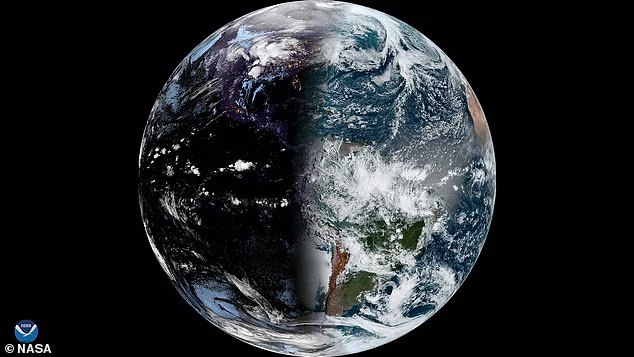
'Equinoxes are associated with the changing seasons,' NASA explained. 'In March, Northern Hemisphere observers welcome the longer, warmer days heralded by their vernal, or spring, equinox'

‘Equinoxes are associated with the changing seasons,’ NASA explained. ‘In March, Northern Hemisphere observers welcome the longer, warmer days heralded by their vernal, or spring, equinox’

This adds several minutes of light to every day.   

‘The Sun doesn’t neatly wink on and off at sunrise and sunset like a light bulb, and so there isn’t a perfect split of day and night on the equinox – but it’s very close,’ NASA added. 

Some of you might be reading this story slightly confused, having thought that spring has already sprung. 

Well, it already has – that is, if you go by the meteorological definition.

Rather than using the equnioxes, this method divides the year into four fixed seasons, each lasting three months, making it easier to track weather patterns and compare statistics. 

‘In the UK, meteorological spring always begins on 1 March and ends on 31 May,’ the Met Office explains. 

When does spring start?

How the first day of spring is defined depends on whether you are referring to astronomical or meteorological spring.

Meteorological spring 

In the UK, meteorological spring always begins on 1 March and ends on 31 May. 

This method divides the year into four fixed seasons, each lasting three months, making it easier to track weather patterns and compare statistics.

Astronomical spring 

Astronomical spring starts on the vernal equinox, around 20 March in the Northern Hemisphere, when day and night are roughly equal in length. 

The exact dates can vary each year due to the Earth’s tilt and orbit around the Sun.

Source: Met Office 

Share or comment on this article:
Spring has officially sprung! The sun shines directly over the equator as the Vernal Equinox arrives – meaning winter is finally over


Source link

Tags: dailymailearthNASAsciencetech
LJ News Opinions

LJ News Opinions

Next Post

Trump signs executive order to protect the Army-Navy game broadcast

Recommended

Democrats pushing to ‘get ICE under control’ with DHS shutdown, Jeffries says

2 months ago

Aaron Rodgers dishes on ex-girlfriend drama

2 months ago

Popular News

    Connect with us

    LJ News Opinions

    Welcome to LJ News Opinions, where breaking news stories have captivated us for over 20 years.
    Join us in this journey of sharing points of view about the news – read, react, engage, and unleash your opinion!

    Category

    • Business
    • Entertainment
    • Health
    • Opinions
    • Politics
    • Sports
    • Technology
    • U.S.
    • World News

    Site links

    • Home
    • About us
    • Contact

    Legal Pages

    • Privacy Policy
    • Cookie Privacy Policy
    • Terms of Use
    • Disclaimer
    • California Consumer Privacy Act (CCPA)
    • DMCA
    • About us
    • Advertise
    • Contact

    © 2024, All rights reserved.

    No Result
    View All Result
    • Home
    • U.S.
    • Politics
    • World News
    • Business
    • Entertainment
    • Sports
    • Technology
    • Health
    • Opinions

    © 2024, All rights reserved.