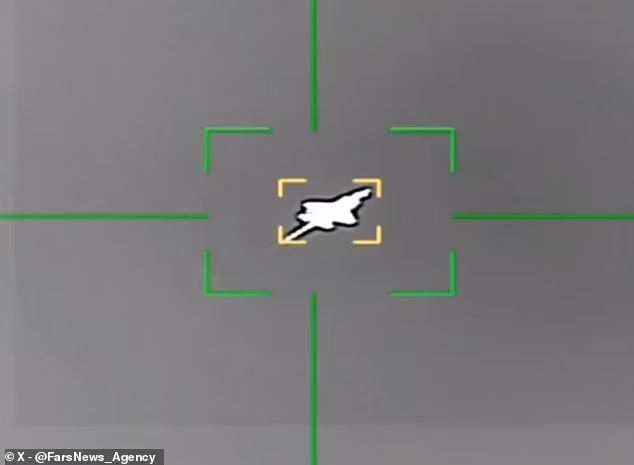
As US forces step up their bombardment of Iranian defences, the battered regime appears to have found a counter to one of America’s most feared weapons.
Iran‘s military claims to have hit an F–35 Lightning II stealth fighter jet with anti–aircraft artillery.
This would be the very first time that an American F–35 has been struck in combat by enemy fire.
Now, experts reveal that the $100 million state–of–the–art fighter jet might not be as invisible as the US would like to think.
US Central Command confirmed that the fighter jet was forced to make an emergency landing while ‘flying a combat mission over Iran.’
‘The aircraft landed safely, and the pilot is in stable condition,’ Captain Tim Hawkins said. It is unclear if the pilot, who landed at a US base in the Middle East, was injured.
The F–35’s stealth technology should render it all but undetectable by conventional military radar systems, making the hit enormously unlikely.
However, researchers say that Iranian air defences aren’t relying on radar alone to keep tabs on America’s invisible fighters.
Iran’s military claims to have scored a direct hit on a US F–35 Lightning II stealth fighter, marking the first time an American F–35 has been hit by enemy fire

The F–35 (pictured) should be all but undetectable by conventional military radar systems, but experts claim it is not entirely ‘invisible’
What gives the F–35 its stealth ability?
The F–35 Lightning II is a fifth–generation stealth fighter jet developed by Lockheed Martin and used extensively by the United States and Israel.
What makes this long–range fighter so deadly is its ability to avoid or confound enemy radar systems, letting it strike targets without being hit back.
Radar systems work by sending out bursts of electromagnetic signals and listening carefully for how those waves bounce back – like a bat hunting by echolocation.
To avoid detection, the F–35 is specially shaped so that radar signals deflect off its surface like light on a slanted mirror.
The fighter also has the capacity to keep its weapons inside the body of the plane, safely protected by its radar–baffling panels.
This breaks up the plane’s radar signature, making it significantly harder for enemy systems to spot.
To further enhance this effect, the entire plane is coated with a radar–absorbing material that soaks up incoming electromagnetic signals rather than bouncing them back.

The F–35’s specially shaped panels and radar–absorbing coating mean that it only has the radar cross section of a small bird, making it extremely hard to detect and hit
Although the F–35’s physical wingspan is 35 feet (10.7 metres), its radar cross–section is about the size of a small bird.
How invisible is the F–35?
Although stealth technology is often compared to an ‘invisibility cloak’, this greatly exaggerates the F–35’s abilities.
Dr Can Kasapoğlu, senior fellow at the Hudson Institute, told the Daily Mail: ‘The F–35 is not invisible; it is low observable.
‘It is designed to delay detection, degrade tracking, and avoid engagement zones rather than eliminate detection entirely.’
Dr Kasapoğlu adds: ‘Any aircraft can be detected under the right conditions; the key issue is when and with what quality.’
Certain types of radar, such as very–high frequency (VHF) and ultra–high frequency (UHF) systems, can beat most stealth systems.
However, the key is that these detections aren’t ‘weapons grade’ – meaning they aren’t high enough quality to guide a missile to impact.
Even as early as 2023, Iran claimed it had the capacity to detect American F–35s flying over the Gulf.
However, this doesn’t mean that Iran had the ability to shoot down American stealth fighters, only to roughly know where they are.
A more plausible explanation for the reported hit on an F–35 is that the Iranian military was using a ‘passive infrared’ system.
Instead of actively sending out radar signals to spot jets, infrared systems scan the sky for the telltale heat signature of a fighter’s engine.
Even though the F–35’s engine is specially designed to reduce its infrared signature, it isn’t enough to prevent short–range detection.
This means that the Iranian attack was more likely to have been an opportunistic close–range ambush rather than a deliberate long–range strike.
Dr Kasapoğlu suggests that the Iranian 358 loitering munition is a ‘natural culprit’.
This nine–feet–long (2.7 m) surface–to–air missile flies slowly in a figure of eight over the battlefield, waiting to spot a target with its infrared detector.

Experts say the F–35 might have been hit by an Iranian 358 loitering munition (pictured). These missiles use a passive infrared detection system rather than radar, allowing them to beat the F–35’s stealth technology at short range
If an F–35 had got close enough, it could have been struck with almost no warning as the 358 locked on to its engine signature.
In Yemen last year, Houthi rebels demonstrated how even relatively crude infrared systems could be used to great effect to counter stealth technology.
US F–35s flying against Houthi air defences were forced to take evasive actions to avoid being hit by surface–to–air missiles, with one pilot reportedly dodging several attacks.
However, Dr Kasapoğlu maintains that this is a one–off, unattributed case that doesn’t require the US to radically change its strategy.
If passive infrared detectors are being used, they are likely part of a ‘layered detection approach’ rather than a standalone capacity.
This means the F–35’s ability to strike targets long before it is detected will still be a valuable asset.
‘No fundamental shift is required for now. It reinforces the need for disciplined mission planning and continuous suppression of enemy air defences in complex environments,’ Dr Kasapoğlu says.
‘The F–35 remains a reliable fifth–generation platform and a cornerstone of US airpower.’