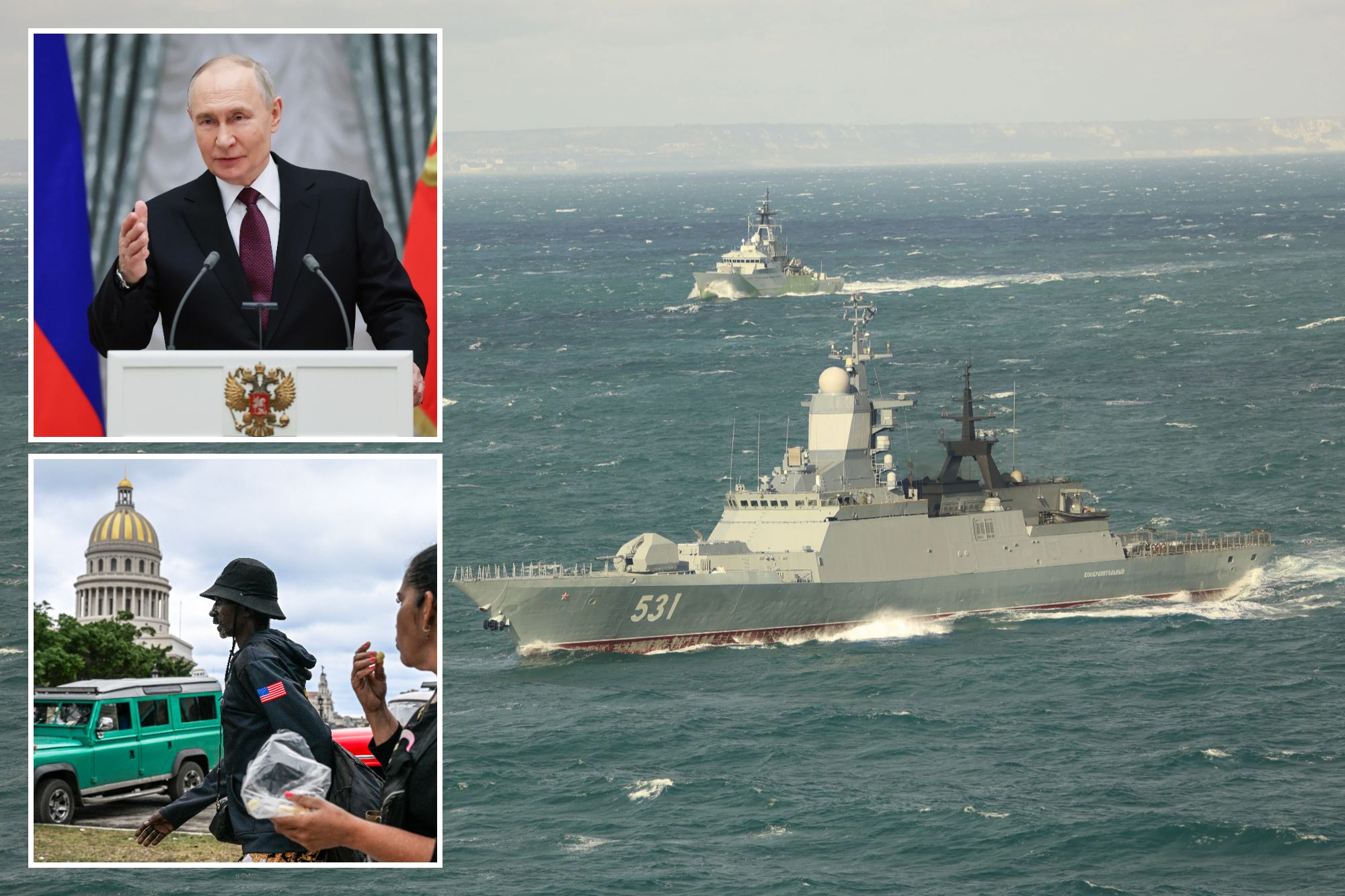
A RUSSIAN warship and sanctioned oil tanker has sailed through the English channel and is potentially headed for Cuba.
The Russian tanker has crossed the Atlantic with suggestions it could be attempting to break Donald Trump’s oil blockade of the island.
The Royal Navy confirmed on Thursday that they had completed a “48-hour operation” shadowing Putin’s ships through British waters.
The Russian Steregushchiy-class frigate, RFN Soobrazitelny, and the sanctioned oil tanker, MV Anatoly Kolodkin, were tracked sailing westward through the English Channel.
The two Russian vessels then separated at the western end of the Channel as the tanker continued into the Atlantic while its escort turned back.
The Kolodkin, carrying an estimated 730,000 barrels of crude oil, has been tracked heading towards Cuba, reports the New York Times.


It’s ultimate destination remains unknown but the tanker’s oil stores could help power Cuba for weeks.
The island is currently reeling from a power collapse that has left large parts of the island without electricity.
As many as ten million people are without power as the fragile grid buckled under immense strain.
Oil shipments from Venezuela have been halted since the US arrested Venezuelan leader Nicolás Maduro, bringing Cuba to its knees.
The loss of fuel has pushed the already fragile power system to breaking point.
Cuban President Miguel Díaz‑Canel said no petroleum shipments have arrived on the island for the past three months.
Should Russia try and break the US blockade, it could result in a potential showdown between the two superpowers.
The sanctioned Kolodkin reportedly left Primorsk, Russia on March 9 – it later broadcast its destination as “Atlantis, USA”.
Last month, a Chinese-owned Russian tanker called The Sea Horse, equipped with barrels of oil gas, was reportedly on its way to Cuba before it stopped in the Atlantic for three weeks.
It eventually changed course as Trump has threatened to hit any country selling oil to Cuba with tariffs.
The crisis comes as Washington ramps up pressure on Havana amid a worsening regional standoff.
Earlier this month, Trump even floated the idea of a “friendly takeover” of the island before quickly adding it “may not be a friendly takeover.”
This week he said he can do “anything I want with Cuba” and labelled the island a “weakened state”.
Power outages have become an everyday part of Cuban island life, with cuts lasting up to 20 hours a day.
The collapse has been particularly devastating for tourism which is a vital pillar of Cuba’s economy.
The blackouts – combined with chronic shortages of food and medicine – have left many Cubans increasingly desperate.
The RFN Soobrazitelny

The frigate, RFN Soobrazitelny, is the second ship of the Russian Steregushchiy-class that recently escorted the sanctioned oil tanker, MV Anatoly Kolodkin, through British waters.
It was built for the Russian Navy and launched in March 2010 after it was laid down at a Saint Petersburg shipyard in 2003.
The vessel is often monitored by NATO forces and has frequently operated in the North Sea and English Channel.
It had previously been escorted through the Channel alongside her sister Boyky by HMS Sutherland in 2017.
It’s equipped with a 100mm A-190 gun, anti-ship missiles, vertical launch systems for surface-to-air missiles as well as torpedos.
Just two weeks ago the Royal Navy was forced to shadow two sanctioned Russian cargo ships and their escorting warships through British waters.
That time, HMS Cutlass managed to intercept the Russian Navy Ropucha-class landing ship Aleksandr Otrakovsky and merchant vessel Sparta IV at the Gibraltar Strait.
HMS Tyne and a Wildcat helicopter then tracked them in the Channel and the North Sea.
And just two days later, a Russian Ropucha-class warship, Aleksandr Shabalin, and cargo vessel MV Sabetta, were sailing through the Channel – again tracked by HMS Tyne and a Wildcat.
The Sun reported in January how British vessels and aircraft were deployed to track Putin‘s shadowy fleet of warships.