Are you always getting caught in the rain without an umbrella?
If so, you might be reading your weather forecast app wrong.
When many people see a ‘30% chance of rain’ on their app, they think this corresponds to the heaviness of the downpour, or the area of land that will experience it.
However, Dr Rob Thompson, a meteorologist at the University of Reading, explains why this is incorrect.
‘People sometimes misread this to mean that it will rain over 30% of the area – or that, if it does rain, it will only be a light drizzle,’ he explained to Which?.
‘Neither of those is true.
‘A 30% chance of rain means that there is a small chance – three times out of 10 – that it will rain, but seven times out of 10, it will stay dry.
‘And that 30% could still mean a heavy downpour for the full length of time covered by the forecast, or a brief five–minute shower right at the end.’
When many people see a ‘30% chance of rain’ on their app, they think this corresponds to the heaviness of the downpour, or the area of land that will experience it. However, Dr Rob Thompson, a meteorologist at the University of Reading, explains why this is incorrect
While many people focus on the rain or sunshine symbols that weather apps use, experts at Which? say the percentages are actually more important.
‘It’s sometimes more useful to look beyond the symbols and emojis that weather apps use to summarise the weather of the day,’ the consumer champion explained.
‘Instead, check the actual forecast, including the daily and hourly percentage chance of rain.
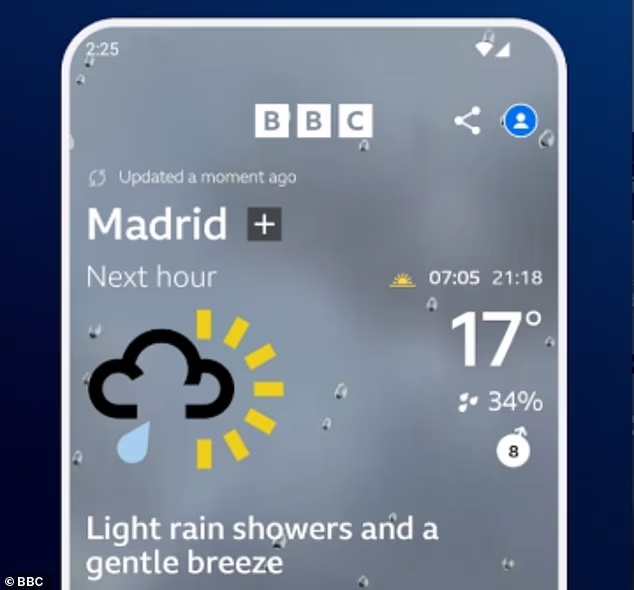
‘Some apps, including BBC Weather, show a single rain cloud icon for the day even when the chance of rain is 50% or less — for example, the flip of a coin.
‘But even if it doesn’t rain that day, the forecast was technically right because there was also a 50% chance it wouldn’t rain.’
The rain percentage is the chance of rain during the time covered by the forecast – with many apps showing both the hourly and daily chance of rain.
Meanwhile, another common assumption is that a single forecast will apply to the whole area.
Which? explains that weather apps actually divide the the country into a grid of squares, each covering an area as large as 124 miles (200km).

The rain percentage is the chance of rain during the time covered by the forecast – with many apps showing both the hourly and daily chance of rain
‘If a downpour is forecast somewhere in that grid, a rain icon may inaccurately be assigned,’ it explained.
‘That doesn’t mean it will rain where you are.’
Which? has also worked with the University of Reading to uncover which weather app is the most accurate – and it’s bad news for fans of BBC Weather.
Overall, this app was the worst at predicting the weather.
‘BBC Weather was especially poor at predicting the forecast for later the same day and overestimated the amount of rain due,’ Which? explained.
In contrast, the most accurate app was found to be The Weather Channel app.
The consumer champion added: ‘It performed well when forecasting the weather for the next few hours (known as a nowcast) and was also strong at predicting the weather accurately for later the same day.’
If you’re sick of getting caught without an umbrella, Which?’s senior researcher, Jo Rhodes, has given three tips to get the most accurate forecast.
Firstly, use more than one app.
‘As the research shows, each app is better or worse at predicting different elements of the weather. That’s why it’s a good idea to compare several,’ Ms Rhodes said.
Next, make sure you have your phone’s location services turned on.
‘The weather is very location-specific, so for the most accurate forecast, switch on your “precise location” for the relevant app,’ she added.
‘Most apps will ask for this permission when you install them, or you can update their access to location data in the settings.’
Finally, switch on the TV, where a forecaster will interpret data in front of a map for you.
Ms Rhodes added: ‘An app can only provide a “yes or no” prediction – and then it’s up to the user to translate the information they’ve been given.’