It’s widely considered the biggest night in film.
Yet there are growing calls to axe the Academy Awards after viewers were left bored by Sunday night’s ‘predictable’ ceremony.
In a particularly bland night, Oscars were handed out to the likes of Jessie Buckley, Amy Madigan and Sean Penn – the latter of which didn’t even attend the ceremony.
Taking to social media during the show, viewers questioned the show’s future amid claims of unfair voting tactics and dwindling figures.
The ceremony has had less than 20 million viewers since 2020 after decades of easily reaching the milestone.
In a bid to claw back viewers, the Oscars will be moving to YouTube in 2029 – marking the end of ABC’s 50-year run as its broadcaster.
The new partnership ‘will allow us to expand access to the work of the Academy to the largest worldwide audience possible.’
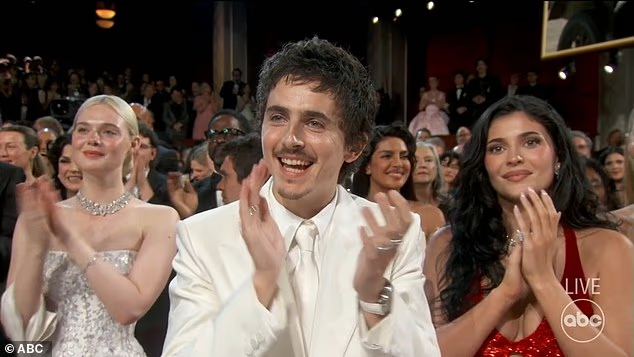
Is it time to axe the Oscars? Calls grow to scrap the ceremony as it battles ageism and sexism claims, viewing figures dwindle and stars don’t show up (pictured: Elle Fanning, Timothee Chalamet and Kylie Jenner at the ceremony)

Taking to social media during the show, viewers questioned the show’s future amid claims of unfair voting tactics and dwindling figures (pictured host Conan O’Brien)
Yet they’ll need a change in tactics if they want viewers to tune into the livestream, with comments shared this year reading: ‘Just cancel the Oscars at this point. Who cares’;
‘Please cancel the oscars #Oscars’; ‘Is it only me or #oscars this year is extremely boring’; ‘Such a boring beginning. Yikes #oscars’;
‘How tf yal watch the Oscars??? put on for two minutes & sauuur boring omg just a bunch of old men I’ve never heard of & movies I never watched’; ‘THIS SHOW IS SO BORING. #Oscars’;
‘#Oscars And thats done. This time around, I felt the ceremony was a bit… Boring. Like, very boring. Then again I didnt pay attention to the whole thing. Lol’; ‘tbh it was kinda boring #Oscars’;
‘Very! The jokes are forced, dry, and fall very flat. #Oscars’; ‘The Oscars are sooooo predictable it’s just what wins at BAFTA or sag’; ‘they’re calling it the most predictable oscars ever’.
While labelled predictable, there was one move that some may not have been expecting.
At the beginning of the awards season race, Timothee Chalamet had originally been widely tipped to win his first Oscar for his role in Marty Supreme, yet he ended up losing to Michael B Jordan, 39 – who became a last minute frontrunner for the award.
It’s been suggested that Timothee’s controversial comments about ‘no one caring’ about the ballet and opera were to blame for the last minute shakeup.
However, before his clumsy comments, industry insiders were already suggesting that Timothee, 30, wouldn’t be able to secure the win because of his age.
There is a decline in young men winning a coveted award, despite actresses of all ages being recognised.
Across the last 97 ceremonies, the average age of a Best Actor winner is said to be around 44, while the Best Actress winner is younger by eight.
It means even the most admired male stars are routinely overlooked by the Academy until later in life.
Leonardo DiCaprio only managed to win his first Oscar when he was 41-years-old despite landing four nominations for Eating Gilbert at age 19, The Aviator, Blood Diamond and The Wolf Of Wall Street in his thirties.
Sean Penn won his first Oscar in 2004 at the age of 44. He had previously been turned down for Dead Man Walking, aged 36, Sweet and Lowdown Nominated, aged 40, and I Am Sam aged 42.
He has gone on to win the three Oscars he’s been nominated for since, including at Sunday’s ceremony when he scooped Best Supporting Actor for One Battle After Another.
However, he failed to attend the ceremony, with Kieran Culkin, who was announcing the winner, cracking a joke about Sean’s absence.
‘Sean Penn couldn’t be here this evening or didn’t want to, so I’ll be accepting the award on his behalf,’ the Succession star joked.
His absence infuriated X users, who suggested that future shows cease awarding trophies to winners who are not present.
However, it was later revealed that the actor and activist had skipped the ceremony to visit Ukraine. He has visited multiple times, including to film a documentary about President Volodymyr Zelensky when Russia invaded the country.
Sean has previously missed out on past Oscars where he had been a nominee and also did not attend this year’s BAFTAs and the Actor Awards, where he ended up reigning victorious.


The Academy will need a change in tactics if they want viewers to tune into the livestream, with comments shared this year reading: ‘Just cancel the Oscars at this point. Who cares’;
Seasoned award’s pro Michael Schulman believes the bias against younger actors is ‘grounded in stereotypes, popular iconography and the gender politics embedded in our culture’.
He told The Telegraph: ‘We tend to think of successful men as those who have worked their way up the ladder – who have achieved their highest levels of power in their 40s or 50s when they, say, become a CEO.
‘And as in life, so it is in Hollywood. For male actors, an Oscar can stand as recognition for their entire ascent, or just time served.’
In contrast, women are more likely to win Best Actress if they’re under the age of 40.
Notably, there was widespread shock last year when Demi Moore, 63, missed out on the win for her career defining performing in The Substance, with Mikey Madison, 26, scooping the prize for Anora.
Schulman described the phenomenon as the ‘Cinderella myth’ noting: ‘There’s an assumption that men will have longer, more sustained careers, so there’s no rush to recognise them for a breakthrough in their 20s.
‘But in Hollywood, like elsewhere in life, women aren’t allowed that same trajectory.’
The Oscars have increasingly come under fire in recent years for failing to recognise widely-watched films, despite ratings for the ceremony continuing to dwindle.
It’s thought that the Academy’s ‘representation and inclusion standards’, first introduced at last year’s ceremony, have had an impact as well.
The academy now requires that for films to be considered for Best Picture, they have to meet two out of four possible categories, which focus on underrepresented groups, including racial and ethnic groups, women, people with disabilities and the LGBTQ+ community.
This has led to claims that some voters have refused to vote, with one expert sharing last year it could spell ‘the end’ of the awards show.
The Academy passed its Aperture 2025 initiative in 2020, five years after the #OscarsSoWhite controversy in order to promote more diversity in the industry, but the move has been under fire ever since.
The initiative was spearheaded by black filmmaker Ava DuVernay and developed by the academy to set criteria – which included diversifying nearly every aspect of a movie, from cast and crew to production, marketing, financing, distribution and even internships by 30 percent.
Last year’s ceremony was also blasted by viewers for its ‘woke’ tones, with jokes delivered with far less conviction and fanfare than past spectacles and drawing little response from critics or fans.

Sean Penn failed to attend the ceremony, with Kieran Culkin, who was announcing the winner, cracking a joke about his absence. It was later claimed that the actor skipped the ceremony to visit Ukraine. Sean has previously missed out on past Oscars where he had been a nominee

The Academy have been accused of ageism and sexism when it comes to picking winners. Notably, Demi Moore, 63, missed out on the win for The Substance last year , with Mikey Madison, 26, scooping the prize for Anora (pictured at Sunday’s ceremony)
While in general, there have been calls for a revamp of the ceremony as a whole, given the so-called experts who choose the winners of the famous statue haven’t always watched the films they’re voting for.
Typically the winners of each Oscar are chosen by members of The Academy, an organisation of over 8,000 film industry professionals, who individually choose which films and stars they believe should receive an award.
New guidelines were also introduced this year for members, where they had to attest that they have seen the films that they are voting on, either in a cinema, through the Academy’s digital screening room, or through some other means.
However, one voter anonymously admitted this month that they ‘didn’t care’ to watch the full list of films that feature on this year’s Oscars shortlist, and said those that they did watch they found to be ‘mediocre.’
This further fuels complaints from film fans that the Oscars have become out-of-touch, with accusations some voters simply ‘coattail’ by picking films that have already won big this awards season.
The awards have also faced claims the ceremony has become ‘woke’ due to a focus on smaller movies over box office hits.
In an email published by Deadline, the voter said: ‘I thought you might be interested to hear a take from an Academy member about this year’s rules.
‘I haven’t seen even half of the nominated films, nor do I care to, because my time is far too valuable to spend watching movies I know I’d never vote for (much less be able to sit through).
‘I found most of the films I did see to be mediocre, and nothing that I nominated made the final cut. Therefore, since I don’t want to lie, I decided I simply would not vote at all this year. Yes, I’d like to vote for K-Pop Demon Hunters, but not at the price of watching four other movies I know won’t be as good.
‘But really, the Oscars have become pretty irrelevant. Anora? CODA? Everything Everywhere All At Once? vs The Godfather, Lawrence of Arabia, Patton? Which three movies will people still be watching five years from now?
‘It’s all about the film, not the award. Rather than watch the Awards, I’ll probably watch Singin’ In The Rain or North By Northwest or The Searchers – REAL best pictures which weren’t even nominated.’
Following last year’s ceremony, the Academy announced a string of new guidelines for voters.
The rules, which were first announced back in April, combined digital tracking through the Academy Screening Room with member-reported viewings of films that make up the shortlist.
Across all 24 competitive categories, voters were told that the online ballots could only be access if members themselves verified they’d seen all of the films nominated in a given category.
Another new rule regarding Generative Artificial Intelligence (AI) and other digital tools states that ‘the tools neither help nor harm the chances of achieving a nomination.’
It comes following controversy around last year’s nominee The Brutalist, which used AI to enhance the Hungarian dialogue of stars Adrien Brody and Felicity Jones. Adrien went on to win his second Best Actor award for the performance.
‘The academy and each branch will judge the achievement, taking into account the degree to which a human was at the heart of the creative authorship when choosing which movie to award,’ the Academy said in a statement.
However, it remains to be seen if any of the Academy’s latest shakeups will help the future and the reputation of the awards ceremony in the long term.