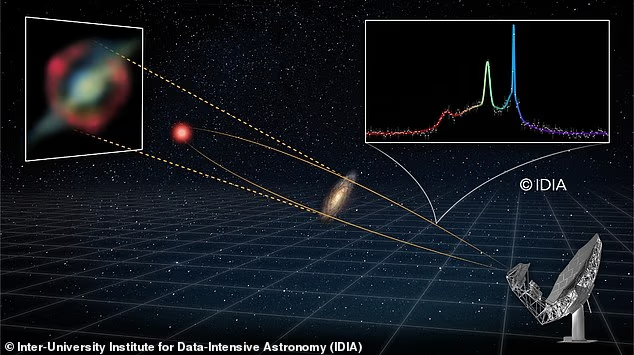
Humanity has received a mysterious signal, described as a ‘mega-laser’ beam, from a violently merging galaxy more than 8 billion light-years away.
The signal, deemed the most distant hydroxyl megamaser ever detected, was intercepted by the MeerKAT radio telescope in South Africa, which features 64 antennas.
A hydroxyl megamaser is a giant natural laser in space. When galaxies full of gas collide, molecules called hydroxyl smash together and release very strong radio waves.
These waves behave like a laser, but instead of visible light, they produce radio signals that astronomers can detect with telescopes.
Because these signals are extremely bright, they can be seen from very far across the universe.
In this case, the object is so powerful that scientists said it may actually be a ‘gigamaser,’ which is even stronger than a megamaser.
The system, called HATLAS J142935.3–002836, is so far away that we are seeing it as it looked more than 8 billion years ago, when the universe was less than half its current age.
Dr Thato Manamela, SARAO-funded postdoctoral researcher at the University of Pretoria and lead author of the new study, said: ‘This system is truly extraordinary. We are seeing the radio equivalent of a laser halfway across the universe.’
Humanity has received a mysterious signal, described as a ‘mega-laser’ beam, from a violently merging galaxy more than 8 billion light-years away
Manamela added that as the radio waves traveled toward Earth, they were also strengthened by a separate galaxy positioned directly along the line of sight.
‘This galaxy acts as a lens, the way a water droplet on a window pane would, because its mass curves the local space-time,’ he said.
‘So we have a radio laser passing through a cosmic telescope before being detected by the powerful MeerKAT radio telescope – all together enabling a wonderfully serendipitous discovery.’
The radio signal contained four separate components, meaning it is coming from multiple regions within the galaxy system.
At least two of these areas appear to be strongly magnified by gravitational lensing, which makes the signal more than ten times brighter than it would normally appear.
In this case, a massive foreground galaxy sits between Earth and the distant system.
Its gravity bends space-time and acts like a cosmic magnifying glass, boosting the brightness of the radio emission.
This amplification allowed the signal to be detected by the MeerKAT radio telescope even though the source is over 8 billion light-years away.

Pictured is the galaxy system where astronomers said is the source of the signal

The signal, deemed the most distant hydroxyl megamaser ever detected, was intercepted using the MeerKAT radio telescope in South Africa (PICTURED), which consists of 64 antennas
Normally, signals from objects this far away are too weak for telescopes to detect.
But the powerful radio signal coming from HATLAS J142935.3–002836 was boosted by a rare effect called gravitational lensing, a phenomenon predicted by Albert Einstein.
Gravitational lensing happens when a massive object, such as a galaxy, sits between Earth and a distant source.
Its strong gravity bends space-time, which changes the path of the light or radio waves traveling through it.
This makes the distant signal appear brighter and magnified, allowing telescopes like the MeerKAT radio telescope to detect it even from billions of light-years away.
From Earth, this effect can sometimes create a ring-shaped halo of light around the foreground object, called an Einstein ring, named after the famed physicist.
The same effect also magnifies the distant source, in this case a radio or microwave signal, making it much easier for astronomers to study objects that would normally be too faint to detect.