Amna Nawaz:
Primaries for the midterm elections are under way, while President Trump pushes for a sweeping voting bill.
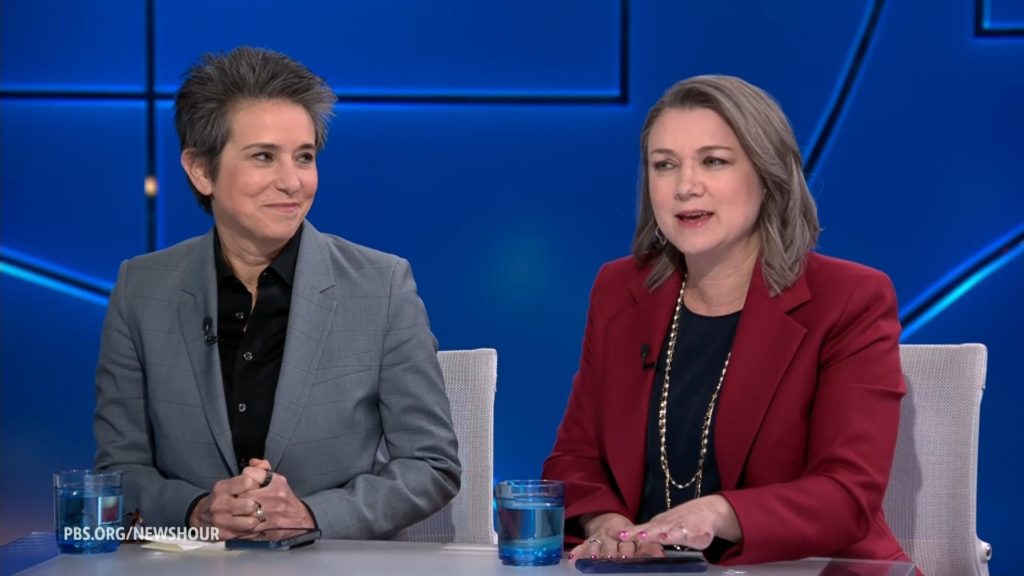
For analysis of that and the politics of the war with Iran, we turn now to our Politics Monday duo. That is Amy Walter of the Cook Political Report with Amy Walter and Tamara Keith of NPR.
Good to see you both.
Tamara Keith, National Public Radio:
Hello.
Amy Walter, The Cook Political Report:
Great to be here.
Amna Nawaz:
All right let’s start with this SAVE America Act, the Safeguard American Voter Eligibility Act. This legislation, as you know, would require people to show proof of citizenship to register to vote in federal elections, also to show I.D.s when they’re voting in person or by mail.
Tam, President Trump says it’s his number one legislative priority. Senate Republicans do not have the votes. Why is it so important to the president? And what are Republicans going to do?
Tamara Keith:
President Trump has had a pretty single-minded focus on election laws. Going back to even 2016 after he won, he said that there had been illegal votes and he would have won more, he would have won the popular vote if it hadn’t been for all the illegal votes.
So this is a thing that he has been talking about as long as he has been on this stage. But also this comes in a broader context, which is just at his State of the Union address for instance. He said Democrats can’t win unless they cheat as he was arguing for this law. That certainly sounds like someone who is coming up with a message that he could use after the election results if Republicans don’t hold the House or don’t hold the Senate.
I did ask a White House official about this, and he insisted that, no, this isn’t about that. It’s just that the president really cares about election security.
But the fact is, it doesn’t have the votes to get through the Senate, and the president is staking a whole bunch of political capital on this. He believes it’s one of these 80/20 issues, that it’s the thing that they can all run on. I think there are a lot of people in Congress, Republicans in Congress, who would like to run on an economic message instead. But that is being challenged in multiple different ways.
Amy Walter:
Yes.
Amna Nawaz:
We should point out it’s not an 80/20 message. Our latest poll actually shows some 59 percent of people say they’re more concerned with making sure everyone who wants to vote can, less, about 41 percent, with stopping what would be called ineligible voters.
And, Amy, we should also point out that noncitizen voting is extremely rare, right?
Amy Walter:
Right. It’s — absolutely.
Here’s another thing that I think is problematic for Republicans who are on the ballot in 2026. The more the president talks about the election potentially being rigged, or it’s going to get stolen and Democrats are going to win anyway because they didn’t pass the SAVE Act, the harder it is going to be for Republican voters to get motivated to show up and vote in the first place.
I mean, if you’re telling your own voters over and over again, hey, this thing’s rigged anyway, we’re going to lose, what incentive do they have to show up. This is especially problematic at this time, because Democrats already have an enthusiasm advantage. If you look at the results of the special elections that have been held so far this year, Democrats are turning out at a much higher level than Republicans.
Same with the question on polls. How enthusiastic are you to show up to vote? Democrats are much more enthusiastic. So while I think the president, I agree with Tam, I think is setting up the straw man for what happens if there’s a bad election, he could blame it on this, we have already seen in previous elections, like in 2020, he went down to Georgia, was very frustrated with the results of that election, said it was rigged there.
In the run-off election that was held a month after the regular election in November, the two Republicans lost in those Senate races, in part because the president went down and said it’s rigged.
Amna Nawaz:
It’s rigged, yes.
Well, meanwhile, midterm primary season is upon us. Illinois is holding theirs tomorrow. It’s a very crowded Democratic primary to replace longtime Senator Dick Durbin. And our latest poll has the generic ballot with a nine-point advantage for the Democrats at 53 to 44 percent.
Amy, let’s start with you here. What’s at stake for the Democrats in these early primaries?
Amy Walter:
So Illinois is a little bit different because it’s such a blue state. So the winner is going to go on and most likely show up and be a senator in November.
What we are seeing in a lot of these Democratic primaries, Texas was one example of this, is really a fight between two theories of the case among Democrats. One is, do you want somebody who’s more of a compromiser, who’s willing to maybe work across the aisle and potentially win over independent voters who aren’t aligned with Democrats?
Or do you want somebody who is basically all in, who’s not interested in compromise? It’s a zero sum game. That is a choice that we’re going to see in a number of primaries coming up, especially in places like Maine, Minnesota, Michigan.
Amna Nawaz:
Tam, how are you looking at these?
Tamara Keith:
Yes, so I would say that these primaries are not necessarily going to tell us everything about the future of the Democratic Party. I do think that there’s an interesting House race where there are some generational divides and some other issues that are playing out that could tell us a little something about what Democratic voters think about Democratic candidates.
But it is important to note that there are a lot of primaries in either very red states or very blue states where the primary is the election. The primary voters are going to decide who represents that state or that district.
Amna Nawaz:
Meanwhile, we know the war with Iran continues.
And, Tam, I want to start with you here, because, as it enters its third week, gas prices, which had been coming down early in President Trump’s second term, continue to go up. When does this start to become an issue for voters in the midterms?
Tamara Keith:
It’s an issue, that voters are not making their final decision on November right now, but it is absolutely an issue. I’m talking to voters about this, and they’re telling me that it’s costing more to fill up and that they’re frustrated and they’re angry and that it happened, like, overnight.
And I think we talked about this last week also, but President Trump, by not really preparing the American public for this war, also didn’t prepare the American public for the sacrifice. And so he told Liz, he has told others that it’s a small price to pay.
But for people who are living paycheck to paycheck, this is actually a big price to pay. And this is an election that we know is going to hinge on affordability and the cost of living. Every voter I talk to says the economy is the most important issue that will determine their vote. And previously, when President Trump was asked about affordability, he pointed to cheap gas prices, literally hours before the war started.
He was pointing to low gas prices. And now those prices aren’t low. They’re up about 85 cents from last week.
Amy Walter:
And yet you’re not really seeing much movement in the president’s overall approval ratings. He’s not going up, he’s not going down.
And that’s because most voters are already so polarized. It’s hard to believe that anybody’s going to move whether things go well or whether they don’t. The real question and what people keep watching for is whether there will be some really serious cracks within the Republican support for the president.
Right now, it’s not there even among those — there was an NBC poll out last week that showed, even among Republicans who said they disapproved of the way Trump’s handling the issue of Iran, overall, they approve of the job he’s doing as president. So, there may be some cracks, but they’re not doing much damage to the president standing right now.
Tamara Keith:
His voters are giving him the benefit of the doubt.
Amy Walter:
That’s right.
Amna Nawaz:
Amy Walter, Tamara Keith, always good to start the week with you. Thank you.
Amy Walter:
You’re welcome.
Tamara Keith:
You’re welcome.