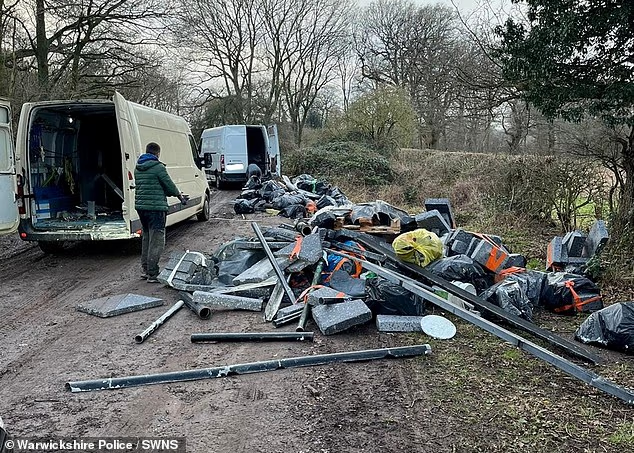
Waste criminals are facing a tough crackdown as the government announces new ‘zero-tolerance’ plans to deal with gangs who illegally dump rubbish.
Environment officers could soon be given police-like powers to search premises, seize assets and arrest individuals without a warrant.
The new approach would allow officers to intervene earlier, bring more criminals to justice and hit the organised gangs behind illegal waste ‘where it hurts’ by disrupting their finances.
It would involve expanding powers under the Police and Criminal Evidence Act (PACE) as well as the Proceeds of Crime Act 2022.
The move would make the Environment Agency one of a few organisations with these powers and comes as the government prepares to publish its new ‘Waste Crime Action Plan’.
It follows the announcement that drivers could receive penalty points on their licenses if they are caught fly-tipping, leading to a potential ban from the roads.
The government is also urging councils to seize and crush vehicles belonging to people caught fly-tipping.
Government figures show that between 2024 and 2025, councils in England dealt with 1.26 million fly-tipping incidents, of which 62 per cent involved household waste.
Two fly-tippers were caught dumping rubbish from two white vans on a country lane near Meriden in the West Midlands in 2024

Footage showing men in a white van dumping rubbish near Nuneaton. Officials are planning to give environment officers police-like powers to search premises, seize assets and arrest individuals without a warrant
During this time there were 122 prosecutions and 1,205 illegal waste sites were shut down.
‘Waste crime is a disgrace,’ Environment Secretary Emma Reynolds said. ‘It blights our countryside and communities, damaging our environment and economy.
‘That is why we are taking decisive action. We’re giving the Environment Agency the police-like powers they need to stop waste criminals in their tracks and bring those responsible swiftly to justice.’
The government is also exploring how enforcement bodies can share information with banks and finance companies to inform them of waste criminality, so they can decide whether to keep doing business with waste criminals.
‘Fly tipping is an attack on our countryside, our communities, and the environment we all share,’ Crime and Policing minister Sarah Jones said.
‘We will give the Environment Agency the power they need to crack down on these reckless criminals.’
Currently, fly-tipping is a criminal offence under the Environmental Protection Act 1990.
Under new legislation, people caught transporting and dealing with waste illegally will face up to five years in prison.

Last month, Defra published guidance to help councils seize and crush more vehicles used for fly-tipping
Any laws would be introduced when parliamentary time allows, the government said.
A series of vast illegal dumps have gained national attention in recent months, prompting calls for tougher punishments against waste criminals.
They include a 500ft-long, 12ft-high waste ‘mountain’ abandoned in a field near Kidlington in Oxfordshire, and a two-acre illegal rubbish site at the back of Over Farm in Gloucestershire.
Criminals can make large profits by charging to collect waste before illegally dumping it on public land without paying landfill tax, which now stands at £126.15 per tonne.
While some offenders are fined, experts fear the large profits on offer mean financial penalties are seen merely as a ‘cost of doing business’.