Sunday, March 15, 2026
No Result
View All Result
LJ News Opinions
  • Home
  • U.S.
  • Politics
  • World News
  • Business
  • Entertainment
  • Sports
  • Technology
  • Health
  • Opinions
  • Home
  • U.S.
  • Politics
  • World News
  • Business
  • Entertainment
  • Sports
  • Technology
  • Health
  • Opinions
No Result
View All Result
LJ News Opinions
No Result
View All Result
Home Technology

Scientists reveal exactly where you’re going WRONG on your dating profile – and the simple changes you can make to bag a date

by LJ News Opinions
March 15, 2026
in Technology
0
Share on FacebookShare on Twitter


Are you struggling to find love online? 

Scientists have revealed where you’re probably going wrong. 

A new study has uncovered nine different types of profile photos that singletons tend to use – and what they convey about you to fellow daters. 

Some singletons opt for ‘casual poser’ snaps, according to the researchers, while some prefer shots that show off their love for nature. 

Others choose to show ‘a bit of myself’, while some even adopt a ‘nothing to hide’ pose – usually in skimpy outfits or topless.

So, which of these will help you to find love, and which will unintentionally hinder you chances? 

‘Your profile should first and foremost appeal to you and reflect who you are,’ said Alejandro García Alamán, a psychologist at The Open University of Catalonia in Spain. 

‘If you want to add a touch of authenticity, you can include something slightly different that feels genuinely yours.’

Dr García Alamán was inspired to carry out the research after talking to his own patients.

‘I detected a growing unease among users of dating apps, similar to burnout at work. And it was this combination of disappointment, boredom and depersonalisation, because all Tinder profiles were alike, that led me to investigate what was going on,’ he said. 

For the study, the team analysed 1,000 real Tinder profiles based in Barcelona.

Their findings, published in The Journal of Sexual Medicine, revealed that far from being unique, most users opt for one of a nine visual strategies.

But the researchers argue that these strategies do not reflect who we are as much as who we think we should be in order to be liked.

‘Choosing a strategy based on social desirability strips us of authenticity and blurs our identity as individuals,’ Dr García Alamán said.

‘It protects us, but at the same time it stereotypes us.’

Some of the photo types are obvious – those who choose photographs where they are out and about in nature are hoping to convey an active, healthy lifestyle, the researchers said.

Dating coach Mathew Hyman says featuring a ‘lifestyle’ picture can help boost your dating app profile

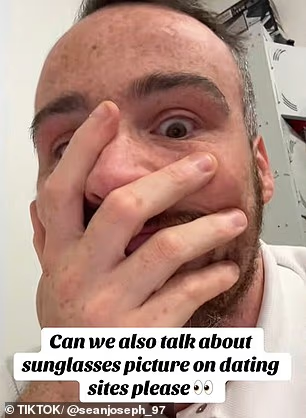
Some people (left) have lamented about the use of sunglasses in dating app photos. Experts say it functions as a ‘form of protection’. Meanwhile, dating coach Mathew Hyman (right) says featuring a ‘lifestyle’ picture can help boost your dating app profile

What your dating app pictures say about you

Half portrait: The most neutral and socially acceptable presentation

Casual poser: Make you seem more spontaneous and conveys informality/friendliness

Close up/ Selfie: Could indicate signs of concern about the body ageing

Full portrait: Especially common among straight women

Sunglasses: Functions as a form of protection and partial concealment

Nature lover: Conveys activity, health and a connection with nature

Nothing to hide: Could signal a desire for casual hookups

Screensaver: Likely to be older and minimizing body exposure

A bit of myself: Could be an attempt to conceal your overall appearance

The ‘casual poser’ photo, which shows someone looking in a different direction, can make you seem spontaneous and friendly, they explained. 

Meanwhile someone wearing glasses might be trying to conceal a part of themselves, by using them as a form of protection.

Those who use a generic ‘screensaver’ picture – for example an image of a quote or landscape – are likely to be older.

However the ones who use ‘nothing to hide’ images, which feature a high degree of nudity, could unwittingly be signaling a desire for casual hookups.

‘Clusters associated with high levels of nudity accounted for only 10 per cent of the sample, contrasting with Tinder’s reputation as a ‘hookup’ platform,’ the team said.

They explained that younger cohorts – especially women – tended to include photos that showed more skin, which generally decreased as age increased.

However, an ‘exception’ was observed among individuals aged 30–39, who presented the highest amount of nudity in their first pictures.

‘Although a definitive explanation for this result remains unclear, one possible interpretation could be related to the perceived self–image within this age range,’ the researchers said.

‘This cohort represents adults transitioning between youth and middle age, during which appreciation of physical appearance still persist.’ 

Other popular image types used include the ‘half portrait’, which accounted for a quarter of the profiles analysed. This is the most ‘socially acceptable presentation’ of a person, the authors said.

Close–up shots and partial–body images could be attempts to conceal your appearance.

The researchers also found that sexual orientation had an influence on the type of photos used.

Among straight profiles, women smiled more and appeared with less clothing, showing off more of their whole body, while men are more action or nature–oriented and show less of their bodies.

The results also reveal that lesbian women show less of their bodies and smile less than heterosexuals, while gay men look at the camera and smile more than heterosexuals.

While they didn’t directly investigate which photos have the most success on dating apps, Dr García Alamán said: ‘We suspect that some types of images may be more successful than others. 

‘Beyond physical attractiveness, an important factor may be the implicit message a photo conveys. For example, images can signal humour, social or professional success, health, or an active lifestyle.’ 

HOW CAN YOU CHECK IF YOU ARE BEING CATFISHED?

Dating apps and online websites are plagued with fraudulent profiles, known as ‘catfishes’.

‘Catfishing’ originated as a term for the process of luring people into false relationships, however, it has also come to encompass people giving out false information about themselves more generally. 

These profiles often use images of another person to allow users to pretend to be someone else in order to get a date, or scam money from a lonelyheart.

Fortunately, there are certain ways to check if these profiles are real people or if they are bogus accounts —

1. Google reverse image search

This is probably the most valuable tool for catching out a catfish and can be done via Google. 

To kickstart the process, people need only right-click the photos that are arousing their suspcions, copy the URL and paste it into images.google.com.

The search engine will search to see if the image has been used elsewhere.

If you find the picture associated with a different person to the one you’re speaking to on your dating app, it’s likely you’ve met a catfish! 

2. Use an app called Veracity 

It is useful for dating sites such as Tinder, Bumble and Grindr as it allows images from Dropbox or Camera roll (or similar) to be cross-referenced against any matching results.

Load the app, then select a screenshot of the suspicious dating app profile from your camera roll to launch the search.

The app will tell you if the picture belongs to somebody else. 

3. Check their Facebook 

Almost everyone who has a profile on a dating site will have a Facebook account (most dating apps require users to have one, after all!) so it is always advisable to track down your potential suitor on other forms of social media.

4. Google them

Google and other search engines have an extensive repertoire and most people will crop up in a search. 

In this day and age, it’s unusual for someone to have nothing on Google.

Have a search through for them or their relatives, things they’ve said or posted in the past. If there’s nothing, that should raise alarm bells.

5. Skype/Facetime/Video Chat 

For prospective romantic engagements, seeing the face of someone you are virtually talking to is essential. 

6.  Money

Anyone that asks for money online or via an app is likely to be a fraud. 

This is probably a scam and should provide immediate red flags.   

Source link

Tags: dailymailGraphicssciencetechSpaintinder
LJ News Opinions

LJ News Opinions

Next Post

Olympian Alysa Liu reveals reason for World Championships withdrawal

Recommended

Will Trump help or hinder Zimbabwe's white farmers in their compensation battle?

18 hours ago

6-5 Wildfire rages within historic California Gold Rush community

6 months ago

Popular News

    Connect with us

    LJ News Opinions

    Welcome to LJ News Opinions, where breaking news stories have captivated us for over 20 years.
    Join us in this journey of sharing points of view about the news – read, react, engage, and unleash your opinion!

    Category

    • Business
    • Entertainment
    • Health
    • Opinions
    • Politics
    • Sports
    • Technology
    • U.S.
    • World News

    Site links

    • Home
    • About us
    • Contact

    Legal Pages

    • Privacy Policy
    • Cookie Privacy Policy
    • Terms of Use
    • Disclaimer
    • California Consumer Privacy Act (CCPA)
    • DMCA
    • About us
    • Advertise
    • Contact

    © 2024, All rights reserved.

    No Result
    View All Result
    • Home
    • U.S.
    • Politics
    • World News
    • Business
    • Entertainment
    • Sports
    • Technology
    • Health
    • Opinions

    © 2024, All rights reserved.