It might sometimes feel like the days are starting to drag on, but scientists say that this isn’t necessarily all in your head.
In a new study, researchers from the University of Vienna and ETH Zurich have found that the length of days on Earth is increasing at an ‘unprecedented’ rate.
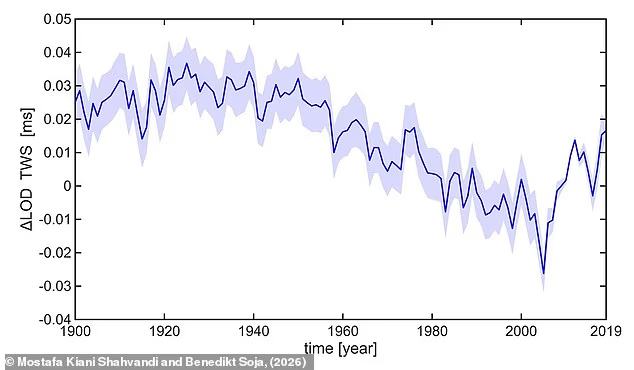
Days are getting longer at a rate of 1.33 milliseconds per century, a rate of change faster than any other point in 3.6 million years of Earth’s history.
Now, scientists say that climate change is to blame.
As the polar ice sheets and glaciers melt faster due to global warming, rising sea levels are slowing down Earth’s rotation and making the days last longer.
Like a figure skater stretching out their arms to slow their spin, water from the melting poles flows towards the equator, moving the Earth’s mass further from its axis of rotation.
Co–author Professor Benedikt Soja, of the University of Vienna, told the Daily Mail: ‘While natural cycles caused variations in the past, the current rate of change, due to human impact, is so rapid that it stands out in climate history.
‘Only one time – around 2 million years ago – the rate of change in length of day was nearly comparable, but never before or after that has the planetary “figure skater” raised her arms and sea–levels so quickly as in 2000 to 2020.’
Scientists say that days on Earth are getting longer at a rate of 1.33 milliseconds per century, and climate change is to blame. Pictured: A graph showing the rate of change in day length over time
Days on Earth have never been exactly 24 hours, and the speed of rotation can be altered by the gravity of the moon, processes deep beneath the surface, and changes in the atmosphere.
These minute fluctuations don’t have noticeable impacts on the world at large and are simply part of the planet’s natural cycles.
However, in previous studies, Professor Soja and his co–authors found that humans are starting to change the planet’s rotation as much, if not more than, natural factors.
By shifting the distribution of mass around the globe, melting ice and rising sea levels increase the planet’s moment of inertia – resulting in slower spin and longer days.
The changes aren’t large enough for anyone to notice, but they could soon cause serious problems for sensitive systems.
Professor Soja says: ‘Even though the changes are only milliseconds, they can disrupt systems that require extremely precise time keeping.
‘This includes space navigation, GPS and satellite navigation systems, and synchronisation of atomic clocks, which makes it so important to precisely monitor the Earth’s rotation.’
As climate change continues, the researchers expect that this deceleration will only become more pronounced.

Researchers have calculated the rate of change in the length of days over the last 3.6 million years. This shows that no force has slowed the Earth’s rotation as much as human–caused climate change. Pictured: A graph showing the rate of change in day length over time
By the end of the 21st Century, researchers expect climate change to affect the length of the day more strongly than the gravitational pull of the moon.
That could mean that days on Earth get 2.62 milliseconds longer every century, starting from the 2080s.
But scientists still didn’t know how big those changes really were on the scale of Earth’s geological history.
Luckily for them, our planet has a hidden way of recording the length of days stretching back millions of years into the past.
The scientists looked at the tiny, fossilised remains of an ancient single–celled organism called benthic foraminifera.
Locked inside the shells of these long–dead creatures are subtle traces that can tell scientists a lot about what the world was like when they were alive.
‘From the chemical composition of the fossilised shells of these marine organisms, it is possible to trace past sea–level fluctuations,’ Dr Soja explained.
‘Based on this information on past sea level, we developed a physics–informed machine learning model to derive the corresponding changes in day length over the last 3.6 million years.’
This revealed that the length of days on Earth had indeed changed in the past due to natural fluctuations in sea levels.

Scientists could work out how long the day was 3.6 million years ago by looking at chemical traces in the shells of fossilised marine organisms called benthic foraminifera (pictured)
As the vast ice sheets melted and grew again over hundreds of thousands of years, mass was pushed towards and away from the equator – slowing and accelerating the Earth’s rotation.
However, no force in the last 3.6 million years has changed the planet quite as fast as humanity’s production of greenhouse gases.
Before the 21st Century, the most rapid changes occurred around two million years ago, at a time when extremely high levels of CO2 meant that Greenland was iceless and forested.
But even during this period of rapid natural climate change, Earth’s rotation didn’t slow as rapidly as it has in the last 25 years.