Amna Nawaz:
Today, two violent attacks left communities in separate states on edge, with investigators searching for answers. In Michigan, a driver ran a truck into a synagogue and school, the latest incident involving a temple and the Jewish community in North America.
Geoff Bennett:
No one but the gunman was killed, but law enforcement officials told reporters they believe he had a large amount of explosives in the vehicle.
And, earlier in Virginia, a university campus was once again the scene of deadly gunfire. FBI officials say this afternoon that the gunman wanted the attack to be similar to the Fort Hood shooting back in 2009. Authorities say ROTC students subdued and killed the shooter.
Officials say they are investigating a shooting this morning at Old Dominion University as a possible act of terrorism. Authorities say the gunman, Mohamed Jalloh, killed one person and wounded two others. The gunman was also killed in the shooting. It wasn’t immediately clear how he died.
The school says the gunman opened fire shortly before 11:00 a.m. Eastern at a building on the university’s Norfolk campus. The gunman was a former National Guard member who previously served prison time after pleading guilty to attempting to aid the terror group ISIS, then, in Michigan this afternoon, billowing smoke and a swarm of law enforcement vehicles at a synagogue outside Detroit.
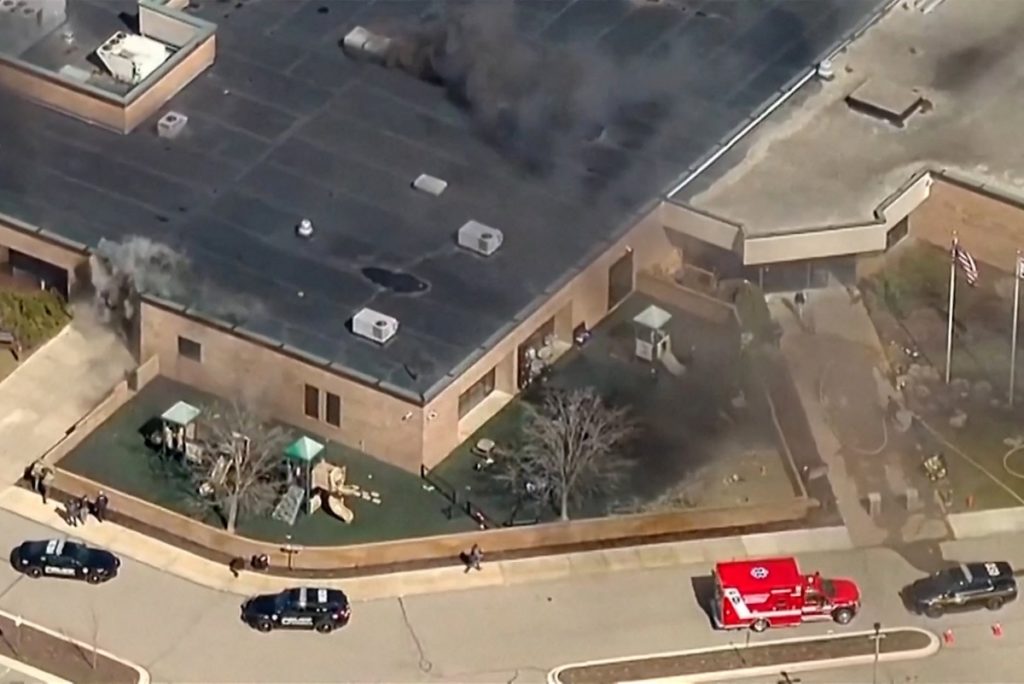
More than 200 officers responded to reports of an active shooter at Temple Israel, which is the nation’s largest Reform synagogue, which also houses an on-site preschool. Authorities say the suspect drove a car into the synagogue building before security guards on site opened fire.
Michael Bouchard, Oakland County, Michigan, Sheriff:
We can’t say what killed him at this point, but security did engage the suspect with gunfire. He breached the building, drove down the hall, and he was engaged by security.
Geoff Bennett:
Smoke could be seen pouring out from the synagogue’s roof as officers wearing respirators moved in to secure the building. One security guard who was knocked unconscious is expected to recover.
None of the 140 children at the school or any of the teachers were hurt.
Michael Bouchard:
There were multiple security officers on scene and the one that was hurt was pulled from that area by his team.
Geoff Bennett:
The incident in Michigan comes as several synagogues across North America have been targeted in recent weeks, including in Toronto. Officials said law enforcement in the area were prepared for the potential of violence and FBI agents had trained for an active shooter event there back in January.
Michael Bouchard:
Many times there’s a concern, there’s communication, there’s extra patrol, extra attention, extra warnings. That had all happened for the weeks leading up to this. The team inside that building was very cued up, and I know the chief had communicated directly with their head of security weeks ago.
Geoff Bennett:
Local authorities say there are no ongoing threats to the community and Temple Israel today called it security personnel heroes.
Amna Nawaz:
For more on today’s attacks, I’m joined now by Juliette Kayyem with the Homeland Security Project at Harvard’s Kennedy school. She previously served as assistant DHS secretary during the Obama administration.
Juliette, thanks for joining us.
Let’s begin with the university shooting in Virginia. We have the suspect’s name from officials now. We know he was a former Army National Guardsmen, as Geoff just reported, with a previous conviction in 2016, providing material support to ISIS.
What do you take away from this right now? What questions do you still have?
Juliette Kayyem, Former U.S. Department of Homeland Security Assistant Secretary: Well, he was just recently released, and this is someone who has — who was not purged, so to speak, of his — an interest in ISIS and in violence.
How you put that together with his target, we do not know yet. It just may be that this was a target-rich environment, a university, and he went in to kill. The good news in both instances in this horrible world we live in, in which good news is, did they minimize the harm, is that the quick action by ROTC students apparently led to no additional casualties.
And that’s what — in some ways, that’s how you judge success, is that can you just minimize the harm? But, right now, the linkage between why this location at this time, we do not know yet.
Amna Nawaz:
Let’s turn now to the Michigan synagogue attack. And if you have previously noted, as we have talked about, synagogues have been on high alert for years. You wrote a piece about this back in 2022 when you talked about how synagogues shouldn’t have to be fortresses, but they do have to maximize defenses here.
It does seem like the armed guards in this case played a role in minimizing the harm. What do you see in this incident?
Juliette Kayyem:
That’s absolutely right. I mean, it is, as far as we know from early reporting, that the car was a weapon of mass destruction, it comes into the building, and that the perpetrator, the terrorist, wanted to kill lots more people, including likely children.
It was the quick action by not one, but several internal security officers that essentially minimize the harm in this instance. I, of course, am not talking about the emotional harm that is impacting members of that community, of the Jewish community there, but obviously throughout the United States.
We do not know, but I think it’s fair to at least raise a possibility that this is also related to Islamic terrorism, just given the focus of the synagogue at this time in the United States and in the threat environment we have been — we talked about this just a few days ago.
It is an elevated threat environment for, in particular or specifically, Islamic-related terrorism, whether that comes from someone who just got out of prison and is still interested in ISIS or something that is state-sponsored, either — mostly from Iran. That, we don’t know yet.
And I will say the environment is so high, we — sometimes, the exact motive of that particular individual we do not know. We know many countries in the Middle East are now impacted by the war. And if it’s related to what’s happening in Iran or in the Gulf or Lebanon, we do not know at this stage.
But you would have to — every law enforcement person I have talked to in the last two weeks, this is the thing that they fear the most, that the war unleashes something unforgivable and justifiable, but nonetheless somewhat predictable. And that is that is terrorism that is inspired by Islam.
Amna Nawaz:
And we know, of course, officials specifically with the Michigan synagogue attack are going to be briefing. We will continue to post updates online for anyone following the latest news.
But, Juliette, as someone who has worked in this space and studies this space, how are investigators approaching both of these incidents, if there’s a common thread between both of them or not, to try to get some answers and try to prevent similar attacks from happening in the future?
Juliette Kayyem:
So, right now, we are — there are a variety of ways, I will say.
They will look at the connections between the two. But just given the M.O. of each, it is hard to see whether there is a direct connection. It may just be a coincidence of timing. What they — what we can do now is two things. One is — obviously, it’s defense right now. It is for fortifying of institutions that we think might be subject to harm or focus.
That includes not — that’s not just the U.S. stuff, like embassies or consulates. It is, of course, synagogues and places of worship here in the United States, places where the Jewish community may convene. It is not good that we have to do this. This is a threat that the Jewish community has faced for many, many years, but it’s more acute now.
The other is that, in almost all of these cases, someone around the person doing it may have known. We call it spillage in law enforcement. They talk about it. They show an interest in something they hadn’t shown before. They seem to be secretive. Maybe the guns are noticed in the room.
This is where we are — law enforcement is very dependent on the community, right, around these people, whether it’s a social community, family community, or religious community, to step forward early and say they don’t like what they’re — something is different about this individual.
Amna Nawaz:
Juliette Kayyem of Harvard’s Kennedy School, always good to speak with you and hear your expertise. Thank you so much.
Juliette Kayyem:
Thank you.