According to a new report, the FAA says by 2035, one person could be killed every two years by satellites falling from space. FOX 35 Orlando reporter Esther Bower has the report.
After nearly 14 years in space, NASA’s Van Allen Probe A made a fiery return to Earth on Wednesday, March 11.
Weighing just over 1,300 pounds, the satellite blazed through Earth’s atmosphere and splashed down in the eastern Pacific Ocean, south of Mexico and west of Ecuador, at 6:37 a.m. EDT — approximately 2 degrees south latitude and 255.3 degrees east longitude, the U.S. Space Force Confirmed.
NASA ANNOUNCES CRITICAL CHANGES TO ARTEMIS MISSION’S RETURN TO THE MOON
Before it made landfall — or should we say ‘oceanfall’ — NASA noted that the risk of it harming Earth was low, at 1 in 4,200.
Illustration of twin Van Allen Probes
(JHU/APL, NASA)
As it has been through years of orbital decay, NASA expected the satellite to burn up and mostly disintegrate upon reentry, though some components may have survived, they said.
Scientists had initially predicted the satellite would reenter Earth’s atmosphere around 7:45 p.m. EDT on March 10, noting a 24-hour margin of error.
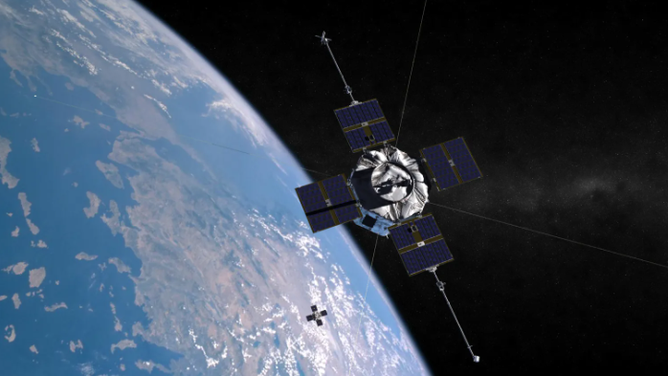
Illustration of twin Van Allen Probes
(JHUAPL / NASA)
The Van Allen Prob A was launched to study the rings of charged particles surrounding our planet.
From 2012 to 2019, the satellite, along with its twin, Van Allen Probe B, spent time exploring how Earth’s magnetic field captures and releases radiation.
After the mission came to a close in 2019, they analyzed data that showed the spacecraft to re-enter Earth’s atmosphere in 2034, but scientists calculated those findings before the current solar cycle, “which has proven far more active than expected,” they said.
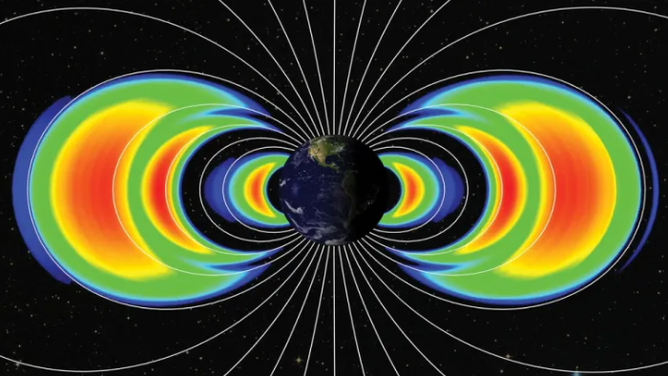
Van Allen Probes image showing three radiation belts first seen around Earth in 2012
(NASA’s Goddard Space Flight Center/Johns Hopkins University, Applied Physics Laboratory)
By 2024, the Sun had reached its solar maximum, sparking frequent and intense space weather events.
DANGEROUS ASTEROID NO LONGER EXPECTED TO HIT THE MOON IN 2032
These conditions increased atmospheric drag on the spacecraft well beyond initial projections, speeding up its descent and causing it to re-enter earlier than expected.
The mission yielded major discoveries about how the radiation belts operate, including data that revealed the existence of a transient third radiation belt.
The data collected from both probes will keep enhancing scientists’ understanding of Earth’s radiation belts and play a crucial role in studying space weather and its wide-ranging effects.