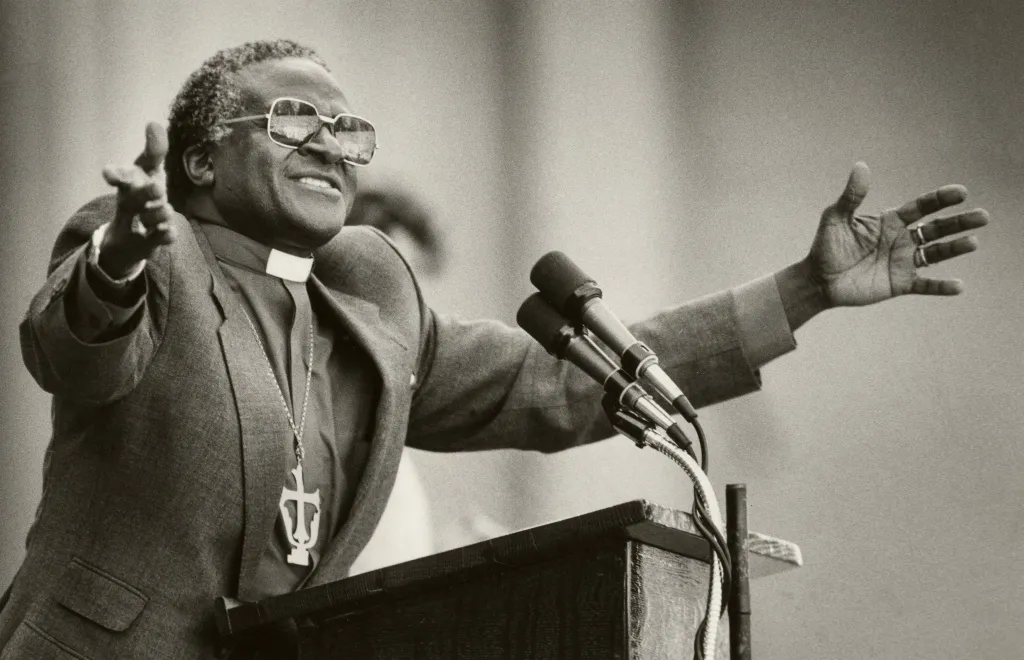
Born in the Transvaal in 1931, Archbishop Desmond Tutu died nearly five years ago, in the last week of 2021, but this documentary arrives as a timely reminder of his legacy and the great strides he made throughout his career. Though primarily identified with the anti-apartheid movement in South Africa, which he supported from the mid-’60s till the end finally came in the mid-90s, the charismatic Anglican lent his name to many other humanitarian causes, not simply matters of black versus white. This suitably reverential doc shows the tip of that iceberg, offering a striking portrait of a leader with a strong moral compass and a fearlessness that now seems almost superhuman.
Organized into chapters, Tutu makes great use of first-hand footage filmed by journalist Roger Friedman and activist/photographer Benny Gool, who both worked with Tutu for the last 20 years of his life. Much of it filmed behind the scenes, this footage is vital, not only showing the archbishop’s playfulness and sense of humor but also taking us deep into his family life and his extraordinary relationship with his long-suffering wife, Nomalizo Leah. Much is made of Tutu’s bravery, but, as Sam Pollard’s film clearly shows, Leah’s self-sacrifice cannot be understated, notably when she agreed to follow her husband back to South Africa after moving to the relative safety of London in the early ’60s.
Quite why Tutu chose to return to South Africa in 1967 is neatly explained by three quotes that pop up early. In. the first, Tutu explains his belief that “when people decide to be free, nothing can stop them from being free”. In the second, he describes himself as “a man of peace but not a pacifist”. And in the third — and most important — he notes that “the Christian faith is hopelessly optimistic”. Even so, in retrospect it seems almost like a death wish; the late ’60s were a turbulent time, especially for civil rights, and in American would soon come to a head with the assassination of Martin Luther King Jr.
Though the film sticks to the strict chronology of Desmond Tutu’s increasing immersion in South African politics, it’s not hard to see what appealed to the film’s American director. Detailing the cleric’s fights with successive white governments, which lead us to the Soweto Uprising (1976) and the murder of activist Steve Biko (1977), it also shows that he wasn’t afraid to question the ANC (African National Council) either, which came with its own dangers. Immediately we see echoes of today’s ICE raids all over the USA, and when the issue of sanctions is addressed — both Ronald Reagan and Margaret Thatcher refused to use them as a means to stop apartheid — we see that nothing much has changed, given the number of wars currently ongoing in the world today.
Thankfully, Pollard handles all this with a light touch, focusing on Tutu and the way he so ably defused these situations, being a man who preferred answers to questions. That said, a cloud still hangs over his attempts to hold the previously all-white establishment to account once Nelson Mandela came to power in 1994 — Tutu’s promise of “forgiveness as well as punishment” through his Truth and Reconciliation Commission (1995-6) came up visibly short on the latter, since most of the perpetrators skated, leaving behind an absence of accountability that brings to mind the Epstein files.
Such failings, however, are only human, and a measure of what his devotees came to believe Desmond Tutu was capable of. In that respect, the bar was always set very high, and yet Tutu — who spent two-thirds of his entire life in the public eye — mostly lived up to it. This film explains why that was, and why his indomitable spirit refuses to die.
Title: Tutu
Festival: CPH:DOX (Backstory)
Director: Sam Pollard
World sales: Cinetic Media
Running time: 1 hr 42 mins