In the UK, casket burials and cremations have been the main burial options for decades.
But more and more people are ditching these traditional options in favour of more modern, eco–friendly techniques.
From artificial reefs to sending your remains into space, Britons now have more choices than ever for their final resting place.
And with some big changes in the law potentially coming, Brits may soon have even more say in how they leave the world – and what they leave behind.
Across the UK, there are now more than 400 cemeteries offering ‘green’ burials, and funeral operators say that the industry is only growing.
Meanwhile, just this week, Scotland became the first part of the UK to introduce ‘boil in the bag’ aquamations.
Louise Winter, founder of independent London funeral director, Poetic Endings, told the Daily Mail: ‘People want their person to be in death as they were in life.
‘And if that involved being conscious of the environment, then natural burial is a really lovely choice.’
As the popularity of traditional burial techniques fades, more people are looking for unique options, such as becoming part of an artificial reef
Artificial reefs
Even for those who do choose a traditional cremation, there is now a bewildering array of choices for what to do with the ashes.
When Linda Tagg was diagnosed with cancer, she and her husband had more than enough places to choose from.
As avid travellers and divers, she and her husband, David, now 79, had been all over the world from Antarctica to the Galapagos.
‘I told her whatever she wanted to do, wherever she wanted to go, I would do it. Sod the money,’ David told the Daily Mail.
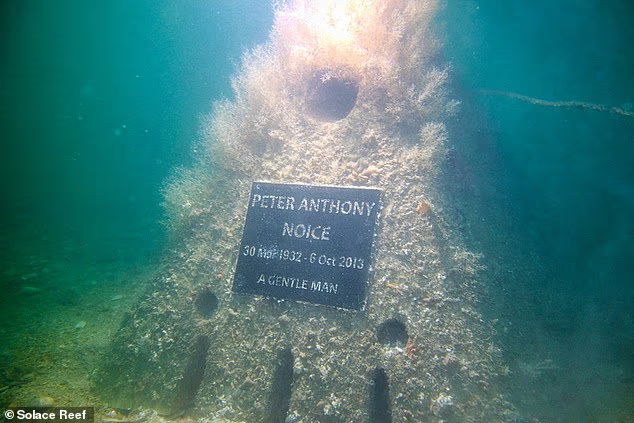
That was when the couple heard about Solace Reef, a company that turns people’s remains into part of an artificial reef off the coast of Weymouth, where Linda and David had dived for years.
Instead of being scattered or sitting in an urn, Solace Reef seals the ashes inside a stone memorial that is sunk to the bottom of the ocean.
There, the stone becomes a home for soft corals, fish, and lobsters, which thrive in the underwater cemetery.


Solace Reef is a UK–based company that seals people’s ashes inside stones and sinks them to the bottom of the ocean off the coast of Weymouth, England, to form an artificial reef
As divers and nature lovers, David says that this ‘seemed like the sensible thing to do’.
When Linda passed away in 2019 at the age of 65, she was set in one stone while her father Maurice, who had passed years prior, was set in another.
The pair were sunk to the bottom of the ocean, with Linda’s stone facing south and Maurice facing north.
‘My friend keeps promising to take me down to see Linda, you know, but I’m getting a little old for diving,’ says David.
‘But if any of my daughters become divers, they can then go down and visit.’
Later, when Linda’s mother, Audrey, also died, she requested that her ashes be set in a stone and sunk to sit corner to corner with her daughter and husband.
‘When I go, I’ll be going down facing southwest, corner to corner with Linda,’ David says.
‘Instead of becoming part of a graveyard, you become a sea life reserve. It’s just a very useful way of being there forever. Rather than tipping the ashes away, they’re actually serving a purpose.’

David Tagg (pictured) told the Daily Mail that laying his wife, Linda, to rest in a reef felt like ‘the sensible thing to do’ for a nature lover and keen diver
Solace Reef now has 35 stones in its artificial reef, with each stone adding more places for marine flora and fauna to thrive.
Sean Duncan, founder of Solace Reef, told the Daily Mail: ‘People are fed up of being processed in the traditional manner and people are looking for new and creative ways to mark their passing.
‘The solace reef is giving life after a life lived. Which we know people love.’
Space burial
While some people like the idea of having their loved one’s remains close by, many people are now looking much, much further afield.
‘My husband, Mark, died suddenly on the 27th of January. We went to bed on Tuesday night as normal, and he never woke up,’ says Jane Berwick, 59.
‘I found a note that he’d left me, and he said that he understood he would be cremated. But we’ve got a couple of dogs that we’ve lost in a cupboard under the stairs, and his last wishes were that he didn’t sit in a cupboard under the stairs.
‘We live in North Norfolk with no light pollution, and we used to love sitting out in the evening looking at the stars, and I thought, ‘Wouldn’t it be lovely to send them into space?”

After Jane Berwick’s husband, Mark, unexpectedly passed away, she decided to send his ashes into space
Incredibly, just a few months later, Jane was able to do just that.
In November, Mark’s ashes were collected from a funeral parlour by a UK–based company called Aura Flights.
They were then loaded into a specially designed capsule, attached to a hydrogen balloon and carried to the edge of space before being gently scattered into the stratosphere, 100,000 feet (32,500 metres) above the ground.
Mark’s ashes will now spend up to a year drifting on the stratospheric winds high above the Earth before falling to the ground as rain and snow, and becoming part of nature.
‘Looking up at the stars and thinking he’s out there somewhere was a bit of comfort for us,’ Jane says.
‘I’ve lost family members who have been buried, and I’ve been to cemeteries that just have so many untended graves. I didn’t want that for Mark. I didn’t want to think that he was just lying there while nobody bothered about him.
‘I think he would be thrilled to know he’s not sitting in a cupboard somewhere.’
At £3,950, this process isn’t cheap, and comes on top of the cost of a cremation and funeral.

Mark’s ashes were loaded into a specially designed capsule, attached to a hydrogen balloon and carried to the edge of space before being gently scattered into the stratosphere, 100,000 feet (32,500 metres) above the ground
However, that hasn’t stopped Aura Flights’ services from growing in popularity.
Samantha Richardson, General Manager of Aura Flights, told the Daily Mail that the company has just launched its 350th flight since starting in 2017.
Ms Richardson also says that the company is now receiving more inquiries from people planning for their deaths well in advance, with some potential customers making arrangements while in their 30s and 40s.
She says: ‘In general, people seem to be moving away from traditional burial practices and looking for something a bit more personalised or modern.
‘Instead of being a quiet, sombre event, it’s a celebration of their life, and so they’re looking for something that connects with their personality, their way of life, and the life they lived.’
Natural burials
While traditional burial methods might be comforting in their familiarity, they are also creating a serious problem.
Each year, the Green Burial Council estimates that traditional funerals in the US consume 16.2 million litres of embalming fluid, 20 million board feet of hardwood boards, 17,000 tons of copper and bronze, and 1.6 million tons of concrete.

Natural burials are one of the UK’s fastest–growing alternative funeral options. The body is buried out in nature with only biodegradable materials, so that it can decompose naturally
This has an enormous environmental impact that is pushing many people towards new, green alternatives.
Over 60 per cent of families said they would be interested in green funeral options, according to a recent survey from the National Funeral Directors Association.
During a natural burial, the body is simply placed in the ground as it is and allowed to decay naturally, eventually becoming part of the soil.
Instead of hardwood caskets, natural burials use biodegradable options like linen shrouds or wicker baskets that rapidly break down in the earth.
Ms Winter says: ‘Natural burials have a very different feel. There’s just something more raw about returning to Earth in the purest way possible, I think that’s what attracts people to it.’
However, natural burials also solve a very practical problem for some mourners.
‘Space in London is really limited in the traditional cemeteries, and some are running out of space,’ says Ms Winter.
Out of the big cities, almost any available field can quickly be converted into a natural burial ground.

There are now over 400 locations offering natural burials, ranging from reserved areas of normal cemeteries to vast natural parks such as Scraptoft Natural Burial Ground (pictured)
Ms Winter even says that some farmers have started offering parts of their land as sites for natural burials.
That means natural burials are often significantly cheaper, as well as being better for the environment.
Rosie Inman–Cook, manager of the Natural Death Centre, told the Daily Mail: ‘A proper natural burial is a win–win–win. Great, meaningful funerals for the mourners, better for the planet, and better for wildlife as they establish and protect areas of countryside.’
However, the boom in green funerals has also led to big differences between sites, which vary from a corner in the regular council cemetery to spacious nature reserves.
‘Buyer beware, some opportunists who have little regard for the ethos of providing natural burials have jumped on the wagon,’ Ms Inman–Cook cautions.
‘They disregard the basic requirements and just want to make money. They accept embalmed bodies in any old coffin, and some have inadequate mapping systems and appalling customer service.’
Mushroom coffins
Natural burials require the body to be placed in something that will break down quickly, but not every family is happy with a simple shroud.

The world’s first ‘living coffin’ is made out of mushrooms and is designed to biodegrade within 45 days, ‘becoming one’ with nature
Previously, the best biodegradable coffins were made of willow or bamboo and were often imported from China at a huge environmental cost.
One futuristic solution is the Loop Living Cocoon, a coffin which is grown out of living mushrooms.
Recycled hemp fibre is mixed with mycelium – the root–like structure of fungi – and grown into a strong and completely biodegradable coffin in just seven days.
Once in the ground, the coffin breaks down completely in 45 days, enriching the soil and supporting the process of decomposition.
Bob Hendrikx, inventor of the Loop Living Cocoon and founder of Loop Biotech, told the Daily Mail: ‘If you put them in the soil, they’re not hurting the planet, but enriching it.
‘We talk about this as the logical option, not the green alternative. Because the non–logical option is polluting the planet that you’re leaving behind for your children.’
That eco–friendly selling point has proven to be a hit, with Loop Biotech having now sold coffins to over 4,000 families, including ‘a few hundred’ in the UK.
‘People want to leave the world a better place for their grandchildren and do one final good deed,’ Mr Hendrikx says.

In addition to being good for the environment, families also like the fact that the Loop Living Cocoon is soft to the touch and rounded
However, besides the environmental appeal, Mr Hendrikx says there is also a more human aspect to the mushroom coffin’s success.
Unlike a hard, angular wooden coffin, the Loop Living Cocoon is soft, almost furry, with a texture that is likened to the rind of a brie.
‘It’s something you might want to cuddle,’ says Mr Hendrikx.
‘For the grieving process that can be quite healing, and we often hear stories about people stoking the coffin, almost petting it.’
‘Boil in the bag’ funerals
This week, Scotland became the first part of the UK to legalise so–called ‘boil in the bag’ funerals.
This process, properly known as alkaline hydrolysis, sees bodies dissolved into a sterile liquid and washed down the drains.
During a boil in the bag funeral, the body is wrapped in a biodegradable shroud, often made of silk or wool, and placed in a pressurised steel chamber.
The tank is then filled with a liquid made up of 95 per cent water and five per cent of an alkaline chemical such as potassium hydroxide.
The body is heated to 150°C (302°F) under pressure, which ensures that it does not actually ‘boil’.
Over three to four hours, this replicates the natural processes of decomposition that would normally take decades to occur inside a coffin.
Finally, the resulting liquid is cooled, treated, and poured into the drains, where it is processed alongside normal wastewater.
This process has been legal for several years in other countries, including Canada, the US, and Ireland, but it might take six to nine months before the first centres open in Scotland.
However, funeral directors are already preparing to offer the service, which is seen as significantly more environmentally friendly than traditional cremation.
Kindly Earth, which has the exclusive rights to produce alkaline hydrolysis equipment in Scotland, says that families also describe the process as ‘gentler’ than cremation.

Scotland has become the first part of the UK to legalise ‘boil in a bag’ funerals, properly known as alkaline hydrolysis, which involves rapidly decomposing a corpse in water and alkaline chemicals in a steel chamber(pictured)
Helen Chandler, General Manager of Kindly Earth, says: ‘We know that not everyone will choose hydrolysis – and that’s the point. It’s about giving families more choice.
‘Each family has different values and priorities. Some people, particularly those planning ahead for their own funeral, are looking for options that feel more aligned to their own preferences. Hydrolysis provides that additional choice.’
Human composting
In England and Wales, the Law Commission is currently considering a legal framework for new funerary practices.
In addition to opening the door to boil in the bag funerals, this would also allow for more eco–friendly options such as ‘human composting’.
While it is not currently legal in the UK, this process, also known as ‘terramation’, is becoming a popular alternative to cremation in the US.
The body is placed in a vessel surrounded by wood chips, alfalfa, straw, and flowers or other biodegradable items the family may want to leave.
Over the next 30 days, the vessel is kept warm as oxygen flows through, allowing microbes to rapidly transform the body into soil.

Although not currently legal in the UK, England and Wales may soon allow human composting, a process which breaks the body down into soil. Pictured: Recompose funeral home in Seattle, Washington

Over 30 days, the body is broken down into rich soil, which is returned to the families to use as they please
After a further 30 days of resting and cooling, the body has become about one cubic metre of rich compost, which is returned to the family.
Brienna Smith, funeral director at the Return Home funeral company in Washington State, told the Daily Mail: ‘What appeals to many people is the alignment with their values. Terramation is gentle, participatory, and rooted in ecology.
‘Families most often choose to place the soil in meaningful locations. Some return it to family land, gardens, forests, or conservation areas. Some use the remains in their house plants. Others participate in reforestation projects or use it to nourish trees planted in their loved one’s honour.’
Terramation also uses about 87 per cent less energy than conventional cremation or burial, which is a big appeal for environmentally conscious mourners.
Ms Smith says Return Home has composted loved ones for over 700 families since opening, and the practice is only becoming more popular.
If the Law Commission’s new bill, expected in a few months, opens the doors for human composting in the UK, it may soon become one of the more popular alternative options.
Ms Smith says: ‘I believe more people are turning toward alternative practices because they are asking deeper questions about impact, meaning, and transparency.
‘There is growing awareness of environmental concerns, as well as a desire for rituals that feel personal rather than industrial.’