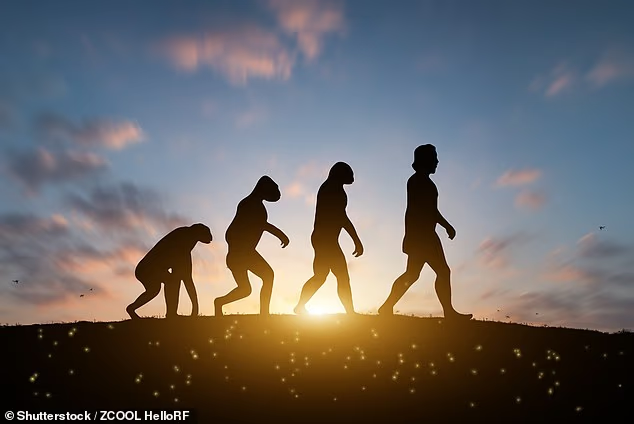
A Harvard physicist who once fully embraced evolution says finding God turned his understanding of life’s origins upside down.
Dr Michael Guillen told the Daily Mail that for decades, he saw science as the highest authority, until the 1980s, when reading the Bible for the first time changed everything.
Guillen now argues that modern science increasingly points away from Darwin’s theory of evolution and closer to the Christian view of human origins.
‘When you look at the continuum that evolutionary biologists say we are part of, in fact, we are not part of a continuum,’ he said.
‘All these animals are related to one another. And then all of a sudden, we appear without precedent. There’s no precedent for the modern human species, the Homo sapiens.’
One of the biggest issues with the theory of evolution, he said, is the fossil record.
Early evolutionary scientists believed that as more fossils were discovered, they would reveal a continuous chain of life showing animals slowly transforming into new species.
‘There was an expectation that if we kept digging, we would eventually fill in those gaps,’ he said. ‘But it became very clear that wasn’t happening.’
A Harvard physicist who once fully embraced evolution says finding God turned his understanding of life’s origins upside down
Guillen told the Daily Mail that science was once his god, until a ‘pretty sorority girl’ invited him to read the Bible.
‘I thought to myself, well, I’m a scientific nerd, but I’m not that stupid,’ he said, adding how it would allow him to spend more time with her.
His mindset completely changed when, as a graduate student at Cornell University in the 1980s, he said he realized that science might be able to answer his burning questions about religion – one of those being the theory of evolution.
Guillen said that when Darwin first introduced the theory of natural selection in the 19th century, scientists believed species evolved gradually from common ancestors.
Darwin’s theory proposes that organisms better adapted to their environment are more likely to survive and produce more offspring.
Under that view, humans were simply the latest branch on a long evolutionary tree stretching back millions of years.
But Guillen argues that discoveries over the past century have raised serious questions about whether evolution actually unfolded as Darwin imagined.
He pointed to the lack of fossil records that prove all species are related, share a common ancestor, and change over time through natural selection and genetic variation.

Harvard physicist Dr Michael Guillen pointed to how humans appeared suddenly and the lack of fossil records to support his believe that God created humans
Instead, researchers found large gaps between species rather than clear transitions.
The lack of transitional fossils eventually led scientists to develop a new evolutionary concept known as punctuated equilibrium.
The theory suggests that species evolve in sudden bursts rather than through a slow, continuous process.
‘It’s almost like driving a car with a clutch, and the car lurches forward, stops, and then suddenly moves again,’ Guillen explained.
Scientists have also theorized that the intermittent gaps are explained by geological processes which have destroyed or prevented fossils from forming.
Niklas Hohmann of Utrecht University’s Faculty of Geosciences, who led a team of British and Dutch scientists on a 2024 study into the issue, said the incompleteness of the fossil record does not disprove continuous evolution.
‘We have a good understanding of where the gaps are, how long they are, and what causes them. With this geological knowledge, we can reconstruct evolution hundreds of millions of years ago,’ he said at the time.
But to Guillen, the gaps continue to highlight how uncertain the evolutionary timeline remains.
He also pointed to what some evolutionary researchers have described as the sudden appearance of modern humans.
Pulitzer Prize-winning evolutionary biologist Jared Diamond famously called the phenomenon the ‘Great Leap Forward,’ noting that Homo sapiens appeared relatively recently and rapidly compared with other species.
According to Guillen, humans display abilities that are dramatically different from anything seen in the animal kingdom.
These include advanced reasoning, complex language, art, music and abstract thought.
But the most puzzling difference, he argued, is humanity’s search for spiritual meaning.
‘Our religiosity sets us apart from every other animal on the planet,’ Guillen said.
‘There’s no other species that asks questions about God or eternity. Those questions have nothing to do with survival or reproduction.’
Guillen acknowledged that scientists widely accept microevolution, the small genetic changes that allow species to adapt to their environments.
Examples include insects developing resistance to chemicals or animals evolving traits that improve survival.
He said such adaptations do not conflict with Christianity.
‘If God created life, it would make sense that he designed it with the ability to adapt to changing environments,’ Guillen said.
But he strongly disputes macroevolution, the idea that entirely new species emerge from existing ones.
According to Guillen, the fossil evidence supporting that process is weak.
‘When you look at the fossil record and ask whether one species morphs into a completely different species, the evidence simply isn’t there,’ he said.
Another unanswered question is how life began in the first place.
Even if evolution explains how species change over time, Guillen said scientists still struggle to explain how the first living organisms appeared.
Some researchers have suggested that the earliest life on Earth may have been seeded by extraterrestrial organisms.
Evolutionary biologist Richard Dawkins once raised the possibility that advanced alien civilizations could have introduced life to Earth.
But Guillen argues that such explanations only push the mystery further back.
‘If aliens created life here, then how did the aliens come into existence?’ he said.
For Guillen, these unanswered questions highlight what he believes are the limits of Darwin’s theory.
He predicts that future discoveries could radically reshape how scientists view evolution.
‘I think the theory of evolution is on very shaky ground,’ he said.