This article originally appeared on PolitiFact
Just days after launching a war against Iran, President Donald Trump favorably compared his efforts eliminating Iran’s nuclear weapons capability to a 2015 deal negotiated by one of his predecessors. President Barack Obama’s nuclear agreement with Iran was in force until 2018, when Trump pulled the U.S. out during his first term.
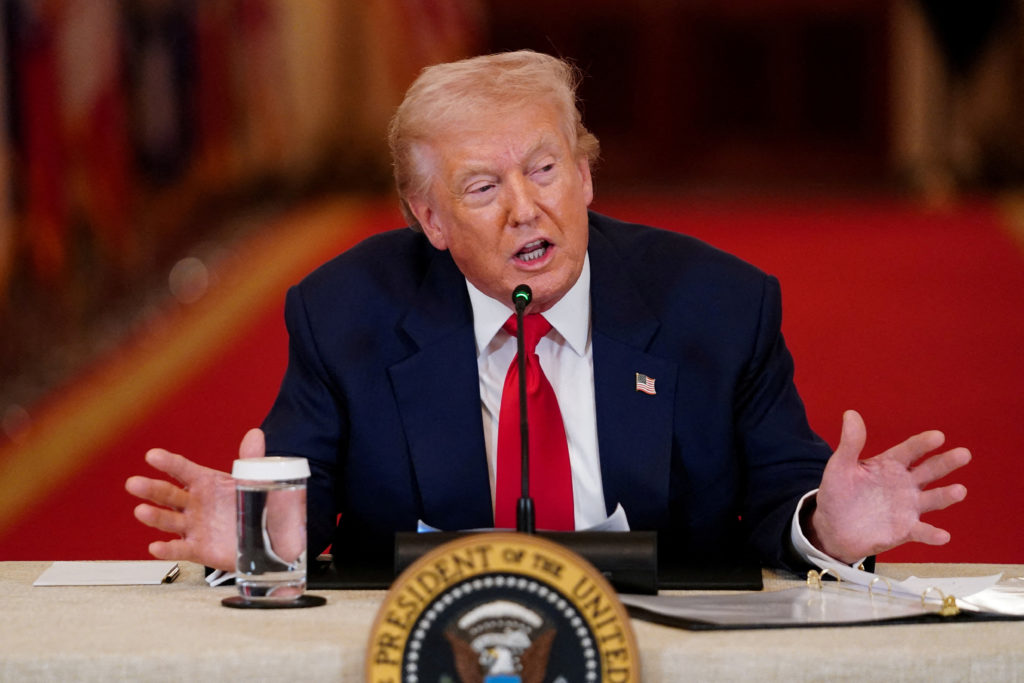
Taking questions in the Oval Office on March 3 with German Chancellor Friedrich Merz, Trump said that the agreement he pulled out of “gave (Iran) the right to have top-of-the-line nuclear weapons.”
WATCH: Trump meets with Germany’s Merz as U.S.-Israel conflict with Iran widens
His comments echoed Trump’s remarks the day before at a Medal of Honor ceremony.
“I was very proud to have knocked out the Iran nuclear deal by President Barack Hussein Obama,” Trump said. “That was a horrible, horrible, dangerous document. They were on the road to getting (a nuclear weapon) legitimately, through a deal that was signed foolishly by our country.”
And on March 4, Trump said at a roundtable on energy prices that the nuclear deal “was a route to a nuclear weapon.”
Multiple experts told PolitiFact that, whatever its shortcomings, the Iran nuclear agreement never allowed Iran the “right” to “legitimately” possess nuclear weapons, “top-of-the-line” or otherwise.
The 2015 agreement — also known as the Joint Comprehensive Plan of Action, or JCPOA — “absolutely did not give Iran ‘the right to have top-of-the-line nuclear weapons,'” said Daryl G. Kimball, executive director of the Arms Control Association.
READ MORE: Majority of Americans oppose military action in Iran, new poll finds
The White House referred PolitiFact to Press Secretary Karoline Leavitt’s March 4 briefing remarks, in which she referred to “stupid and naive deals that put Iran on the path of developing nuclear bombs.”
“After years of endless appeasement and empty statements from politicians on both sides of the political aisle in this town, President Trump is finally the man of action,” Leavitt said. “President Trump is holding these monsters accountable and permanently extinguishing their nuclear ambitions.”
What was the Iran nuclear agreement?
Obama had campaigned on a promise to ensure that Iran did not obtain a nuclear weapon. The negotiated agreement was signed in 2015 by the United States and Iran as well as China, Russia, France, Germany and the United Kingdom.
Under the deal, Iran agreed to refrain from pursuing nuclear weapons and to allow continuous monitoring of its compliance in exchange for relief from economic sanctions. Different parts of the agreement were scheduled to last between 10 and 25 years; some elements were to last indefinitely. Obama officials hoped for future renegotiations.
Iran agreed to relinquish 97% of its enriched uranium stockpile and 70% of its centrifuges, which are machines used to enrich uranium. It also agreed to stop plutonium production and to dismantle a plutonium reactor. If Iran broke any of these pledges, the other signatories would be able to reimpose sanctions, a process known as a “snapback” provision.
Some Democrats joined Republicans in opposing the agreement, but they did not have enough votes to block the deal. Critics said the agreement didn’t address other actions by Iran, including support for terrorism, and that it posed a threat to Israel.
AP EXPLAINS: Iran’s nuclear program as 2015 deal unravels
Over the 28 months the deal was in effect, the International Atomic Energy Agency said it found Iran committed no violations, aside from some minor infractions that were addressed.
When Trump ran for his first term, he echoed many of the critics’ original concerns and promised to renegotiate the agreement.
He said he believed the deal should have allowed international weapons inspectors to have greater access to Iranian military sites. He also said it should have addressed Iran’s missile program, including intercontinental ballistic missiles, which could reach the U.S. mainland. He also criticized the deal for failing to rein in Iran’s support of sectarian violence in places such as Syria and Yemen.
In 2018, Trump pulled the U.S. out of the deal. The U.S. then imposed economic sanctions on Iran, and Iran reduced its compliance with the deal, including curbing compliance with international inspectors.
In 2025, Trump ordered the U.S. military to join Israel in bombing nuclear sites in Iran, seeking to end the nuclear program by force rather than negotiation. Then, on Feb. 28, Trump launched a new and larger air campaign that both sought to degrade Iran’s military capabilities and take out many members of its political and military leadership.
Why the 2015 agreement did not allow Iran to legitimately possess a nuclear weapon
The problem with Trump’s recent phrasings, experts said, is that he said the Iran nuclear agreement conferred upon Iran the right to have nuclear weapons, and to have those weapons legitimately. That’s false.
The agreement was premised on Iran continuing to belong to the Nuclear Non-Proliferation Treaty, or NPT, which requires Iran to agree to forgo developing or acquiring nuclear weapons.
By signing the 2015 agreement, Iran “explicitly committed not to have a nuclear weapon, reflecting their NPT commitment not to have one,” said Richard Nephew, who worked for the U.S. government on Iranian issues during the Biden administration. “The entire purpose of the deal was to make sure that they could not do so.”
While some aspects of the agreement would phase out after 10 to 25 years, “there was no sunset of the non-weapons obligation,” he said.
This doesn’t mean that, at some point, Iran couldn’t have ended up with nuclear weapons — but if it did so, it would have occurred by contravening the agreement, not by exercising a right it granted.
“Any acquisition of nuclear weapons, under any circumstances, while Iran is a member of the NPT, cannot be regarded as ‘legitimate,'” said Brendan Green, a University of Cincinnati political scientist who specializes in nuclear weapons policy.
In one scenario cited by the deal’s critics, Iran, as a continuing signatory to the treaty, would have maintained the right to generate civilian nuclear energy. Ten years into the deal, the snapback provisions were scheduled to go away and Iran would have begun to get increasing rights to nuclear enrichment capabilities, Green said.
At that point, Iran could have spurned either the spirit or the letter of its agreements — or both — by diverting this nuclear enrichment material into weapons development. But that would have been contrary to the agreement, and contrary to the NPT — not something blessed by the agreement.
“If Iran abused that enrichment capability, it could be used to produce nuclear material necessary for a nuclear weapon,” said Gary Samore, a politics professor at Brandeis University’s Crown Center for Middle East Studies.
Even if it was “executed perfectly,” Green said, the agreement “was always going to put Iran in a position where it would be able to sprint for a bomb if it chose to do so. The debate was about whether this was an acceptable outcome, or whether some kind of additional measures, ranging from war to further negotiations, would be necessary before the deal’s expiration.”
Our ruling
Trump said the nuclear agreement “gave (Iran) the right to have top-of-the-line nuclear weapons.”
The nuclear agreement did not bless any Iranian “right” to nuclear weapons, top-of-the-line or otherwise. To the contrary, Iran could have acquired or developed a nuclear weapon by defying the terms of the nuclear agreement.
That’s because the agreement was based on Iran’s continued adherence to the Nuclear Non-Proliferation Treaty, which Iran signed in 1970. This treaty deems Iran a non-nuclear state, meaning it promised to forgo developing or acquiring nuclear weapons.
We rate the statement False.