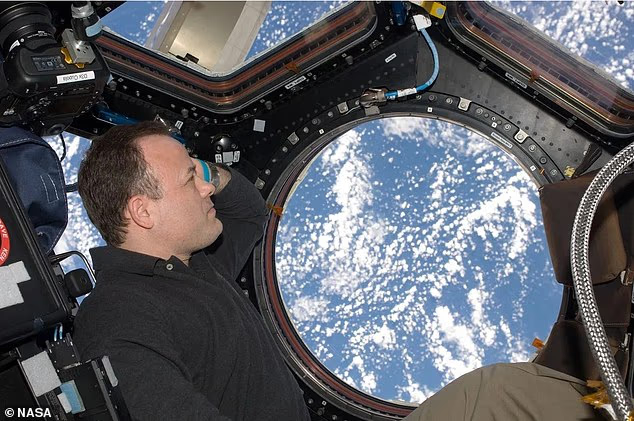
A NASA astronaut had a life-changing revelation after spending 178 days on the International Space Station.
Ron Garan, who launched on April 4, 2011 and returned home on September 16, 2011, completed nearly 3,000 orbits around Earth, discovering humanity has been ‘living a lie.’
Garan said that while looking out the window of the International Space Station (ISS), he was struck by how differently the world appears from orbit.
From space, the planet’s fragile life-support systems, its atmosphere, oceans and ecosystems are clearly visible, yet human society treats them as if they exist only to serve the global economy.
‘I didn’t see the economy. But since our human-made systems treat everything, including the very life-support systems of our planet, as the wholly owned subsidiary of the global economy, it’s obvious from the vantage point of space that we’re living a lie,’ he told Big Think.
Garan said the view made him realize that many of the systems humanity relies on are built around a flawed idea: that Earth’s natural resources are merely a subsidiary of economic growth.
From that vantage point, he said, it becomes obvious that the way humanity organizes its priorities is fundamentally misguided.
‘We need to move from thinking economy, society, planet to planet, society, economy. That’s when we’re going to continue our evolutionary process,’ Garan explained.
NASA astronaut Ron Garan said that while looking out the window of the International Space Station, he was struck by how differently the world appears from orbit
Astronauts call this shift the Overview Effect, which was first coined by space philosopher Frank White in 1987.
It describes a profound shift in awareness experienced by many astronauts while viewing Earth from space.
They often report an overwhelming sense of awe, a deeper appreciation for the planet’s beauty and fragility and a powerful feeling of connection to humanity and the Earth as a whole.
For Garan, it was not an abstract idea, but a permanent change in perspective.
While the astronaut made the statements in 2022, his interview has recently emerged on social media, where users marveled at the revelation.
‘He came back changed forever. Most of us stay down here arguing about lines on a map,’ on X user shared.
In the interview with Big Think, Garan explained that if the Overview Effect is the moment of awareness, like a light bulb switching on to reveal humanity’s interconnected and interdependent nature, then the ‘orbital perspective’ is what people do with that realization.
‘The orbital perspective is the call to action,’ Garan said.

Ron Garan, who launched on April 4, 2011 and returned home on September 16, 2011, completed nearly 3,000 orbits around Earth, discovering humanity has been ‘living a lie’
It’s a sense of injustice that we see when we see the sobering contradiction between the indescribable beauty of our planet and the unfortunate realities of life on our planet for a significant number of the inhabitants.
‘One of the things that I realized during my time in space is that we’re not from Earth, we’re of Earth.
‘And to take that one step further is that we’re not in the universe; we are the universe. We are the universe becoming conscious of itself.’
The astronaut added that understanding the concept does not require traveling to space, noting that people can develop what he calls an ‘orbital perspective’ without leaving Earth.
One way to think about this mindset is through a filmmaking technique known as a ‘dolly zoom,’ which he used as a metaphor for examining problems from both a wide and close-up perspective.
‘[It] is where the camera is rolled back, or dollied back, at the same rate as the lens is zoomed in, and it was used in ‘Jaws’, ‘Vertigo’ and many other films,’ Garan explained.
‘And what the filmmakers use that technique for is to give altitude to a scene, and as the foreground stays the same, the background stretches.

Garan said the view made him realize that many of the systems humanity relies on are built around a flawed idea: that Earth’s natural resources are merely a subsidiary of economic growth
‘But we could also apply that term to the challenges that we face. If we dolly zoom a situation, that means that we zoom out to the widest geographical area we possibly can, ideally the entire planet, but as we zoom out to that big picture, we don’t lose focus on the worm’s-eye details on the ground.’
He said adopting this broader perspective should not come at the cost of losing sight of individual people, stressing that humans should never be reduced to statistics, voting blocs or consumer groups but recognized as valued members of society.
Garan also noted that the approach involves thinking across long timescales, ideally across generations, while still addressing immediate challenges.
Looking at problems from multiple viewpoints, he said, helps reveal their full complexity and leads to stronger, more lasting solutions.
He added that individuals have more power than they may realize to influence positive change, explaining that he tries to live with this wider perspective every day, remembering not only his daily life but also humanity’s shared existence on Earth.
Despite the challenges facing the world, Garan said he remains optimistic, believing a growing awareness of humanity’s interconnectedness is spreading across the planet.
He predicted that once that awareness reaches a critical point, it could help humanity solve many of its global problems and inspire people to keep working toward a better future.