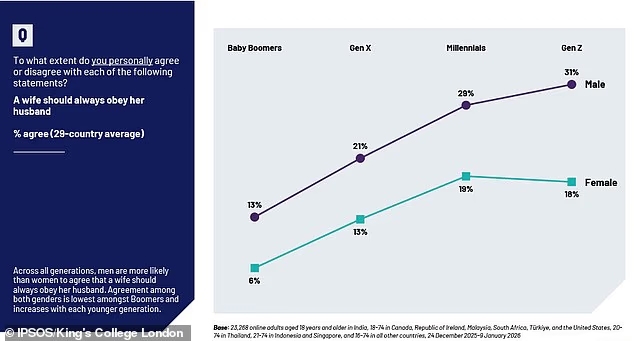
A third of Gen Z men think a wife should obey her husband, a new study has revealed.
This so–called ‘tradwife’ trend has gained momentum on social media over the last few years, with influencers including Nara Smith and Hannah Neeleman amassing millions of followers for their support of these traditional gender roles.
While many sceptics see the movement as regressive, it seems youngsters are increasingly embracing it.
In their study, researchers from King’s College London surveyed 23,000 people about their views on gender roles.
The results revealed that 31 per cent of Gen Z men agree that a wife should always obey her husband, compared to just 13 per cent of Boomer men.
‘It is deeply concerning to see traditional gender norms persisting today, and more troubling still that many people appear to be pressured by social expectations that do not actually reflect what most of us believe,’ said Professor Heejung Chung, Director of the Global Institute for Women’s Leadership at King’s Business School.
‘Our data reveals a striking gap between people’s personal views, which are far more progressive, and what they imagine society demands of them.
‘This gap is particularly pronounced among Gen Z men, who not only appear to feel intense pressure to conform to rigid masculine ideals, but in some cases seem to also expect women to retreat to more traditional ways of being.’
The study revealed that 31 per cent of Gen Z men agree that a wife should always obey her husband, compared to just 13 per cent of Boomer men

A third of Gen Z men think a wife should obey her husband, a new study has revealed. This so–called ‘tradwife’ trend has gained momentum on social media over the last few years, with influencers including Nara Smith (pictured with husband, Lucky Blue Smith) amassing millions of followers for their support of these traditional gender roles
For the study, the researchers set out to understand how views on gender roles vary between different generations.
The team surveyed a total of 23,000 people from 29 countries, including the UK, US, Brazil, Australia and India, ranging from Gen Z (born between 1997 and 2012) to Baby Boomers (born between 1946 and 1964).
The results revealed that young people today are more likely to hold traditional views on gender roles than those in older generations.
When asked whether a woman should always obey her husband, 31 per cent of Gen Z men agreed, compared to 13 per cent of Boomer men, 18 per cent of Gen Z women, and six per cent of Boomer women.
Meanwhile, 24 per cent of Gen Z men agreed that a woman should not appear too independent or self–sufficient, compared with 12 per cent of Boomer men, 15 per cent of Gen Z women and nine per cent of Boomer women.
The survey also found that attitudes toward sexual norms differ across generations.
More than a fifth (21 per cent) of Gen Z men said they think a ‘real woman’ should never initiate sex, compared with only seven per cent of Boomer men, 12 per cent of Gen Z women, and seven per cent of Boomer women.
However, despite being the most likely to believe women should not appear too independent, Gen Z men were the most likely to think that women who have a successful career are more attractive.

The team surveyed a total of 23,000 people from 29 countries, including the UK, US, Brazil, Australia and India, ranging from Gen Z (born between 1997 and 2012) to Baby Boomers (born between 1946 and 1964)

The tradwife trend harks back to 1950s Britain, and is already well established in the US. Pictured: Hannah Neeleman, aka Ballerina Farm, pictured with her husband
According to the researchers, this suggests there’s a ‘great re–negotiation’ of gender roles in today’s society.
Kelly Beaver, Chief Executive of Ipsos in the UK and Ireland, said: ‘Particularly among Gen Z, our data shows an interesting duality.
‘They are both the group most likely to agree that women who have a successful career are more attractive to men but are simultaneously most likely to agree that a wife should always obey her husband and that a woman should never appear too self–sufficient or independent.
‘This duality in perspectives opens a vital dialogue on how gender norms are being reshaped, highlighting the complex interplay between modernity and tradition and urging us to delve deeper into the cultural, social, and economic factors that influence these beliefs.’
Based on the findings, the researchers are calling for more to be done to promote diverse gender roles to young people.
‘Our aim should be to foster inclusive conversations that promote awareness and acceptance of diverse gender roles, paving the way for a more balanced and equitable society and a freer and more equal future for all,’ Ms Beaver added.
The tradwife trend harks back to 1950s Britain, and is already well established in the US.
The belief behind the movement is that wives should not work, and instead should spend their days cooking, cleaning, wearing modest and feminine dresses, and practicing traditional etiquette.
They should also be submissive to their husbands and always put them first.
While the movement has quickly gained momentum on both sides of the pond, sceptics have warned that the trend is an example of ‘hostile sexism’.
‘The tradwife trend isn’t nostalgia—it’s a warning sign,’ said Professor Chung previously warned.
‘Rather than evidence of a return to old–fashioned family values, the tradwife trend shows how younger women are struggling to reconcile impossible demands.
‘They are signaling frustration with workplaces that still expect full devotion to work, while family responsibilities remain largely unchanged and shouldered by women.’