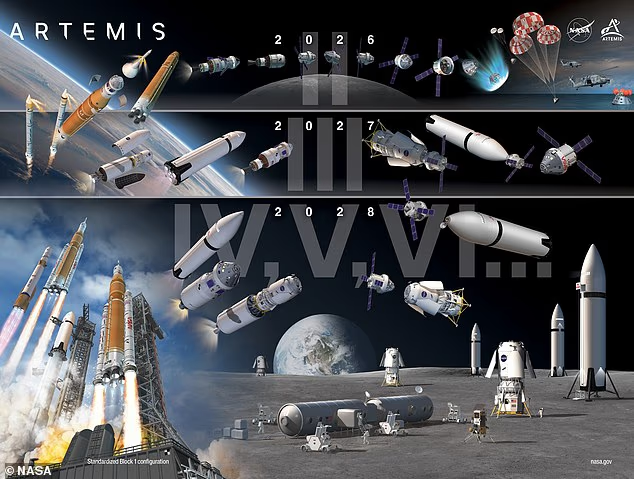
NASA has announced radical changes to its Artemis moon missions, pushing the lunar landing back yet again.
On Friday, the US space agency revealed an ambitious change in strategy that would see a greater number of flights making more incremental progress.
While NASA has sold this as an ‘increase in cadence’, the upshot is that Artemis III will no longer land on the moon in 2027 as previously planned.
Instead, the crew will practice docking with the lander in low–Earth orbit and test out the agency’s new space suit designs ahead of a rescheduled moon landing in 2028.
Online, furious space fans have flocked to social media to vent their outrage over the seemingly endless delays.
On X, formerly Twitter, one irate commenter wrote: ‘Just admit it. We’re never going back. Ever.’
Another morose NASA fan chimed in: ‘Just keep throwing money at it. My kids will be dead before we get there.’
And one added: ‘Not going to mince words here, I have near zero confidence.’
NASA has announced a radical overhaul of its moon mission timeline that will push the lunar landing back to 2028, sparking fury online. Pictured: NASA’s proposed plan for the Artemis mission timeline

Online, furious space fans have flocked to social media to vent their outrage over the seemingly endless delays
Following the successful second wet dress rehearsal for Artemis II, it appeared that the agency had finally worked out the problems plaguing the Space Launch System (SLS) rocket.
However, those hopes were soon dashed as NASA administrator Jared Isaacman revealed that technicians had discovered a blockage in the rocket’s helium system.
That led to NASA rolling the SLS back to the hangar for more repairs, bumping the intended launch date back to April at the very earliest.
But this latest technical mishap is only the latest in a long run of problems that have included significant leaks of super–cooled hydrogen fuel.
Against this problematic background, NASA Administrator Jared Isaacman revealed a plan which he claimed would take NASA back to the spirit of the Apollo missions that first put America on the moon.
He said in a statement: ‘NASA must standardize its approach, increase flight rate safely, and execute on the President’s national space policy.
‘Standardizing vehicle configuration, increasing flight rate and progressing through objectives in a logical, phased approach, is how we achieved the near–impossible in 1969 and it is how we will do it again.’
However, with many space enthusiasts eagerly awaiting the planned 2027 lunar landing, Mr Isaacman’s announcement has met fierce criticism online.

This comes after a series of technical issues pushed the launch of the Artemis II moon mission back to April. Pictured: The Artemis II Space Launch System rocket returns to the hangar for repairs

Mr Isaacman’s plan has been the subject of serious criticism, with former NASA Administrator Lori Garver calling it ‘magical thinking’
‘Over cost, over schedule. too little, too late,’ one commenter bluntly wrote on X.
Another asked: ‘Does anyone actually believe that we are landing people on the moon in 2 years?’
One furious social media user added: ‘You’re gonna get people killed and there is no way in hell we are landing on the moon this decade and you know it.’
But it isn’t just members of the public who have been sceptical of Mr Isaacman’s renewed plans for Artemis.
In a post on X, former NASA administrator Lori Garver wrote: ‘The focus on Artemis spin over substance has been troubling since its inception.
‘However, expressing confidence that we can add a flight in between & make two lunar landings in 2028 is more magical thinking.’
Likewise, some space fans have expressed doubts over the prominent role of the SpaceX Starship rocket in NASA’s new timeline.
A modified version of the powerful Starship rocket had been scheduled for use in the Artemis III mission.

On X, Mr Isaacman claimed that pushing the moon landing back to 2028 was the only way to ‘safely return American astronauts to the Moon’

One commenter questioned whether it was realistic to target landing on the moon in just two years, given NASA’s track record of delays
However, out of 11 Starship test flights, only two have been successful, and none have made it into Earth orbit.
NASA has even suggested that it may open up the contract for the Artemis III mission to other providers if SpaceX cannot get a handle on these delays.
Last year, acting NASA administrator Sean Duffy threatened to open up the contract to other countries due to persistent delays, saying at the time: ‘The problem is, they’re behind.’
On X, which is owned by SpaceX CEO Elon Musk, one commenter wrote: ‘You don’t really believe Starship will ever get to the moon do you?’
Another added: ‘Any roadmap where you intend to use Starship is a guaranteed road to nowhere.
While one commenter chipped in: ‘Who honestly believes that lunar starship is ready next year??’
According to the new Artemis timeline, Artemis II will launch this year to take its crew – Reid Wiseman, Victor Glover, Christina Koch, and Jeremy Hansen – around the moon.
This will be followed by Artemis III in 2027, which will now be a low–Earth orbit mission.
The first moon landing will instead be Artemis IV in 2028, with a second moon landing, Artemis V, potentially following that same year.
After that, NASA says it will attempt another moon mission every year with the goal of establishing a permanent presence on the lunar surface by 2030.
NASA Associate Administrator Amit Kshatriya said in a statement: ‘We are looking back to the wisdom of the folks that designed Apollo.
‘The entire sequence of Artemis flights needs to represent a step–by–step build–up of capability, with each step bringing us closer to our ability to perform the landing missions.’