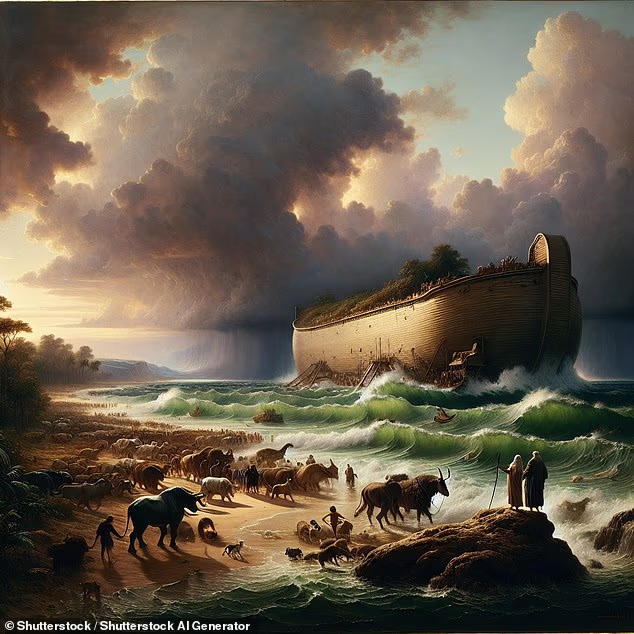
A controversial theory linking the eight survivors of Noah’s Ark to the eight human blood types has sparked a debate over the origins of humanity.
According to the Bible, Noah, his three sons, his wife, and his sons’ wives were the only humans to survive the flood, and later became the ancestors of every person alive today.
Some researchers and enthusiasts have pointed to a striking modern coincidence: the eight individuals on the Ark and the eight primary human blood types recognized by medicine.
Human blood is classified using the ABO and Rh systems, with four main groups, A, B, AB and O, each existing as either Rh-positive or Rh-negative, producing eight common blood types: A+, A-, B+, B-, AB+, AB-, O+ and O-.
The theory has ignited a firestorm on social media, where believers hail it as evidence of a divine blueprint. ‘The Bible is a living blueprint of the human body,’ one user proclaimed. Skeptics, meanwhile, have been quick to push back.
‘Interesting coincidence, but blood types evolved over tens of thousands of years, not from a single bottleneck,’ wrote another, highlighting the scientific caution surrounding the claim.
Genetics, however, shows that ABO and Rh blood types are inherited from parents. Even a small, closely related group can produce all eight types over generations.
With just eight people on Noah’s Ark, the mix of inherited alleles could plausibly have created the full range of blood types seen today, making this centuries-old story suddenly feel strikingly modern.
According to the Bible, Noah, his three sons, his wife, and his sons’ wives were the only humans to survive the flood, and later became the ancestors of every person alive today
The O blood type, the most common worldwide, could theoretically have originated with one of Noah’s family members and spread naturally as the population grew, suggesting that a small founding group might account for modern human blood diversity.
Scientists emphasize, however, that blood types evolved over millions of years through genetic mutations and natural selection, largely shaped by the need for enhanced immunity against disease.
Ancestral forms of the ABO system have been identified in primates dating back more than 20 million years, with Type O considered the most ancient.
Other blood types likely emerged later as adaptations to specific environmental pathogens, underscoring the complex evolutionary history behind human blood diversity.
Despite these evolutionary explanations, the theory continues to spark debate online and in academic circles.
Supporters point to the striking numerical alignment as more than a coincidence, while critics argue that modern genetics and evolution make the connection purely symbolic.
Well-known Christian influencer Oliver Burdick, a former atheist, shared the theory on social media, writing: ‘Noah’s Ark had 8 people.
Today, there are only 8 blood types in the world. Thousands of years apart, yet the same number.’ His post quickly ignited a storm of comments.

Some researchers and enthusiasts have pointed to a striking modern coincidence: the eight individuals on the Ark and the eight primary human blood types recognized by medicine
‘This isn’t just possible … it’s true,’ one user commented.
Another user shared, ‘God knows what He is doing,’ while one person said the statement was ‘beautiful.’ Many comments simply read ‘interesting.’
One X user raised the idea that while the numerical link between Noah’s Ark and the eight blood types is intriguing, genetics shows two parents can produce children with any of the eight types.
Each child inherits one ABO gene and one Rh gene from each parent, and depending on the combination of dominant and recessive alleles, all eight blood types can naturally occur.
However, more comments appeared to dismiss the theory than accept it as true.
One of those users noted that the eight people on Noah’s Ark were all closely related: Noah, his wife, his three sons, and their wives.
While some speculate that the daughters-in-law may have been sisters, the user suggested that the post-Flood population began from a very small, interrelated group, meaning early generations would have involved significant consanguinity.