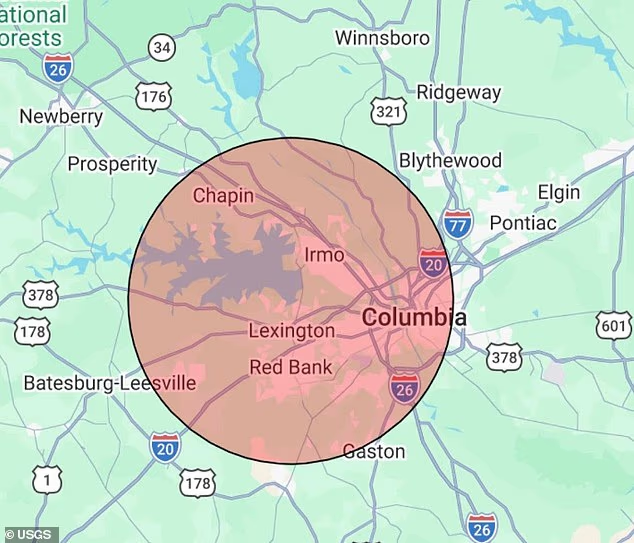
A 3.0-magnitude earthquake has rattled areas of South Carolina on Thursday.
The tremor was detected outside of Lexington and Columbia, home to over 160,000 people combined.
The epicenter, Irmo, lies near the Brevard Fault Zone and other ancient faults that run through the southeastern US, remnants of tectonic activity from hundreds of millions of years ago.
These faults are mostly inactive but can occasionally generate small-to-moderate earthquakes.
Hundreds of people reported feeling shaking in the state.
One local shared on social media, ‘Something is waking up under South Carolina,’ while another posted that their entire home shook.
Meteorologist Daniel Bonds said: That was a big earthquake, for South Carolina standards.’
Thursday’s earthquake had an unusually strong effect because it occurred just a tenth of a mile below the surface, making it the shallowest quake recorded in South Carolina so far in 2026, according to state data.
The tremor was detected at 12.17pm ET, striking outside of Lexington and Columbia, home to over 160,000 people combined
Locals are concerned, as many do not recall an earthquake in the past few years.
‘Just had another earthquake shook whole house this time in Lexington, South Carolina. We haven’t had one for at least two decades, and now three within the last month,’ one local shared on social media.
Residents of South Carolina have noticed a spike in seismic activity in early 2026, with nearly a dozen small earthquakes shaking the Charleston and Lowcountry region in recent weeks.
Understandably, many are curious about what’s happening. Here’s a closer look at the recent activity and why earthquakes occur in the Palmetto State.
According to data from the US Geological Survey (USGS), about 10 quakes clustered near Charleston and surrounding areas in February, with magnitudes ranging from roughly 1.5 to 3.0.
One of the strongest, a magnitude 3.0 tremor on February 26, was felt by residents in Lexington and Richland counties. The quake struck near Lake Murray, about 2.5 miles from Lexington.
The National Weather Service office in Columbia reported the quake was ‘felt and heard’ at its Columbia Metropolitan Airport location.
Earlier in the month, smaller quakes struck near Irmo, with magnitudes of 1.8 and 1.9 on February 15 and 16, according to the USGS.

The tremor was detected outside of Lexington and Columbia (PICTURED), home to over 160,000 people combined
In total, 11 minor earthquakes have been detected in the region since January. While these tremors can be felt locally, they are too weak to cause significant damage.
Unlike the frequent earthquakes of the West Coast, which occur along active plate boundaries, South Carolina’s quakes happen well inside the North American tectonic plate.
Known as intraplate earthquakes, these events arise away from plate edges.
The state’s crust is crisscrossed with ancient fault lines and geologic structures formed hundreds of millions of years ago during periods of mountain building and continental rifting.
Many of these faults are buried beneath sediments and are not visible at the surface, according to the South Carolina Emergency Management Division.
Tectonic stress gradually builds in the Earth’s crust over long periods.
When that stress is released along these older faults, rocks break and shift, triggering earthquakes.
Roughly 70 percent of the state’s seismic activity occurs in the Coastal Plain, particularly around areas such as Ravenel-Hollywood, Middleton Place-Summerville, and Bowman, the South Carolina Geological Survey reports.