An exceptionally hungry black hole from the dawn of the universe is growing at 13 times the cosmic ‘speed limit’, experts say.
Astronomers have used high–tech telescopes to ‘look back in time’ to around 12 billion years ago, not long after the universe was born.
There, they spotted something unexpected – a supermassive black hole that already weighed 440 million solar masses.
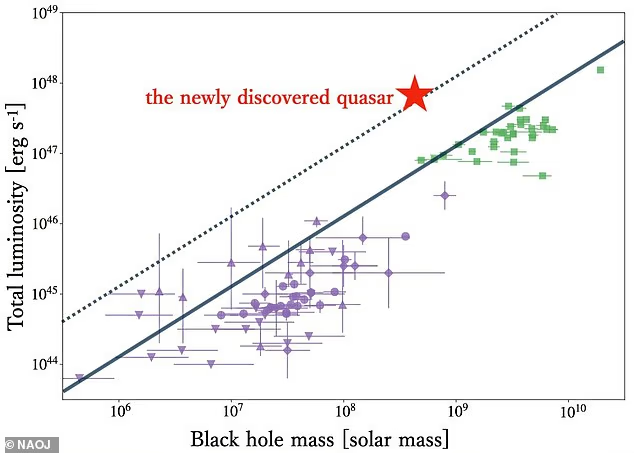
This means it was growing at an unimaginably fast rate, they said, absorbing gas and dust quicker than it was believed possible.
According to theory, there should be a limit on how fast black holes can grow because the act of ‘ingesting’ matter creates an opposing force which prevents more matter from being absorbed.
But this cosmic giant, known as ID830, is defying expectations – and could mark the discovery of the fastest–growing supermassive black hole of a similar mass found to date.
Researchers suggest the black hole may have ‘collided’ with a star or clump of gas, giving it enough energy for this remarkable growth spurt.
‘This discovery may bring us closer to understanding how supermassive black holes formed so quickly in the early universe,’ lead author Sakiko Obuchi said.
A graph displaying ID830’s uniquely brilliant luminosity, compared to previously observed objects. The solid line shows the upper ‘limit’ of how it should be growing

An artist’s impression of a supermassive black hole. Gas accretes onto the central black hole, forming an accretion disk and jets
The team, from Waseda University and Tohoku University in Japan, used the Subaru Telescope to analyse the black hole.
What makes this one even more striking is its multiwavelength behaviour, the researchers, who published their findings in The Astrophysical Journal, said.
When black holes undergo growth spurts, most models predict that their structure changes in ways that can reduce X–ray emissions and that their plasma and radiation jets may be less obvious.
However, this particular black hole shines brightly in both X–rays and radio wavelength.
This unexpected combination suggests scientists still have more to learn about the mechanisms of early black hole growth, the team said.
‘Going forward, we hope to explore the mechanisms of X–ray and radio wave emission from this quasar and determine whether there are any similar objects yet to be discovered,’ Dr Obuchi said.
They suggest they may have observed the black hole during a short transitional period, possibly following a sudden influx of gas.
This could prompt both the X–ray–emitting corona and the radio jet to become highly energised before the system gradually settles into a more typical mode of growth.
In a press release from the universities, the researchers said: ‘Data from the Subaru Telescope show a surprising mix of traits.
‘The quasar is pulling in matter at an exceptionally high rate while also emitting intense X–rays and launching a strong radio jet.
‘Many existing theories suggest these features should not appear together, making this object a rare and revealing find.
‘The observations provide fresh insight into how supermassive black holes may have grown so quickly in the Universe’s early days.’