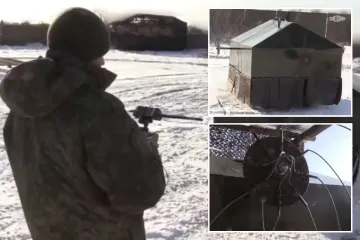
FOUR years after Russia unleashed its full-scale invasion of Ukraine, the first 20 miles of the frontline have turned into a haunted strip of earth where neither infantry nor tanks dare to linger.
Between the abandoned dugouts, a killing zone lies – so exposed and so relentlessly watched that only machines now move with any regularity.
Soldiers call it “no man’s land”. This is where Ukrainian forces hunt for the enemy using drones – the ever-changing technology that has reshaped the geometry of the war.
Patrick Shepherd from defence technology firm Milrem Robotics told The Sun: “They have changed the world – like gunpowder, it is never going back in the bottle.
“It is so cheap, effective and real. The genie is out of the bottle. The way we do everything in the future is going to change.”
Ivan Stupak, a military expert and ex-officer in Ukraine’s security services (SBU), told The Sun that as of 2026, drones are responsible for around 70 percent of all injuries along parts of the front.
“Unfortunately, this is on both sides of the frontline – Russia and Ukraine,” he said.
For Ukrainian and Russian infantries, drones are their guardian – but also executioner. The weapons have long been dubbed the silent killers of the sky and some are known as the “sky’s assassins” – such as America’s MQ-9 Reaper.
In Ukraine, they deliver ammunition and aid to cut-off positions, scout trenches and evacuate the wounded by guiding rescue teams through minefields. But they also stalk, circle, and strike.
Lurking in between trees, these assassins chase armoured vehicles down dirt roads and blow up entire squads.
What began in 2022 as an improvised Ukrainian innovation is now one of the biggest reasons behind Ukraine’s success in bringing Russia to a sort of a stalemate in some regions.
There are models for reconnaissance, rescue, interception and attack, all of which are cheap and expandable compared with the alternatives.
What is even more impressive is the pace with which both the Ukrainian army and foreign contractors have managed to Mad Max them.
Stupak explained: “At first, Ukraine used small drones for reconnaissance, to scout around Ukrainian positions – only 100 or so metres.
“Then, we asked ourselves the question, ‘What if we attach a grenade on this drone’?
“Then, it was about size, so came the Baba Yaga or the Vampire [large 3D-printed, Ukrainian-made octocopter or hexacopter systems used as heavy night bombers].
“It could carry up to 10 explosive materials to be dropped on the Russian infantry. So really, it was a great advantage.
“But the most advanced are first-person-view (FPV) drones, loaded with explosives of up to 3kg. It is not enough to destroy a tank, but it is enough to stop it, and it costs much less.”
At the start of the war on February 24, 2022, Ukraine was heavily reliant on Western military aid as the country fought for survival – so the combat featured “ammunition, tanks, soldiers in trenches.”
“After the first year, there were a lot of changes,” the military expert said.
“Now, the war does not resemble what we saw in Afghanistan or Iraq, or Chechnya.”
Stupak has done the maths, and so has the Ukrainian army. A Russian T-90 battle tank costs a reported $5million. An FPV averages at about $500.
Operation Spiderweb, carried out last June, is a visual guide to Ukraine’s successes, where drones are at the heart of the execution.
After 18 months of preparations, 117 Ukrainian drones struck multiple air bases deep inside Russia, destroying billions of dollars worth of stationed aircraft.
Stupak added: “Spiderweb was conducted using FPV drones far beyond enemy lines. It was a red line that Ukraine crossed.
“This was a really successful as up to 40 percent of all Russian strategic aircraft were destroyed or heavily damaged.”
Before 2022, drones had been used in Azerbaijan’s war in Armenia, and by militant groups like Yemen’s Houthis and Lebanon’s Hezbollah.
But Ukrainian forces have pioneered the use of combat drones on the front, and have also led the way at sea, with naval drones sinking multiple Russian ships and forcing Putin to withdraw the bulk of his fleet from the occupied Crimean peninsula.
Long-range drones also routinely strike military targets and oil depots on Russian soil, hundreds of miles away from the frontline.
As Russia steadily catches up with Ukrainian innovations, with the help of its allies in Iran and China, Ukraine is having to develop its tech further.
Whether it is prolonging the life of the drones’ battery, or extending the signal from 20km to 45km, or installing software that helps it withstand Russian electronic jamming, it all matters on the battlefield.
The only requirement is that the job is done at lightning speed. This is where start-ups have really rallied.
Out of necessity, they have become accustomed to upgrading individual drone models and counter-drone systems within weeks.
Lithuanian drone innovator Granta Autonomy is one of the manufacturers that is working around the clock to boost Ukrainian defences.
Today, the army uses their latest innovation, the X-Wing loitering munition, as well as FPV quadcopters and Hornet XR reconnaissance drones, which are funded by Lithuanian and other European defence ministries.
For their CEO, Gediminas Guoba, this is personal.
He told The Sun: “We have been working in Ukraine from the very start, so from 2014.
“We are based in Lithuania – the eastern flank – so we understand that our country can be next.
“I was born in the Soviet Union, I know what it means and I don’t want to go back to it. This is my motivation.”
Demand for their systems has skyrocketed as Russia got its hands on interceptors and counter-drones.
Guoba said: “We are developing new systems with better cameras and navigation. We always keep improving because we see a high demand in the battlefield.
“Our mission is to replace humans – our soldiers – in the battlefield with robots, with drones.”
Shepherd, from Milrem Robotics, which makes autonomous unmanned ground vehicles (UGVs), said the war in Ukraine has “fundamentally changed” in the past four years.
He said: “We got to Ukraine in 2022. We showed up with these UGVs and everyone’s like, ‘Oh yeah, those are cool and nice to have.’
“In 2022 it was more about tanks, artillery shells. It was infantry fighting in the open. Today the conflict is completely different.
“Big expensive tanks are no longer in the fight because the threat of FPVs is so significant. The cost per kill ratio is thousands in their favour.”
Now, UGVs have gone from being “nice to have” to being critical elements, and he revealed that there has been a thousandfold adoption rate.
Robotic systems are clearly in demand. For Shepherd, his own product is not a realistic alternative to boots on the ground.
Other experts say the vehicles could help ease pressure on infantry as Ukraine struggles with ongoing recruitment problems and losses.
UGVs serve as essential, remotely operated robotic systems focused on logistics, casualty evacuation, and combat, reducing risk to troops in high-danger zones.
Missions that Milrem Robotics is part of involve moving cargo for brigades, evacuations of wounded soldiers and direct fire.
Some of their vehicles are able to carry up to 1,000kg.
Shepherd added: “[The army] cannot lose one or two or three soldiers on moving supplies or ammunition, and so with the FPV threat, they have had to change tactics.
“The only way you can operate in that environment is using unmanned systems.
“Using our UGVs is basically the last line of defence because it is localised and mobile, it is within one or two kilometres of the critical targets.”
Like with soldiers, the main enemy of unmanned vehicles on the frontline is FPVs.
The moment UGVs move inside the “no man’s land”, FPVs start targeting them. Artillery shells and mortars follow shortly after.
With the face of the war changing, the entire mosaic of defence will have to develop, experts say.
One of the lessons from the war is that armies cannot continue deploying missiles worth up to $3million to shoot down $500,000 Shahed drones.
Looking at the future, Shepherd added that the tech industry is going to have to come up with a way of doing “lower cost air defence”.
“It’s a cost per kill ratio, right? If you’re using a $1 million missile to knock down a $500,000 drone, the cost per kill is still in the [enemy’s] favour,” he added.
Ukraine is not alone in investing in the unmanned vehicles industry amid the threat from Russia.
Milrem Robotics is working with the governments of Estonia and Finland as they are “getting themselves lined up and ready” for what is to come next.
Speculation about the Russian president’s next target in Europe has been ongoing for years, with experts pointing to Moldova, Georgia or even one of the Baltic nations.
Two days before the fourth anniversary of Russia’s invasion, explosions rocked Kyiv early on Sunday with officials warning of a ballistic missile attack.
Kyiv Mayor Vitali Klitschko said two wounded people, a woman and a child, were rushed to hospitals from the suburbs.
The Ukrainian capital, regularly targeted by missile and drone attacks since the start of the invasion, has faced waves of overnight strikes in recent weeks as Moscow has intensified its winter assaults on energy and military infrastructure.
It came hours after blasts in Lviv – a western city near the Polish border that rarely sees deadly attacks.
Explosions ripped through a shopping street at around midnight, killing a policewoman and injuring 15 people after officers responded to a reported break-in.
Mayor Andriy Sadovyi said: “This is clearly an act of terrorism.”
Bill Browder, leading business campaigner, who has been dubbed Putin’s “number one enemy”, described the ongoing invasion as a “complete disaster and catastrophe” both for Russia and Ukraine.
He said: “For Russia… its military is corrupt, inept and basically suicidal for anybody who’s a part of it.
“It’s a frozen conflict in the sense that Russia is not making any significant territorial gains.
“I don’t believe it’s going to end,” he said about the war in Ukraine. “The reason why it’s not going to end is because Putin has to be at war for his own personal and political survival.
“It’s a very unpleasant situation for the average Russian. And it’s certainly, of course, extremely unpleasant for the Ukrainians who are bearing the brunt of this psychotic madman.
“He’s really in a whole different category by himself in terms of the evil that he’s able to inflict on his enemies, his neighbours and his own people.”