Your consciousness can connect you with the entire universe, a groundbreaking study suggests.
Experts from Wellesley College in Massachusetts claim that traditional connections in the brain cannot fully explain how we are aware of our existence.
Instead, they argue that quantum physics taking place within our skull is what generates awareness.
This includes the idea that particles can exist in multiple states and locations at the same time.
As a result, our consciousness can hypothetically connect with consciousness across the world and even the universe, they argue.
And it could turn traditional theories, that have persisted for decades, on their head.
‘When it becomes accepted that the mind is a quantum phenomenon, we will have entered a new era in our understanding of what we are,’ said Professor Mike Wiest, an author of the study.
A quantum understanding of consciousness ‘gives us a world picture in which we can be connected to the universe in a more natural and holistic way’, he added.
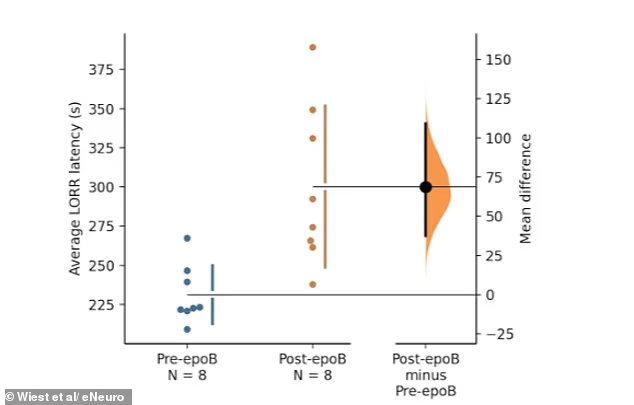
The researchers found that rats took longer to become unconscious when they were given a drug that attached to the microtubules in their brain
Researchers carried out a study to investigate how anaesthesia affects the brain.
They gave rats a drug that attached to tiny neural structures called microtubules, and then exposed the animals to an anaesthetic gas.
They found that these rats took much longer to become unconscious than usual.
This suggests that the drug was blocking or interfering with how the anaesthesia normally works.
Since there isn’t an obvious explanation for how this happens, Professor Wiest believes the results support the idea that consciousness may involve quantum processes in the brain.
If this turns out to be correct, it could completely change our understanding of the phenomenon and strengthen the theory that consciousness is capable of being in all places at the same time.
A study, published in 2024, suggested that myelin – a fatty, insulating layer wrapped around nerve fibres in the brain – provides the ideal environment for quantum processes.
However, many scientists scorn the idea – as quantum effects have so far only been produced in the lab under extremely cold temperatures.

This table shows the average time it took each rat to fall unconscious before (blue) and after (nude) the drug was administered
Professor Wiest’s research, published in the journal eNeuro, concludes with the hope that there will soon be ‘conclusive experimental tests of the quantum consciousness hypothesis’.
Last week, a bombshell study claimed that consciousness exists beyond death and the process of dying should be a ‘negotiable condition’.
Traditionally, death has been defined as the irreversible loss of brain and circulatory function. But experts are beginning to challenge this view – arguing that consciousness can persist even when the brain stops working.
A researcher from Arizona State University carried out a large–scale review of dozens of studies that focused on what happens when people ‘die’.
This included publications on near–death experiences, research on the electrical brain activity of dying patients and clinical studies of conscious awareness during heart attacks.
Analysis revealed that across heart attack studies, 20 per cent of survivors recall conscious experiences during periods when the brain had stopped working.
Brain recordings in dying humans and animals document surges of activity surpassing baseline waking levels, they found.
Meanwhile some patients who have experienced ‘complete circulatory standstill’ – when the heart stops beating – later demonstrated implicit recall of what was going on around them.

Some experts argue that consciousness persists even after the heart has stopped beating. Pictured: A gamma surge following a heart attack
Laboratory work has also demonstrated that metabolism, brain activity and blood flow can be restored in mammal brains and organs ‘well beyond accepted limits’.
This reveals that ‘biological death is not immediately irreversible’, Anna Fowler, from Arizona State University, said.
‘Emerging evidence suggests that biological and neural functions do not cease abruptly,’ she told the American Association for the Advancement of Science (AAAS) conference in Phoenix, Arizona.
‘Instead, they decline from minutes to hours, suggesting that death unfolds as a process rather than an instantaneous event. Elements of consciousness may briefly exist beyond the measurable activity of the brain and death, long considered absolute, is instead a negotiable condition.’