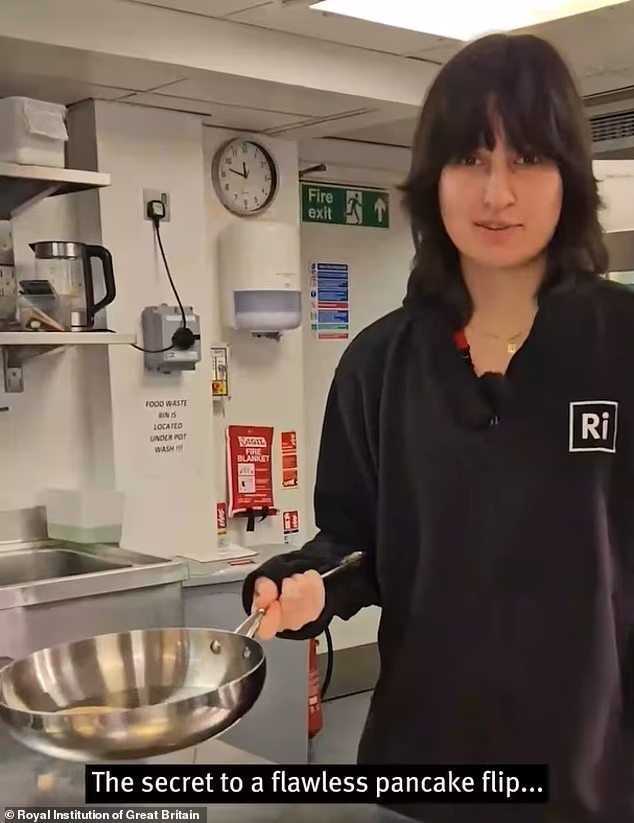
Physicists have revealed how to perfect your pancake flip this Shrove Tuesday – and it could help achieve picture–perfect creations.
While many people have no issues whipping up a pancake recipe, the toss is where it often goes wrong.
Many end up with a crumpled mess in the pan – or worse, a pancake on the floor.
Now, scientists from the Royal Institution of Great Britain have come up with a formula to ‘stick the landing’.
And it’s all to do with finding your pancake’s ‘pivot point’.
In a video shared online, they show how Newton’s laws of motion act on the pancake during a flip.
‘To get it to flip, linear force isn’t enough,’ one of their researchers said. ‘We need a pivot point.
‘For the pancake to flip, it must rotate. This comes from torque, which happens when the pan pushing slightly off the pancake’s centre of mass, giving it angular acceleration.’
Scientists from the Royal Institution of Great Britain have revealed how physics can help make the perfect pancake


She explains that for the pancake’s motion to change, a net force must act on it. This reflects Newton’s first law of motion, that an object at rest stays at rest, and an object in motion stays in motion
The pancake used in the video is a thicker, American–style version.
‘The secret to a flawless pancake flip is physics,’ their researcher says. ‘Put simply, at rest, there are only two forces acting on the pancake – gravity and the equal normal force from the pan.’
She explains that for the pancake’s motion to change, a net force must act on it.
This reflects Newton’s first law of motion, that an object at rest stays at rest, and an object in motion stays in motion.
‘Flicking the pan upward, we push the pancake with an upward net force and acceleration,’ she continues.
‘This demonstrates Newton’s second law. The upward net force causes an upward acceleration.’
Once the pancake is launched from the pan, it turns into a projectile with only gravity acting on it.
‘Depending on how it’s flipped, it will move differently,’ she said, explaining that a linear force – a straight line – isn’t enough.


You need to find your pancake’s ‘pivot point’ – the axis around which it rotates. The trick is using the pan to push slightly off the pancake’s centre of mass, giving it ‘angular acceleration’
Instead, you need to find your pancake’s ‘pivot point’ – the axis around which it rotates.
The trick is using the pan to push slightly off the pancake’s centre of mass, giving it ‘angular acceleration’.
‘The spinning remains almost constant once the pancake leaves the pan,’ she added. ‘The timing of the pancake in the air must be enough for it to do a half or full rotation for it to land flat.
‘And that’s how science sticks the landing.’
The pan used in the video is large with deep sides, suggesting that this could be beneficial to getting a decent flip.
While the demonstration involved a thicker pancake, the scientists added that the same physics applies to thinner pancakes like crepes too.
One commenter pointed out that the pancake is flipped ‘too far’ in the video, landing on the side it was already on.
But the Royal Institution replied: ‘It’s one of those situations where theory is 10/10 but practice…more like 5/10. At least it didn’t end up on the floor.’
Experts have previously revealed the scientific formula for the perfect pancake – including using 200ml of milk, 100g of flour, one or two eggs and a pinch of salt for a UK–style thin pancake.
If you want a more American–style pancake, Professor Ian Eames, a fluid mechanics expert from UCL, suggests 200ml of milk, 200g of flour, and two eggs.
He recommends whisking the batter with a fork and leaving it to rest for 10 to 15 minutes for a thin, crepe–like creation.
Finally, he suggests ditching the butter for vegetable oil to get a perfectly thin, crisp pancake.