It’s often described as the earth–shattering, toe–clenching peak of pleasure.
But the female orgasm actually comes in a range of weird and wonderful forms, according to a new study.
Scientists from Northwestern University surveyed more than 3,000 women about their physical and emotional symptoms during the ‘Big O’.
While muscle weakness and foot tingles might not be too surprising, other responses may raise a few eyebrows.
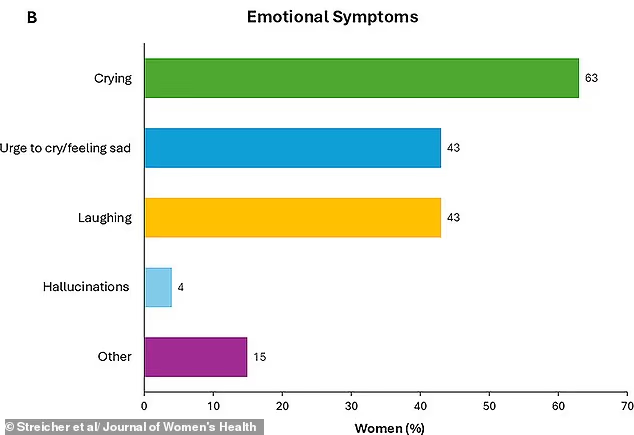
More than half of the women said they’d cried during an orgasm, while four per cent said they’d hallucinated at climax.
The researchers hope the findings will help to reassure women that their responses during orgasm are normal.
‘While there have been case reports of women laughing, crying or having unusual physical symptoms during orgasm, this is the first study to characterize what these phenomena are, and when they are most likely to occur,’ lead author Dr Lauren Streicher said.
‘Women need to know that if they have uncontrollable peals of laughter every time they orgasm, and nothing was funny, they are not alone.’
Crying, sadness and laughing were the top emotional symptoms experienced by women during orgasm, according to the study

If you dissolve into peals of laughter every time you orgasm, you’re not alone, the researchers said (file image)
For the study, published in the Journal of Women’s Health, the researchers asked 3,800 women to view a short video that explained peri–orgasmic phenomena – responses not usually associated with climax.
They were then asked to answer a survey about unusual physical or emotional symptoms and responses they had experienced during orgasm.
While the study found unusual reactions were rare – experienced by only 2.3 per cent of the sample – they were vast.
The most common physical symptoms included headaches, muscle weakness and foot pain.
Meanwhile, crying, sadness and laughing were the top emotional symptoms.
Some women said they kept sneezing after sex, while others couldn’t stop yawning and some had a nosebleed.
Some four per cent even revealed they had hallucinations after reaching a sexual crescendo.
‘Some people cry when they climax – not because the sex was bad or painful, but for no reason,’ Dr Streicher said.

The most common physical symptoms experienced by women included headache, muscle weakness and foot pain, the data revealed
‘Some people laugh hysterically when they have an orgasm, and nothing was funny.’
Of the women who said they experienced unusual symptoms during climax, 17 per cent said they experienced them consistently.
The majority of respondents said they only experienced them with partnered sexual activity, while nine per cent said they occurred after masturbation.
‘Peri–orgasmic phenomena encompass a wide range of physical and emotional symptoms,’ the researchers explained.
‘Although rarely reported, their awareness warrants further study to help reassure women that these phenomena are within the realm of a normal sexual response and to address their sexual health and well–being.
‘A better understanding of peri–orgasmic phenomena is of clinical significance as many individuals experiencing these symptoms may feel distressed, which could affect sexual satisfaction and potentially lead to anxiety or avoidance around sexual activities.
‘Clinicians informed about these phenomena could provide much–needed reassurance to patients experiencing these responses, helping patients recognize that these experiences, while unusual, may not indicate a medical or psychological disorder.’
Previous studies have indicated that moaning and groaning is no way to judge whether a women has had an orgasm.
Experts say the way the sexual crescendo is measured should be redefined – and ‘pleasurable satisfaction’ is the best way to quantify the feeling.
Scientists from the University of Ottawa asked more than 600 women aged 18 to 82 about their experiences of orgasm both in solitary and partnered contexts.
They included questions on both the Orgasm Rating Scale (ORS) and the Bodily Sensations of Orgasm Scale (BSOS) – both commonly used in the realms of scientific research into the sensation.
The women were asked the degree to which they experienced feelings of quivering, shuddering, loving, goosebumps, sweating, faster breathing and facial tingling – plus many more.
Results, published in the Journal of Sexual Medicine, revealed that across all ages ‘pleasurable satisfaction’ was reported as the most common ORS item.
Emotional intimacy and shooting sensations were the least common from the ORS scale.
Meanwhile genital sensations and spasms, plus sweating, were the most common items from the BSOS scale.
On the other hand, moaning was one of the least common – with the researchers even suggesting it should be removed from the scale entirely.