An incredible satellite image has revealed the sheer scale of New York’s winter storm.
At the end of January, New York experienced a week of bitterly cold weather, with at least 10 people killed.
Now, NASA has revealed what the frozen landscape looked like from space.
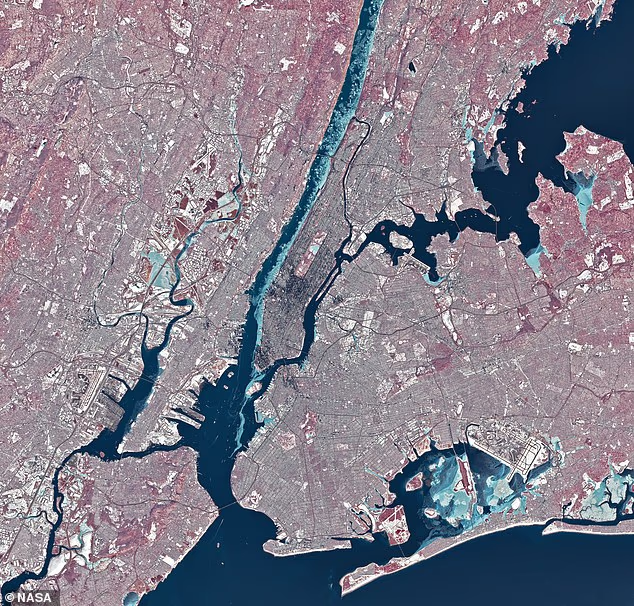
On January 28, the Landsat 8 satellite capture an overhead image of New York City and New Jersey, as temperatures hit a high of just 23°F (–5°C).
The photo shows large parts of the Hudson River, East River, and the Jacqueline Kennedy Onassis Reservoir frozen over.
‘Much of the ice in the image likely floated there from farther upriver, where tidal currents are weaker and salinity is lower,’ NASA explained.
‘These conditions allow water to freeze sooner and at higher temperatures than the faster–flowing, brackish water near the river’s mouth, shown here.
‘A complete freeze of the Hudson around Manhattan is unlikely, experts say, although it did occur back in 1888.’
At the end of January, New York experienced a week of bitterly cold weather, with at least 10 people killed. Now, NASA has revealed what the frozen landscape looked like from space

During the deep freeze, large parts of the Hudson River, East River, and the Jacqueline Kennedy Onassis Reservoir froze over
The Landsat 8 satellite launched in 2013, and is used by NASA to snap high–quality imagery of Earth from above.
At around midday on January 28, the satellite flew directly over New York City, snapping an incredible photo of the frozen city.
In the false–colour photo, ice can be seen in light blue, while vegetation appears red.
With large swathes of the Hudson River frozen, the NYC Ferry was forced to suspend services for several days.
However, NASA points out that iced–up rivers can have several other implications.
This includes flooding and infrastructure damage, and changes in hydrologic processes that affect water quality and aquatic habitats.
‘Scientists, government agencies, and emergency responders are increasingly turning to remote sensing technologies such as synthetic aperture radar and hyperspectral imaging to track river ice,’ the US space agency explained.
‘Improved monitoring can aid in water resource management and mitigate ice’s effects on infrastructure and ecosystems.’

At around midday on January 28, the satellite flew directly over New York City, snapping an incredible photo of the frozen city. In the false–colour photo, ice can be seen in light blue, while vegetation appears red

With large swathes of the Hudson River frozen, the NYC Ferry was forced to suspend services for several days
Beyond the river ice, the satellite photo reveals several other signs of the winter chill.
A fresh layer of snow can be seen coating the landscape, while the low angle of the midwinter sun caused the tall buildings in Midtown and Lower Manhattan to case long shadows.
‘In a neighboring borough on February 2, a shorter shadow was cast—this one by the weather–prognosticating groundhog known as Staten Island Chuck,’ NASA added.
‘Folklore holds that the sighting signals six more weeks of winter.
‘When compared with data from NOAA’s National Centers for Environmental Information, the New York rodent was deemed the most accurate of his peer weather “forecasters.”
‘This year, Chuck might be right, at least in the near term: the National Weather Service forecast called for below–average temperatures to persist, with Arctic air returning to the city by the weekend.’