Non-intrusive inspection technology finds hidden drugs, speeds up commerce, but agency struggles to meet congressional deadline
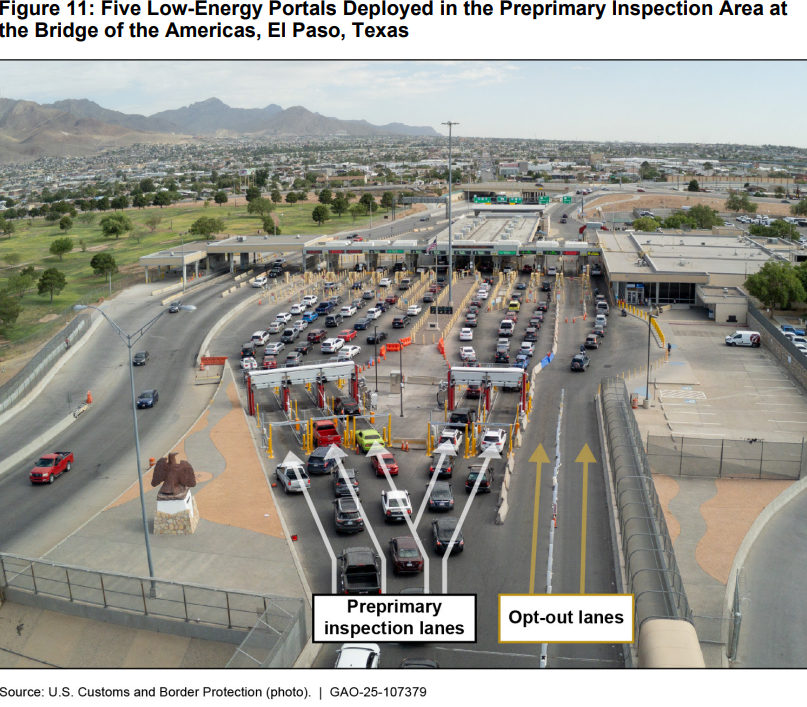
The low-level x-ray vehicle scanners at the Bridge of the Americas in El Paso.
EL PASO, Texas (Border Report) – It was five years ago that Congress passed a law requiring border officers to use cutting-edge technology to inspect every vehicle coming into the U.S.
The law came at a time 93,000 Americans were dying from drug overdoses, many involving deadly fentanyl pills smuggled at Southwest ports of entry. Federal officials submitted a plan to put in place the required non-intrusive inspection portals by 2027.
“As cartels and other smuggling organizations develop more sophisticated means of concealing drugs and contraband, the government must adapt to stay ahead of these evolving threats. The expansion of the NII program will play a critical role in that effort,” said U.S. Rep. Michael Guest, R-Mississippi.
But at a recent hearing of the U.S. House Homeland Security subcommittee headed by Guest, it became clear the goal will not be met by 2027.
The problem with installing non-intrusive inspection systems at every border crossing is money, space constraints and plans that did not include nine of the biggest land ports to begin with, said Hilary Benedict, acting director of the Government Accountability Office, or GAO.
“These nine crossings together account for 40 percent of passenger vehicle crossings at the Southwest border,” Benedict told members of the Subcommittee on Border Security and Enforcement.

Three – San Ysidro and Otay Mesa in California and Nogales in Arizona – as of last September hadn’t found room to accommodate the additional X-ray portals (they already have some in secondary and commercial inspection areas) to look for hidden compartments in cars and contraband in cargo trucks, she said.
Space and other challenges also exist at the Gateway to the Americas Bridge in Laredo; B&M and Gateway International bridges in Brownsville, Texas; the Lukeville and Naco crossings in Arizona; and at the Andrade port in California.
Ports of entry, as in the case of San Ysidro, California, and El Paso, Texas, for instance, are surrounded by long-established commercial properties. Port expansion would be difficult.
Cost issues are another obstacle.
“CBP developed cost estimates, but costs have exceeded estimates” because of the space challenges and the exclusion of the nine ports from the planning, Benedict said.
Other delays have to do with government contractors taking longer than anticipated to install the X-ray machines, in part because of static interference from other CBP monitoring and inspection devices at the port.
CBP told Congress it would deploy 435 of the portals but as of last September had acquired 153 and of those 52 were working, according to GAO.

The agency may not have achieved that 100 percent non-intrusive inspection goal, but it has made measurable progress, CBP Acting Executive Assistant Commissioner Diana Sabatino told the subcommittee.
Currently, 1 in 8 passenger vehicles and 37 percent of trucks are getting NII scans; 400 units including hand-held and mobile scanners are in use at ports of entry; and 89 fixed systems are operational with 44 in “active planning,” she said.
Hand-held scanners could be used at the nine ports of entry where it’s difficult to install fixed portals, she said.

“The effectiveness of CBP’s non-intrusive inspection systems is clear. In (2025), CBP officers used NII systems to scan over 17 million vehicles, rail cars and sea containers resulting in the interdiction of 110,000 pounds of narcotics, $2.2 million in unreported currency and the apprehension” of undeclared passengers, Sabatino said.
The 55 tons of illegal drugs accounted for 70 percent of all illegal drugs seized at the border.
The immediate goal is to inspect 2 out of 5 passenger vehicles and 7 out of 10 commercial trucks by the end of fiscal year 2026, she added.
Some of the Democrats in the subcommittee suggested CBP could seize even more drugs and keep more “bad actors” from coming into the country if those officers now deployed to assist Immigration and Customs Enforcement (ICE) returned to their jobs at ports of entry.