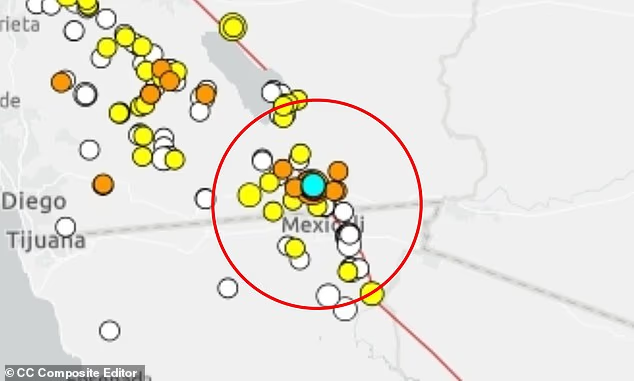
At least 40 earthquakes have shaken Southern California since Wednesday morning, with the largest reaching a magnitude of 4.4.
The US Geological Survey recorded the first quake near Holtville at 1:40am PT on Wednesday, with the most recent detected on Thursday morning.
Hundreds of California residents have issued reports of shaking to the USGS, and shockwaves were also recorded in Arizona and Mexico.
Magnitudes ranged from 1.1 to 4.4, with smaller quakes often unnoticed by residents.
According to Michigan Tech University, quakes under 2.5 are rarely felt, while those between 2.5 and 5.4 can be felt and sometimes cause minor damage.
While swarms of this size are typically harmless, seismologists say they can indicate shifting stress along major faults that could precede a larger earthquake.
Holtville sits in a very active seismic zone in Imperial County, part of the Salton Trough, a slowly spreading rift valley that produces frequent small-to-moderate earthquakes as the crust fractures under tectonic stress.
The epicenter sits within a complex region of fault lines related to the main San Andreas, which scientists have warned is poised for a 7.9 magnitude or higher quake.
At least 40 earthquakes have shaken Southern California since Wednesday morning, with the largest reaching a magnitude of 4.4
Holtville, located about 130 miles east of San Diego, is a small town home to around 6,500 people.
The region frequently experiences small-to-moderate earthquakes, often occurring in swarms, as the crust stretches and fractures under tectonic stress.
While most quakes are minor and go unnoticed, the area has a history of stronger seismic events, including shocks that have reached magnitude 6 and above, reminding scientists that the region is capable of producing major earthquakes in the future.
Holtville and the surrounding Imperial Valley have a history of significant earthquakes. In 1940, a magnitude 6.9 quake struck the region, causing widespread damage and drawing attention to the area’s complex fault systems.
The 1979 Imperial Valley earthquake, measuring 6.4, was felt across Southern California and led to improvements in earthquake engineering and early warning systems.
The Salton Trough is a long, low-lying desert basin in southeastern California that extends into northern Mexico.
It forms part of a larger geological feature known as the Baja California Rift Zone, which connects the San Andreas Fault system in the north with spreading zones in the Gulf of California to the south.
Holtville sits squarely within this rift, making it one of the most seismically active areas in Southern California.

Hundreds of California residents have issued reports of shaking to the USGS, and shockwaves were also recorded in Arizonaand Mexico
Geologists describe the Salton Trough as a young, actively stretching rift valley, meaning the Earth’s crust in the region is slowly pulling apart.
This process occurs because the Pacific Plate is sliding northwestward relative to the North American Plate along the San Andreas system, while simultaneously, the crust in the Salton Trough is being stretched and thinned.
As the land pulls apart, it fractures along numerous faults, including the Imperial Fault and smaller subsidiary faults, producing frequent earthquakes of varying magnitudes.
The rifting also explains why the area experiences earthquake swarms rather than isolated events.
Instead of one single fault releasing energy, stress is distributed across multiple faults.
Small to moderate earthquakes occur as the crust adjusts, a process that can last hours, days or even weeks.
While most of these quakes are minor, scientists warn that the same tectonic forces have the potential to trigger larger, more damaging earthquakes, especially along connected faults like the San Andreas.