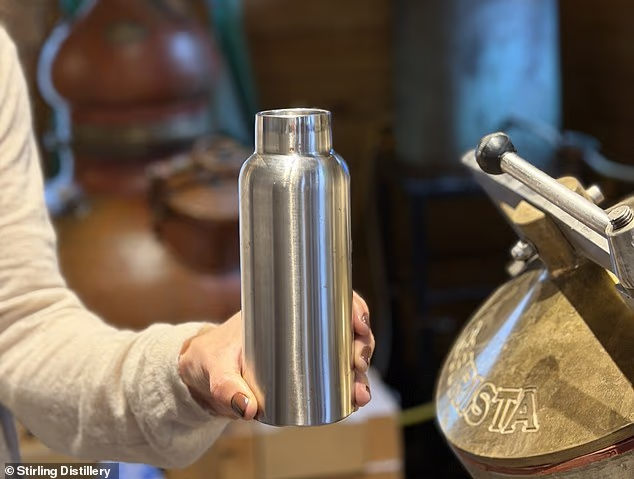
A Scottish distillery has announced controversial plans to store its whisky in aluminium bottles.
Stirling Distillery, one of the country’s smallest whisky makers, says that the metal bottles are better for the environment than traditional glass.
Working with scientists from Heriot-Watt University, the distillery has investigated how whisky behaves and reacts to aluminium containers.
Their study found that participants were unable to taste any difference between a single malt whisky stored in aluminium compared with one kept in a traditional bottle.
However, it could still be a while before you see metal whisky bottles on the shelves.
The scientists found that aluminium reacts with the whisky, changing the chemical profile and leaching into the spirit over time.
These whisky samples were also found to have aluminium levels ‘well above what would be considered acceptable for drinking water’.
Professor Annie Hill, of Heriot-Watt University, says: ‘The next stage of this research would be to find a liner that can withstand high alcohol levels for a prolonged period of time without degrading.’
A Scottish distillery has made the controversial announcement that it will store its whisky in aluminium bottles rather than the traditional glass alternative

Stirling Distillery, one of the country’s smallest whisky makers, says that the metal bottles are better for the environment than traditional glass

Stirling Distillery, one of the country’s smallest whisky makers, says that the metal bottles are better for the environment than traditional glass alternatives
Although a heavy glass bottle is synonymous with the whisky’s luxurious appearance, it isn’t the best option for the environment.
Producing glass requires heating sand to extremely high temperatures, using large amounts of energy and creating a high carbon footprint.
Around the world, the container and flat-glass industries emit over 60 megatonnes of CO2 per year, according to the International Energy Agency.
Likewise, although glass is technically infinitely recyclable, huge amounts of glass are wasted in this process, sent to landfill, or converted into industrial materials.
The UK produces 2.3 million tonnes of glass waste each year, of which just 750,000 tonnes is used to make new containers.
More importantly, glass bottles are significantly heavier and bulkier than aluminium alternatives.
While this might give your bottle a satisfying heft, it drastically increases the environmental cost of shipping whisky around the world.
British gin-makers Penrhos found that, by switching to aluminium bottles, the company could ship more than twice as many bottles in the same volume.

Traditional glass bottles are considered the prestigious choice for whiskey since they do not disturb the flavour, but aluminium may be better for the environment

Aluminium is more widely recycled than glass and is significantly lighter, which gives recycled aluminium a much lower carbon footprint than glass
According to Penrhos, changing to aluminium led to a 91 per cent reduction in carbon emissions.
Kathryn Holm from Stirling Distillery says that these same environmental considerations prompted the team to investigate aluminium as an option for whisky.
She says: ‘We want to make our distillery as sustainable as possible ahead of our first mature whisky being released in 2027.
‘We are not suggesting glass disappears tomorrow. But offering customers a lower carbon option for a premium product is something worth exploring.’
In a series of scientific investigations, researchers placed samples of Stirling Distillery’s whisky in glass and aluminium containers.
These samples were then compared by a panel of taste testers and with an array of chemical tests.
In taste tests, participants weren’t able to detect any differences between the two bottles besides a very slight change in some of the ‘fruity’ notes.
However, at the chemical level, there were some more concerning differences.

British gin-makers Penrhos found that it could reduce its carbon footprint by 91 per cent simply by introducing aluminium bottles instead of glass
Dr Dave Ellis, of Heriot-Watt University, says: ‘We know that certain organic acids naturally present in matured whisky can react with aluminium, which can lead to aluminium entering the liquid.
‘If we stir samples with aluminium metal, the levels were well above what would be considered acceptable for drinking water.’
Likewise, compounds that are produced as whisky ages, such as gallic acid, were reduced or entirely removed following prolonged exposure to the whisky.
But neither the researchers nor Stirling Distillery believe that this is the end of the road for aluminium whisky bottles.
Aluminium is widely used for foods, beers, wines, and even some other spirits without any safety or flavour issues.
This is because all of these containers include some form of lining that protects the contents from direct contact with the metal.
Professor Hill adds: ‘Any innovation has to respect the craft of whisky making while meeting the highest standards of safety. In this case, the liner within the can wasn’t sufficient to prevent aluminium from passing into the spirit.
‘The changes detected in the laboratory didn’t translate into differences in aroma. That’s great news – if we can find an effective liner.’