A poor night’s sleep means a bleary–eyed next day, but it could also shed light on diseases that will strike years down the road.
Scientists have developed a new artificial intelligence program that can predict your risk of dementia, heart attack, stroke and cancer from a single night of sleep data – years before diagnosis.
The model, called SleepFM, was trained on 585,000 hours of sleep data collected from 65,000 participants.
The data comes from a sleep assessment called polysomnography – a study that records brain waves, eye movements, muscle activity, heart rhythm, breathing and oxygen levels.
The team, from Stanford University, compared the polysomnography data to electronic health records, some of which spanned 25 years.
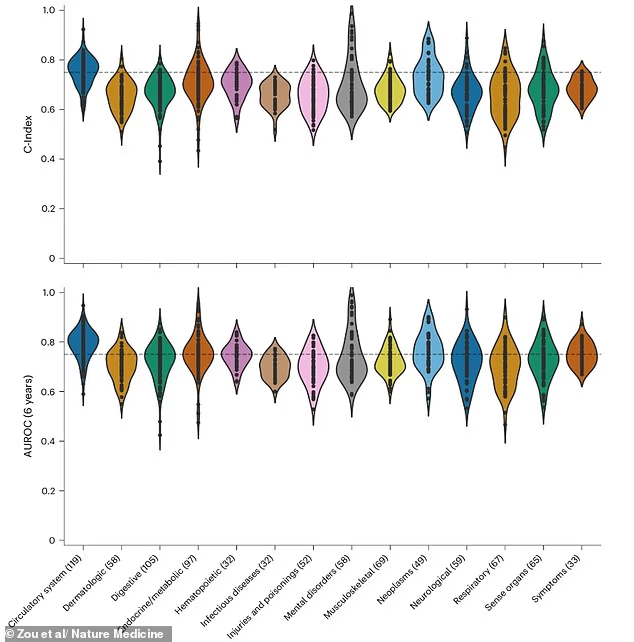
They discovered 130 different diseases could be predicted with reasonable accuracy by a patient’s sleep data.
The model’s predictions were particularly strong for cancers, pregnancy complications, circulatory conditions and mental disorders.
‘SleepFM is essentially learning the language of sleep,’ author James Zou said. ‘We were pleasantly surprised that for a pretty diverse set of conditions, the model is able to make informative predictions.’
The researchers discovered 130 different diseases could be predicted with reasonable accuracy by a patient’s sleep data

The data comes from a sleep assessment called polysomnography – a study that records brain waves, eye movements, muscle activity, heart rhythm, breathing and oxygen levels
The program works by giving a number called a C–index to each disease category.
‘For all possible pairs of individuals, the model gives a ranking of who’s more likely to experience an event – a heart attack, for instance – earlier,’ Dr Zou said.
‘A C–index of 0.8 means that 80 per cent of the time, the model’s prediction is concordant with what actually happened.’
SleepFM was found to be 89 per cent accurate at predicting Parkinson’s disease, 85 per cent accurate at predicting dementia and 81 per cent accurate at predicting a heart attack.
It could also predict breast and prostate cancer with an accuracy of 87 and 89 per cent respectively, and was even 84 per cent accurate at predicting the risk of death.
Although current sleep studies require specialised clinical equipment, the team said their findings suggest polysomnography may eventually become a powerful early detection tool.
The team also discovered that even though heart signals proved most informative for circulatory diseases, brain activity signals better captured mental and neurological conditions and breathing signals were bet for predicting respiratory disorders, it was a combination of all signal types that produced the best overall scores.
‘One of the technical advances that we made in this work is to figure out how to harmonise all these different data modalities so they can come together to learn the same language,’ Dr Zou said.

A poor night’s sleep means a bleary–eyed next day, but it could also shed light on diseases that will strike years down the road, the team said (file image)
They are working on ways to further improve the AI’s predictions – perhaps by adding data from wearables such as an Apple watch.
Writing in the journal Nature Medicine, the researchers wrote: ‘Sleep is a fundamental biological process with broad implications for physical and mental health, yet its complex relationship with disease remains poorly understood.
‘From one night of sleep, SleepFM accurately predicts 130 conditions with a C–Index of at least 0.75.
‘This work shows that foundation models can learn the language of sleep from multimodal sleep recordings, enabling scalable, label–efficient analysis and disease prediction.’