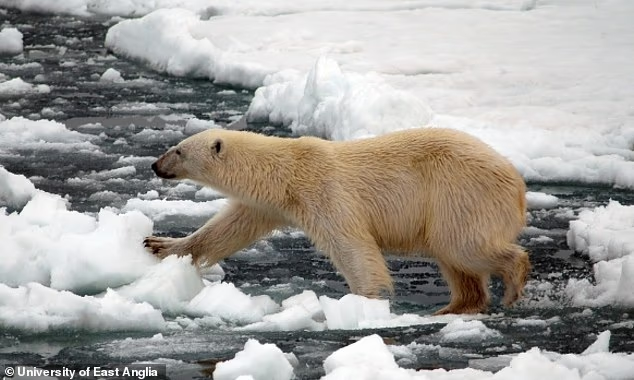
Climate change is triggering genetic changes in polar bears in the North Atlantic, a new study reveals.
Scientists have discovered a strong link between rising temperatures in southeast Greenland and changes in polar bear DNA.
These genetic changes are potentially allowing them to better adapt to higher temperatures caused by global warming.
Study author Dr Alice Godden, environmental scientist at the University of East Anglia, said the finding offers some ‘hope’ for polar bears, but efforts to limit global temperature increases must continue.
‘We still need to be doing everything we can to reduce global carbon emissions and slow temperature increases,’ she said.
Scientists think more than two-thirds of polar bears will be extinct by 2050 with total extinction predicted by the end of this century.
The Arctic Ocean is also at its warmest with temperatures continuing to rise, reducing vital sea ice platforms that the bears use to hunt seals.
This can lead to isolation, food scarcity and, ultimately, starvation.
The loss of ice is a substantial problem for the polar bears, as this reduces the availability of hunting platforms to catch seals

The study analysed blood samples taken from polar bears in northeastern and southeastern Greenland to compare the activity of so-called ‘jumping genes’. Pictured, the locations of polar bears in the northeast (blue) and the warmer southeast (red)
The study analysed blood samples taken from polar bears in two locations in Greenland – one in the northeast and one in the southeast.
This allowed them to compare the activity of ‘jumping genes’ – DNA sequences that move from one location on the genome to another.
This movement can alter or switch genes on or off, which can lead to changes in an organism’s traits – although they can also create harmful genetic mutations.
‘Jumping genes are RNA molecules that don’t stay still,’ Dr Godden told the Daily Mail.
‘They copy themselves and jump around freely, and they are more likely to do this when the animal is, in this case, very hot or starving.
‘It is possible there could be harmful mutations as a result of jumping gene activity.
‘However it is likely that these would be repaired by the cells, and not passed onto future bears.’
The researchers knew that temperatures in the northeast location were colder and less variable than the southeast, a significantly warmer, less-icy environment.

Over two-thirds of polar bears will be extinct by 2050 with total extinction predicted by the end of this century, scientists predict
As expected, jumping gene activity was higher for bears in the southeast – correlating with higher temperatures at that location.
It seems polar bears in the southeast are naturally adapting to survive in increasingly challenging environments where temperatures are higher and ice cover is fragmented.
Some genes linked to heat-stress, ageing and metabolism were found to be behaving differently in the southeast population of polar bears.
Changes were also found in gene expression areas of DNA linked to fat processing, which is important for the mammals when food is scarce.
It could mean the southeastern bears are slowly adapting to the rougher plant-based diets that can be found in the warmer regions, compared to the mainly fatty, seal-based diets of the northern populations.
‘Provided these polar bears can source enough food and breeding partners, this suggests they may potentially survive these new challenging climates,’ said Dr Godden in a piece for The Conversation.
But the fact southeast polar bears are adapting does not mean that they are at any less risk of extinction, according to Dr Godden.
Overall, the study provides further evidence that different groups of bears are having different sections of their DNA changed at different rates, which seems to be linked to their specific environment and climate.

Polar bears in regions of reduced sea ice habitat are at higher risk of pathogen exposure, according to the new study
Published in Mobile DNA, it is thought to mark the first time a statistically significant link has been found between rising temperatures and changing DNA in a wild mammal species.
Understanding these genetic changes is important for guiding future conservation efforts and analysis, and seeing which populations are most at risk.
It builds on work by experts at Washington University published three years ago which discovered that this south-eastern population of Greenland polar bears was genetically different to the north-eastern population.
South-east bears had migrated from the north and became isolated and separate approximately 200 years ago, it revealed.