Though November hurricanes are far less common, that doesn’t mean they don’t exist in the Atlantic basin. Hurricane season runs through Nov. 30 for a reason – treacherous storms can and have happened.
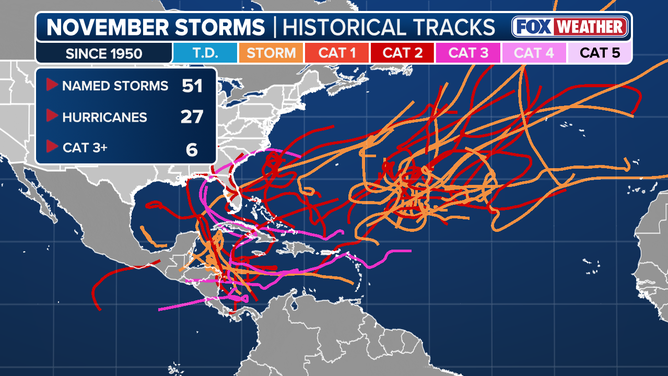
This graphic shows a history of November storms in the Atlantic basin since 1950.
(FOX Weather)
Since 1950, November has produced 51 named storms and 27 hurricanes, six of which strengthened into major hurricanes.
Hurricane Nicole’s November 2022 Florida Landfall
Hurricane Nicole made landfall in Vero Beach, Florida on Nov. 10, 2022 as a Category 1 hurricane, hitting the Sunshine State a little over a month after Hurricane Ian wreaked a path of destruction across the state.
Shortly after making landfall, Nicole was downgraded to a tropical storm as it began to weaken over the Florida Peninsula. It later weakened to a tropical depression over the southeastern U.S. on Thursday evening.
-
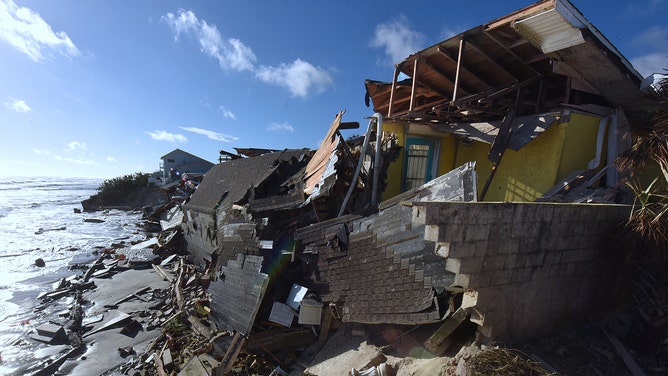
Sections of homes are seen collapsed onto the beach due to the storm surge and resulting erosion caused by Hurricane Nicole on November 11, 2022 in Wilbur-By-The-Sea, Florida.
(Paul Hennessy/Anadolu Agency) -

Nicole pounded the eastern coast of Florida with wind, rain and relentless waves. The storm made landfall as a Category 1 hurricane early Thursday morning near Vero Beach. The influx of water flooded coastal areas and ate away at beaches in the Daytona Beach area.
(Robert Ray) -
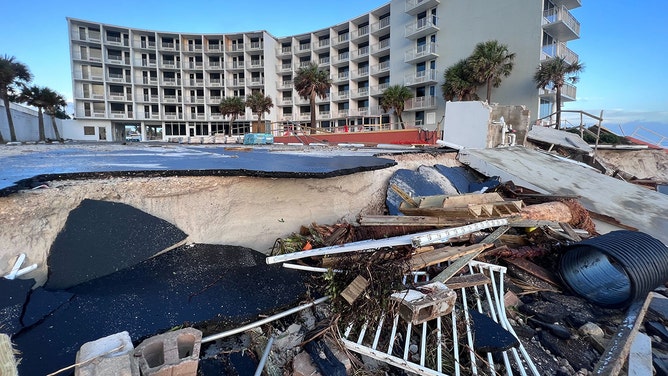
Nicole pounded the eastern coast of Florida with wind, rain and relentless waves. The storm made landfall as a Category 1 hurricane early Thursday morning near Vero Beach. The influx of water flooded coastal areas and ate away at beaches in the Daytona Beach area.
(Robert Ray) -
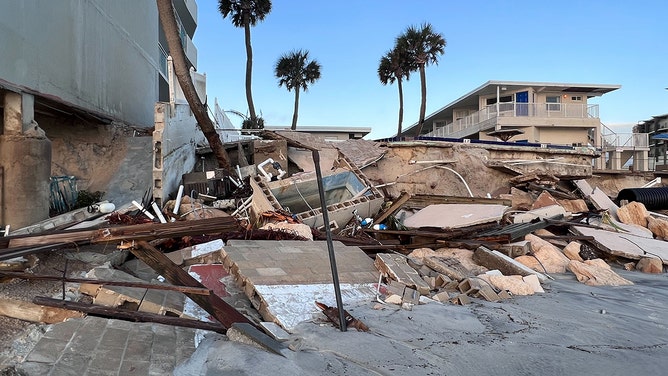
Nicole pounded the eastern coast of Florida with wind, rain and relentless waves. The storm made landfall as a Category 1 hurricane early Thursday morning near Vero Beach. The influx of water flooded coastal areas and ate away at beaches in the Daytona Beach area.
(Robert Ray) -
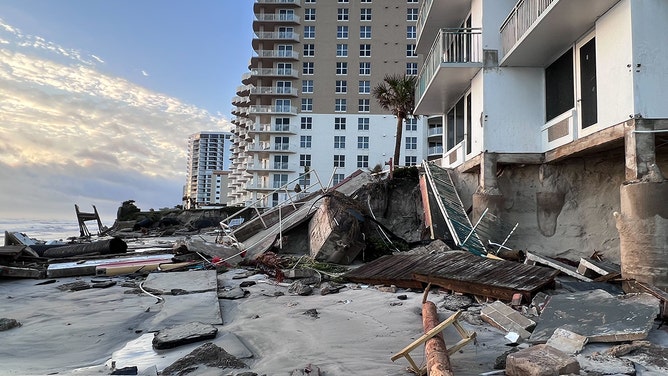
Nicole pounded the eastern coast of Florida with wind, rain and relentless waves. The storm made landfall as a Category 1 hurricane early Thursday morning near Vero Beach. The influx of water flooded coastal areas and ate away at beaches in the Daytona Beach area.
(Robert Ray) -
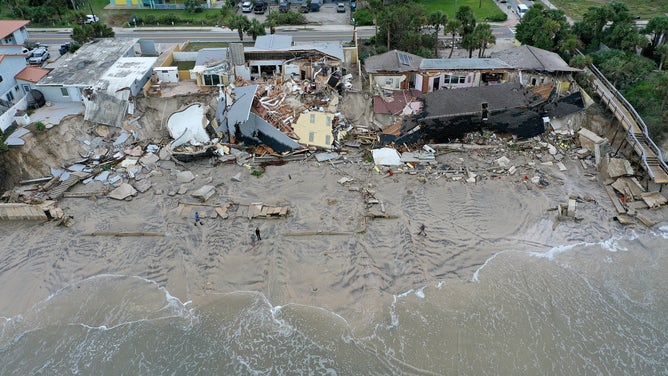
DAYTONA BEACH, FLORIDA – NOVEMBER 10: In this aerial view, homes are partially toppled onto the beach after Hurricane Nicole came ashore on November 10, 2022 in Daytona Beach, Florida. Nicole came ashore as a Category 1 hurricane before weakening to a tropical storm as it moved across the state. (Photo by Joe Raedle/Getty Images)
( ) -
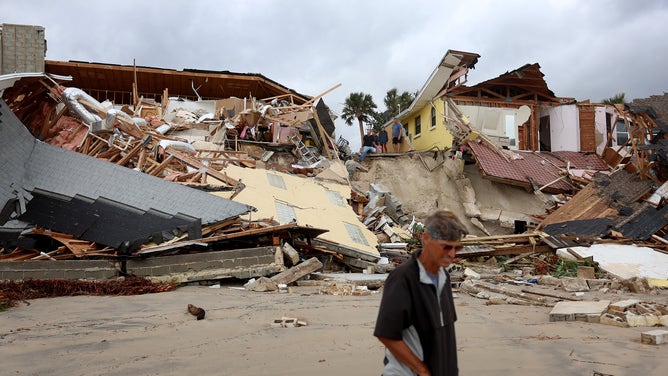
DAYTONA BEACH, FLORIDA – NOVEMBER 10: Homes are partially toppled onto the beach after Hurricane Nicole came ashore on November10, 2022 in Daytona Beach, Florida. Nicole came ashore as a Category 1 hurricane before weakening to a tropical storm as it moved across the state. (Photo by Joe Raedle/Getty Images)
( )
The Yankee hurricane of 1935 was the last time a hurricane made landfall in November along the east coast of Florida, and Hurricane Kate of 1985, which came ashore Nov. 21 along the Florida Panhandle, was the last November hurricane to make landfall anywhere in the U.S. before Nicole’s untimely arrival.
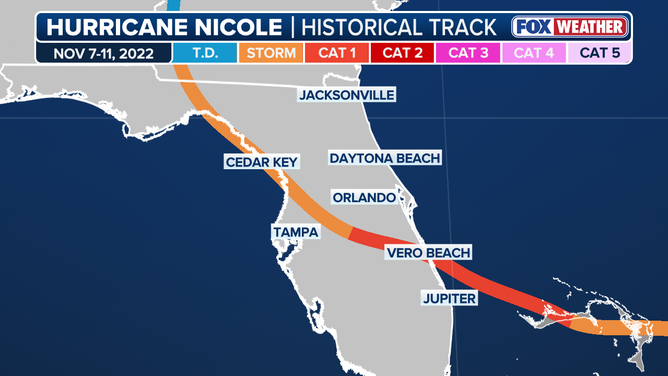
This graphic shows the historical track of Hurricane Nicole.
(FOX Weather)
Nicole brought major coastal flooding to Florida, and struck some of the areas that were ravaged by the stronger and more destructive Hurricane Ian.
Due to storm surge and beach erosion, although Hurricane Nicole was just a Category 1 storm, it caused extensive damage along Florida’s east coast, with an estimated $1 billion in damages attributed to the November hurricane.
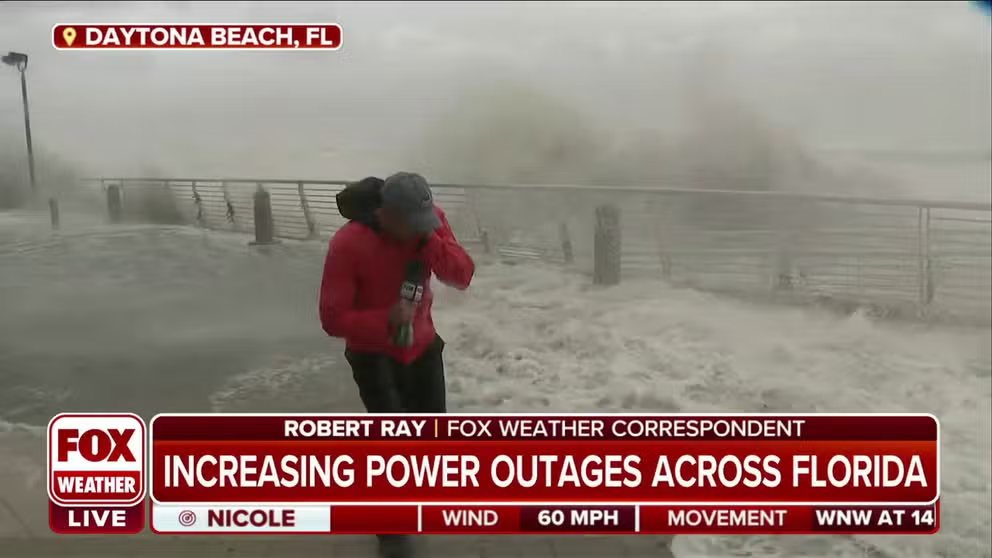
Nicole is unleashing vicious winds and dangerous storm surge along Daytona Beach. FOX Weather’s Robert Ray is feeling the impacts.
Although there were no direct deaths known from Hurricane Nicole, there are five indirect deaths attributed to the storm, according to the NHC.
Hurricanes Eta and Ioda: November 2020
On the tail end of an extremely active 2020 hurricane season, two late-season November hurricanes arrived in succession just two weeks apart and slammed Nicaragua.
Eta, the first of the devastating storms, made landfall as a Category 4 hurricane on the northeast Caribbean coast of Nicaragua near the city of Puerto Cabezas on Nov. 3, 2020.
HURRICANE MAKES HISTORY IN THE ATLANTIC IN 2025
Packing winds close to 140 mph at landfall, Hurricane Eta tore through Nicaragua and left a catastrophic path west across the Caribbean nation before eventually weakening into a destructive tropical depression over Honduras, according to the National Hurricane Center (NHC).
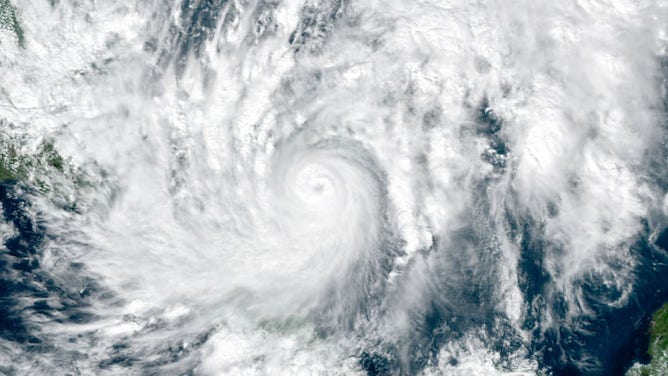
Residents of Nicaragua braced themselves for Hurricane Eta, which make landfall on the country’s northeastern Caribbean coast on November 3, 2020 as a Category 4 Hurricane.
(NASA / NASA)
On Nov. 12, Eta made landfall near Cedar Key, Florida as a tropical storm, bringing high winds, heavy rain and storm surge to both the east and west coasts of Florida.
Across the region, heavy rainfall associated with Eta caused catastrophic flash flooding, river flooding, and deadly landslides.
In the end, Hurricane Eta was responsible for at least 165 direct deaths and over 100 missing people in Central America and southern Mexico, according to the NHC. In the midst of the COVID-19 Pandemic, Hurricane Eta displaced an estimated 110,000 across Central America.
The catastrophic hurricane devastated a number of countries in Central America, including Nicaragua, Honduras, Guatemala, Mexico and Costa Rica.
A mere two weeks later, the communities that were just beginning to recover from the devastating effects of Hurricane Eta, were met with another nightmare. On Nov. 17, Hurricane Ioda made landfall near the village of Haulover, packing winds up to 140 mph.
Iota was the 30th named storm, the 13th hurricane, the 6th major hurricane, and the first Category-5 storm of the record-breaking 2020 Atlantic hurricane season.
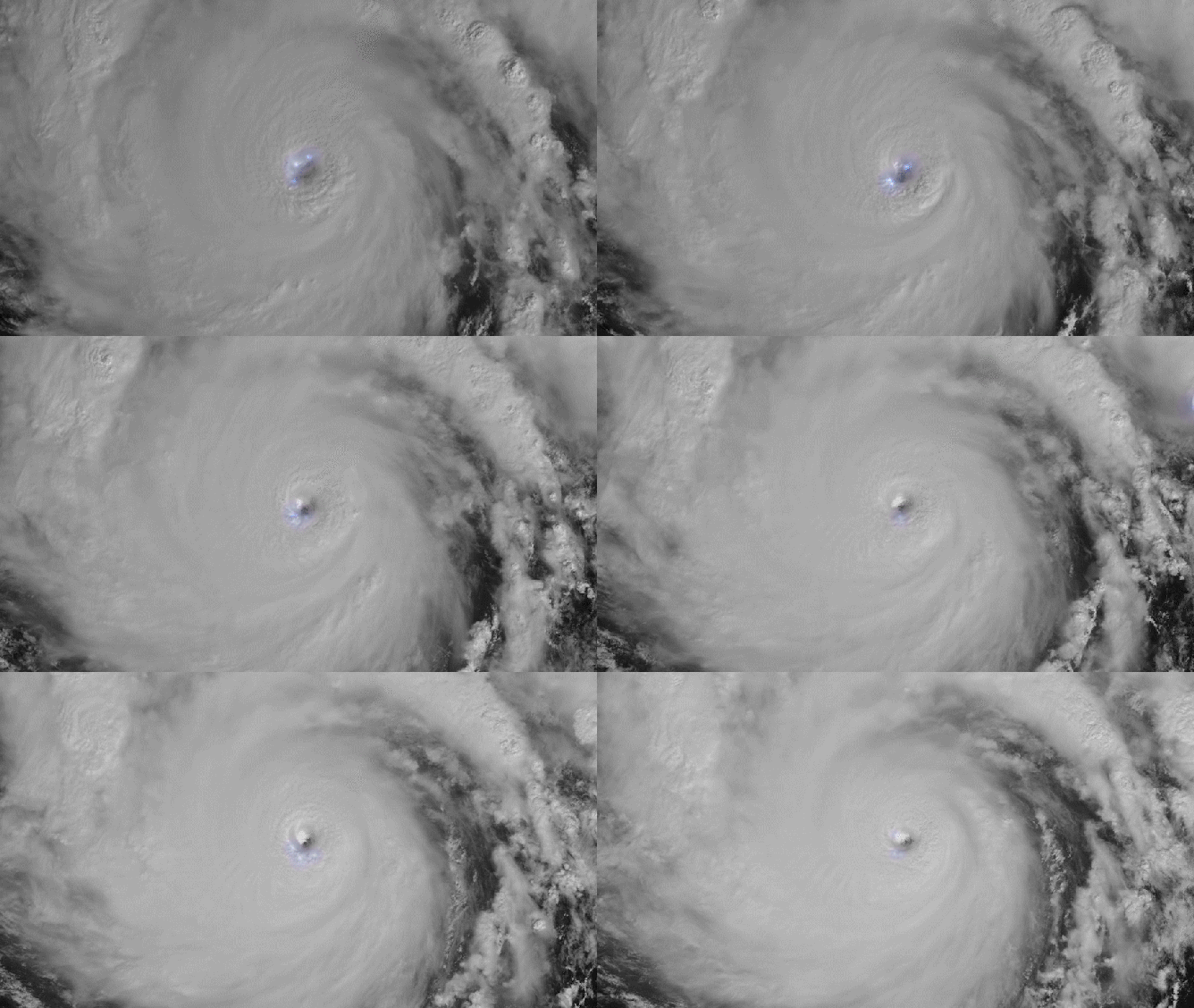
Hurricane Iota strengthened into a Category-5 monster on the morning of Nov. 16, 2020 with sustained wind speeds of 160 mph.
(NOAA / NOAA)
Shorter lived than it’s predecessor, Ioda weakened over the mountainous terrain of western Nicaragua. The storm dissipated the following day, on Nov. 18.
Hurricane Iota is responsible for causing 67 direct deaths, 17 indirect deaths, and 41 missing people, dealing an estimated $1.4 billion in damage, according to the NHC
Damaging the already battered west coast of Nicaragua, heavy rainfall associated with Hurricane Iota led to deadly flooding in Venezuela and Columbia.
Hurricane Lenny’s Infamous ‘Wrong Way Lenny’ Track In November 1999
Hurricane Lenny is famed for its unprecedented movement from west to east across the Caribbean Sea, a movement that had never occurred in the then 113-year record of Atlantic basin tropical cyclones.
BRYAN NORCROSS: GOOD CHANCE 2025 HURRICANE SEASON IS OVER
Lenny became a hurricane on Nov. 15, 1999 150 miles off the southwest coast of Jamaica, and famously traveled west across the Caribbean. Lenny strengthened into a major Category 3 hurricane on its wayward path across the Caribbean.
Due to heavy rains, unprecedented waves and storm surge, Lenny produced considerable damage to a number of islands in the Caribbean.
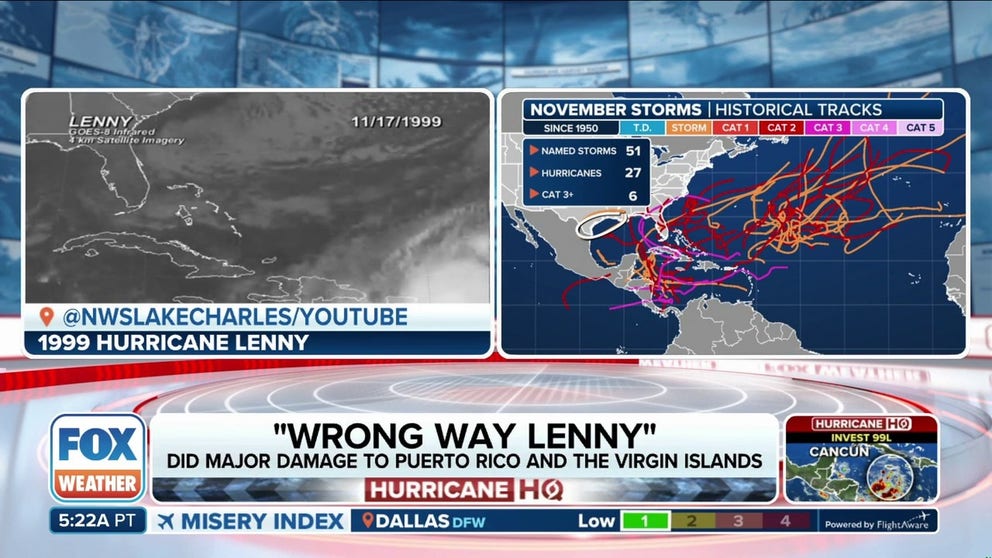
Hurricane Lenny, known as “Wrong Way Lenny” formed in the Caribbean in November 1999 and traveled west to east, an unusual track for tropical activity in the region. Lenny did damage to Puerto Rico and the Virgin Islands.
According to the NHC, Lenny is responsible for 17 deaths across the Caribbean and South America, and caused approximately $330 million in damages alone in the U.S. Virgin Islands and Puerto Rico.
Hurricane Lenny’s infamous track west to east earned it the nickname “Wrong Way Lenny.”
Lenny’s abnormal movement west across was due to a strong dip in the jet stream over the western Atlantic that pulled Lenny the wrong way.
Hurricane Kate: The Latest November U.S. Landfall
When Hurricane Kate made landfall in Mexico Beach, Florida on Nov. 21, 1985, it became the latest hurricane, on record, to make landfall — a title it holds to this day.
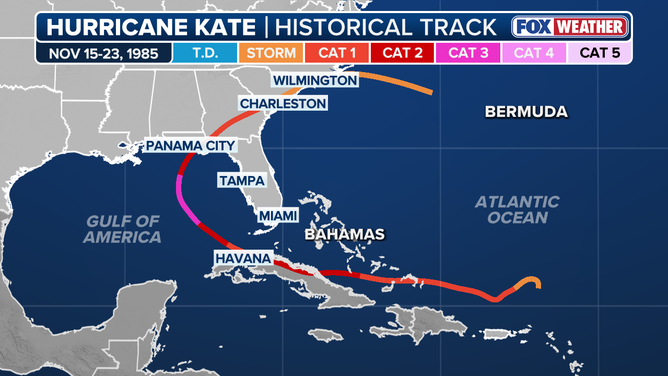
This graphic shows the historical track of Hurricane Kate.
(FOX Weather)
The Category 2 storm on Nov. 21, 1985, is the strongest and latest to have impacted the lower 48 during any season. Forecasters considered the strike and strength of Kate to be rare, with just nine days left of the Atlantic basin hurricane season – a 183-day period that runs from June 1 through Nov. 30.
November ranks fifth out of the six months for seeing the least amount of tropical cyclone development, only running slightly ahead of June’s pace.
HERE’S WHY ATLANTIC HURRICANE SEASON RUNS FROM JUNE TO NOVEMBER
Damage caused by Hurricane Kate is estimated to be around $1.9 billion in today’s dollar value.
Despite the tremendous devastation from the Caribbean to Florida, the storm’s name was not retired from a repeating list of identifications used by the World Meteorological Organization.
“Kate” was used to name cyclones in 2003, 2015, 2021 and will again be available to be used in 2027.