The fall sky-gazing season is officially in full swing with the Orionid meteor shower peak in October and Comet A6 Lemmon increasingly visible in the night sky.
The Orionid meteor shower peaks on Oct. 20 and 21 this year, and could be one of the most beautiful shows of the year, according to NASA.
Lowell Observatory Post-Doctoral Fellow Qicheng Zhang said this year’s Leonids meteor shower peak happens along with a new Moon, providing a dark sky to spot these incredibly fast meteors traveling up to 41 miles per second into Earth’s atmosphere.
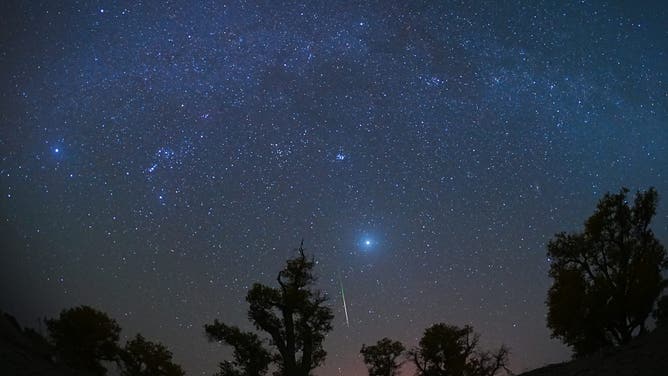
YULI, CHINA – OCTOBER 22: A meteor streaks across the sky over a desert during the Orionid meteor shower on October 22, 2023 in Yuli County, Bayingolin Mongol Autonomous Prefecture, Xinjiang Uygur Autonomous Region of China.
(VCG/VCG )
The Orionids originate from comet 1P/Halley, but Earth does not pass directly through this comet’s orbit, meaning only a handful of meteors. Still, these fast meteors can leave flowing trains in the sky and be visible for several minutes.
Zhang said there are a few ways to increase your chances of enjoying the Orionids. Getting away from city lights and other sources of light pollution is the first step.
“The more of the sky you can see, the better a chance of meteors you can see,” he said.
Orionids also require patience.
“It tends to be a meteor shower that if you’re in a dark sky and have a lot of patience to be watching for at least an hour or so if you want to see more than like a handful of meteors,” Zhang said.
Zhang, who specializes in studying comets, said there is more to see this month in the night sky.
Comet A6 Lemmon is rapidly brightening in the morning sky and will soon be visible in the night sky as it approaches its closest point to the Sun, known as perihelion.
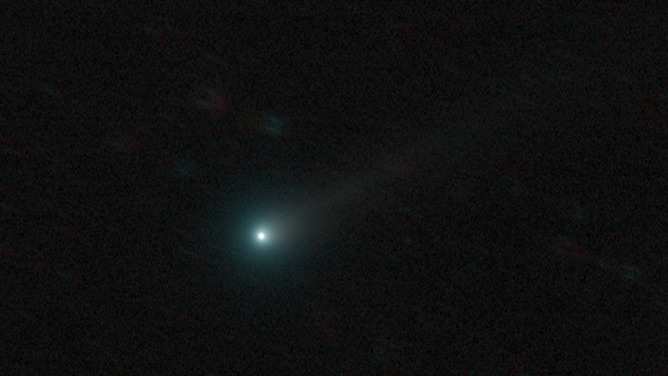
Comet C/2025 A6 Lemmon as seen from Lowell Observatory in Arizona in September 2025.
(Qicheng Zhang/Lowell Observatory)
A comet usually becomes visible to the naked eye when it reaches a magnitude of 3. Zhang estimates Comet A6 Lemmon could be around a magnitude 5 in dark sky conditions, and will brighten by another magnitude or more toward the end of the month.
Zhang said this comet will likely provide the most spectacular views for photographers.
“The thing about this comet is that we are mostly seeing it before it actually passes perihelion, so before it’s actually released most of its dust,” Zhang said. “Comets of this sort tend to look a lot more spectacular in photographs, because regardless if it’s before and after perihelion, you can get a really long, like a lion tail, plasma tail, that you can see intricate features in.”
A clear view of the western horizon will help you view Comet A6 Lemmon later this month as it approaches perihelion.
Visitors to Lowell Observatory in Flagstaff, Arizona, could spot this comet on a clear night with the help of telescopes once it moves into the evening sky.
Next up: Leonid meteor shower peak
Next month, the sky-gazing lineup includes the Leonid meteor shower peak in mid-November.
Originating from comet 55P/Tempel-Tuttle, this meteor shower is considered a major shower even with as few as three meteors per hour because of its history of meteor storms. Tempel-Tuttle takes 33 years to orbit the Sun. When the comet is close to Earth, and we pass through a dense cloud of comet debris, we get a spectacular show, resulting in as many as 1,000 meteors per hour.
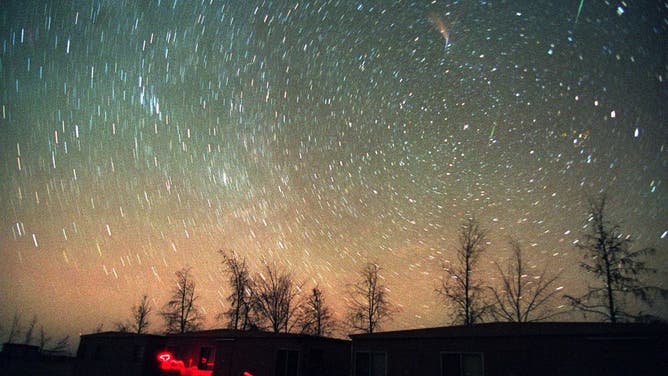
A photo from November 18, 1999 shows a Leonid meteor storm over the Azrak desert, 90km east of Amman. The storm packed up to some 1,500 meteors per hour visible with the eye. (Photo by JAMAL NASRALLAH / AFP via Getty Images)
(JAMAL NASRALLAH / AFP / Getty Images)
Zhang said these increased meteors could happen for several years before and after the close pass.
According to the American Meteor Society, the last Leonid meteor storm happened around 2002, but we aren’t expected to have another true meteor storm until 2099.