Kyiv, Ukraine – When Russia annexed Crimea in 2014, Moscow promised the residents of the Black Sea peninsula higher salaries, better hospitals and retrofitted infrastructure.
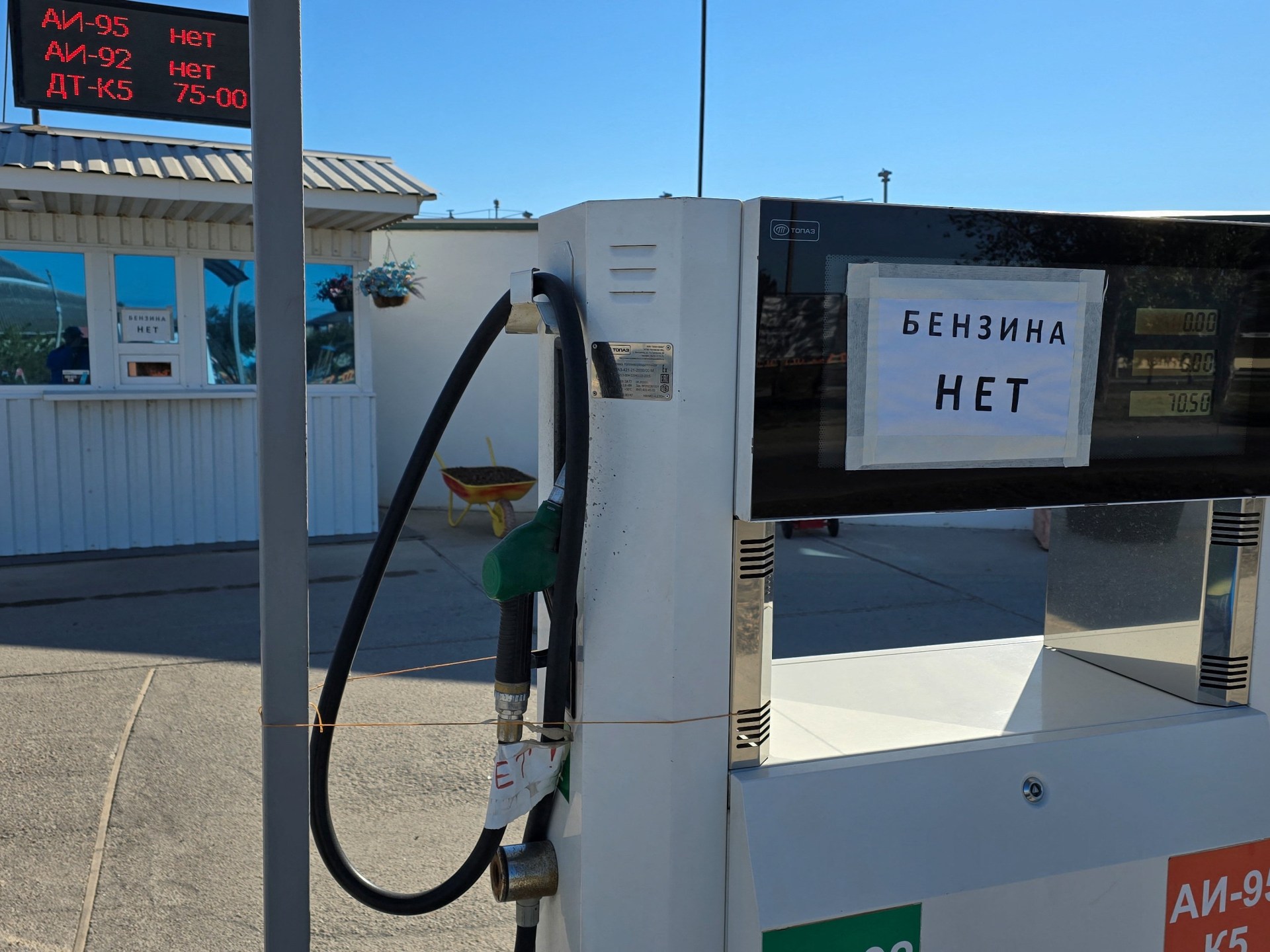
But 11 years later, they are learning to live with almost daily Ukrainian drone and missile attacks, unpredictable blackouts and a growing shortage of gasoline.
Recommended Stories
list of 4 itemsend of list
“Every day I see cars that ran out of fuel and were left on the curb,” Ayder, a resident of Simferopol, Crimea’s administrative capital, told Al Jazeera.
His car runs on natural gas, which is more available these days.
“There are long lines and fistfights at gas stations” after a limit of 20 litres (5.3 gallons) per car was introduced, he said, withholding his last name out of fear of punishment for talking to foreign media.
The shortage has been caused by a months-long Ukrainian campaign to destroy or damage Russian oil refineries, pipelines, pumping stations, terminals, fuel depots and even tankers of the so-called “shadow fleet” that transports crude despite Western sanctions.
Early on Monday, Ukrainian drones hit five reservoirs of the oil terminal in the Crimean port of Feodosiya, causing a huge fire and a sky-high plume of putrid smoke – and damaging two power transmission stations.
‘Ukrainian forces chose a weak spot’
Kyiv’s campaign involves increasingly sophisticated, Ukrainian-made drones and missiles.
It has reduced the output of oil refineries by up to a fifth, hurting Russia’s economy and upsetting President Vladimir Putin’s allies who control oil-related businesses.
“The enemy’s gas deficit is up to 20 percent of their needs,” Ukrainian President Volodymyr Zelenskyy said on October 8.
“Ukrainian forces chose a weak spot, identified it and methodically hit the spot,” Volydymyr Fesenko, head of the Kyiv-based Penta think tank, told Al Jazeera. “This is one of the ways to force Russia to start peaceful negotiations.”
It also has a psychological downside.
Each refinery is a mammoth maze of distillation columns, tanks, kilometres-long pipes and sizeable fuel depots that are hard to protect with air defence systems – and easy to ignite.
If an attack on any of them succeeds, it causes hours or even days-long fires – and much longer pauses in oil refining.
“We’re feeling down already. Awaiting a universal f*** up,” Valentin, a resident of the western Ryazan region, told Al Jazeera. He also withheld his last name, fearing reprisal for talking to media.
Valentin saw or heard all six drone attacks this year on the Ryazan oil refinery that processes 18 million tonnes of oil annually, or 6.9 percent of Russia’s total output.
The refinery belongs to the Rosneft oil company controlled by Igor Sechin, a former Portuguese translator and Putin’s lifelong friend.
Oil refineries are a legitimate military target, according to Ihor Romanenko, former deputy head of Ukraine’s general staff of armed forces.
“Fuel and lubricants are the blood of Russia’s logistical supply. Weaponry and [military] equipment need plenty of fuel and lubricant components,” he told Al Jazeera.
Ukraine mostly relies on its own drones and rockets, as United States President Donald Trump is still mulling the supply of the advanced Tomahawk missiles, he said.
At preliminary talks in Turkiye’s Istanbul, Moscow already urged Kyiv to stop hitting the refineries. But Kyiv insisted on broader limitations such as the complete cessation of air attacks – something Moscow refuses to do.
“They wanted [us] to stop what is sensitive to them,” Romanenko said.
At least 21 out of Russia’s 38 key refineries have been hit and partially damaged in 2025, according to media reports.
Some facilities have been struck several times, causing weeks-long pauses in operation and panic among people living nearby.
“Where the hell is air defence, are you going to down [the drones] with a slingshot?” a man yelled while recently filming a video on his phone of a drone attack on the Kirishi oil refinery, which processes 17.5 million tonnes of oil annually, or 6.6 percent of Russia’s output, outside St Petersburg.
The attacks peaked in September, a month during which there were 40 strikes, according to analysis by Re: Russia, an online project by exiled Russian analysts that was published on October 8.
Gas production throughout Russia fell by up to 27 percent, it said, causing shortages, price hikes and the deterioration of fuel quality.
And while Crimea’s fuel depots are a relatively easy target, Ukrainian drones reach far beyond the Ural Mountains – a border between Russia’s European and Asian parts.
During World War II, dozens of Soviet military plants were transferred to the Ural Mountains as Nazi German aircraft could not reach them. Eight decades later, Ukrainian drones can.
On October 7, they hit a refinery in the western Siberian city of Tyumen, 2,000km (1,240 miles) from the Ukrainian border, surpassing their previous “record” by some 400km (250 miles).
But Nikolay Mitrokhin of Germany’s Bremen University said the overall damage to the Russian economy from the drone attacks “amounts to a couple of percent” while some Ukrainian and European budgets suffer “irreparable damage” as the attacks are costly.
And without directly influencing ongoing hostilities on the ground, the drone offensive triggers Russian retaliatory assaults on Ukraine’s hydrocarbon mining and refining facilities, energy infrastructure and railroad transport, he said.
On October 10, a huge Russian drone and missile attack struck two Ukrainian thermal power stations in Kyiv, causing an hours-long blackout.
“It was a straight hit, there’s nothing left to repair,” Mykola Svyrydenko, who lives next to Thermal Power Station 5 in central Kyiv, told Al Jazeera.