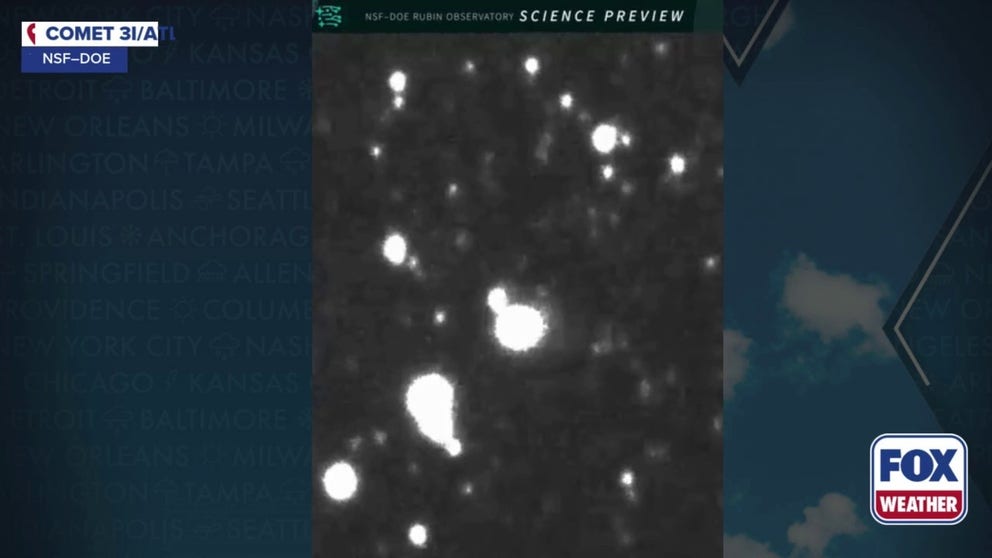
Our solar system’s third discovered interstellar visitor, comet 3I/Atlas, will dip into the glare of the Sun this week, leaving the detective work on this object to spacecraft far from Earth.
The NASA-funded ATLAS survey telescope in Chile first observed the comet on July 1, and since its discovery, astronomers have been busy studying this mystery object.
According to NASA, 3I/ATLAS will remain visible to ground-based observatories until the end of September. After that, it will be too close to the Sun to observe. After it disappears behind the glare of the Sun, it will reappear in early December for more ground-based observations.
The comet is expected to make its closest pass of the Sun on Oct. 30, at a distance of about 130 million miles, inside the orbit of Mars.
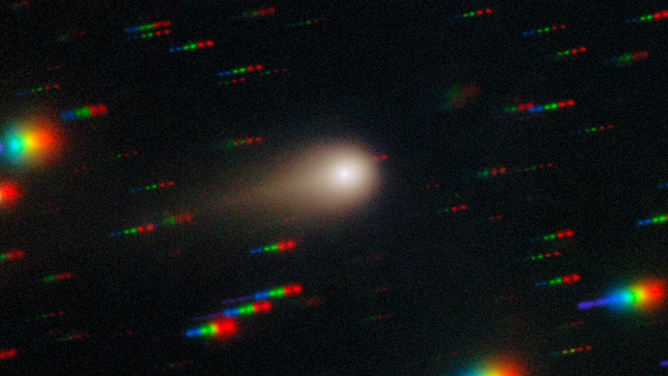
Comet 3I/ATLAS streaks across a dense star field in this image captured by the Gemini Multi-Object Spectrograph (GMOS) on Gemini South at Cerro Pachón in Chile, one half of the International Gemini Observatory, partly funded by the U.S. National Science Foundation (NSF) and operated by NSF NOIRLab. This image is composed of exposures taken through four filters — red, green, blue and ultraviolet. As exposures are taken, the comet remains fixed in the center of the telescope’s field of view. However, the positions of the background stars change relative to the comet, causing them to appear as colorful streaks in the final image.
(International Gemini Observatory/NOIRLab/NSF/AURA/Shadow the Scientist / FOX Weather)
While 3I/Atlas is out of view from Earth, NASA and other partners, like the European Space Agency (ESA), are using spacecraft to track the comet.
With some of these spacecraft observations, including from NASA’s James Webb Space Telescope, astronomers say they have determined comet 3I/Atlas is a biggie, estimated to be about 33 billion tons in mass.
A new study co-authored by Avi Loeb, Baird Professor of Science and Institute director at Harvard University, used more than 4,000 observations of 3I/Atlas to estimate the mass of this unusual comet. Previous observations and studies have revealed the comet has a rare chemical makeup for this classification of object.
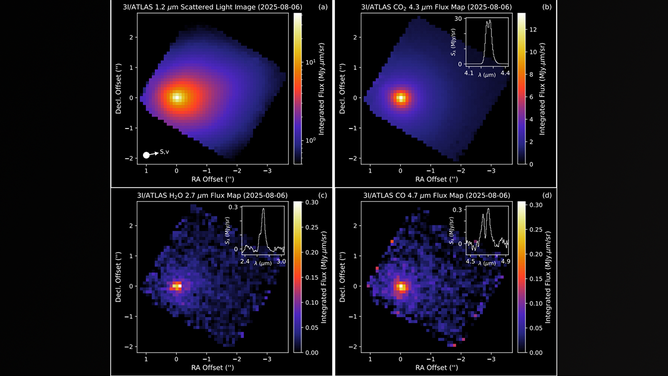
Spectral data for 3I/ATLAS observed using JWST’s NIRSpec.
(NASA/ESA/CSA / NASA)
This study indicated that our newest interstellar visitor is about 3 to 5 times larger than 1I/`Oumuamua and 2I/Borisov, the two previous interstellar objects discovered and tracked through our solar system.
There is still much more to be learned about the comet as it continues zooming through our cosmic neighborhood. In a blog post, Loeb detailed some exciting observations that could happen by NASA’s HiRISE camera onboard the Mars Reconnaissance Orbiter in October and then by NASA’s Juno spacecraft orbiting Jupiter in March 2026.
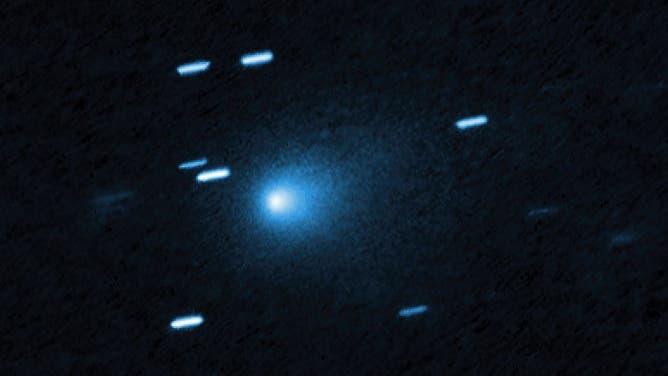
New image of the comet 3I/ATLAS from the Hubble Telescope
(NASA)
Loeb said these observations could help explain some of the unusual characteristics of 3I/ATLAS.
“Is 3I/ATLAS an unusually massive comet with an unusual chemical composition on an unusually rare trajectory or alien technology? In both cases, the object could shed CO2 and H2O ices from material that collected on its frozen surface as it plowed through interplanetary and interstellar space,” Loeb wrote. “We should not decide about the nature of 3I/ATLAS based on the chemical composition of its skin, for the same reason that we should not judge a book by its cover.”
When the question is asked, “Is it aliens?” Science can explain why it’s not. It will be exciting to see in the coming months what new observations can reveal about this massive comet.