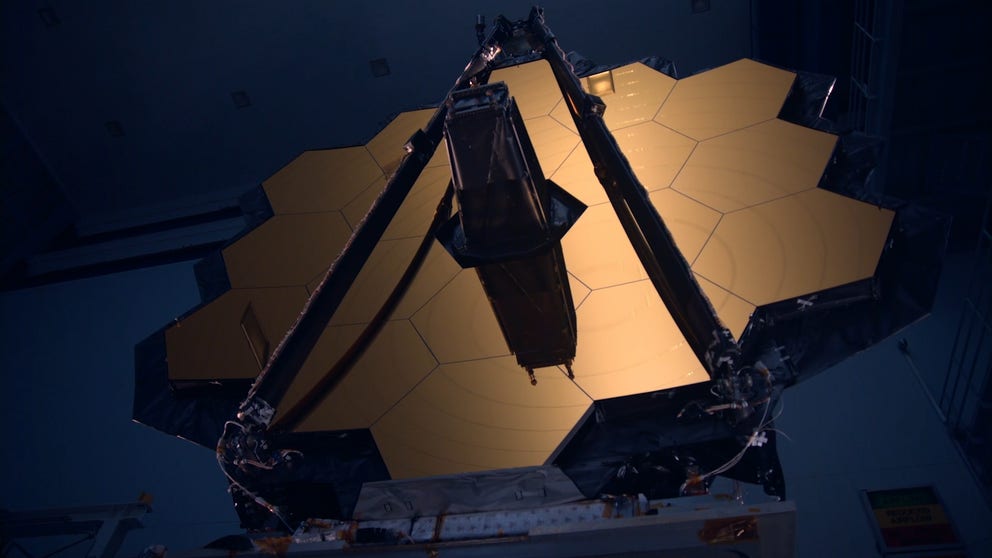
Scientists say the James Webb Space Telescope has captured an unprecedented look inside a butterfly nebula, revealing matter around a dying star.
The international space community, consisting of NASA, the European Space Agency and the Canadian Space Agency, released the new imagery Wednesday, which exposed complex features in the heart of NGC 6302, located about 3,400 light-years away from Earth in the constellation known as Scorpius.
The vast region of gases and dust was previously studied by NASA’s Hubble Space Telescope, but scientists say Webb’s high-resolution imagery offers the clearest portrait yet of complex layers.
Planetary nebulae form when giant stars exhaust their fuel and shed their outer layers, leaving behind a hot core that illuminates the gas and dust surrounding it.
A dense band of dust acts as the “body” of the butterfly, forming a doughnut-shaped figure that blocks out light and gives the nebula its unusual shape.
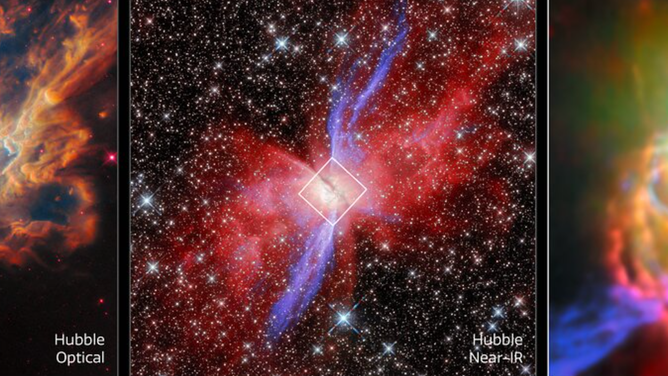
Telescope imagery of Butterfly Nebula, NGC 6302
(NASA/ESA/CSA / FOX Weather)
SPACEX’S MEGAROCKET COMPLETES FIRST TEST FLIGHT AFTER YEARS OF EXPLOSIVE FAILURES
“Planetary nebulae are among the most beautiful and most elusive creatures in the cosmic zoo,” the ESA said. “These nebulae form when stars with masses between about 0.8 and 8 times the mass of the Sun shed most of their mass at the end of their lives. The planetary nebula phase is fleeting, lasting only about 20,000 years.”
The agency said for the first time, astronomers were able to locate the nebula’s hidden central star through the thick dust.
Researchers estimated the temperature around the star to be around 220,000 Kelvin, making it one of the hottest known stars in our galaxy.
Scientists also noted that carbon-based molecules were also observed, which was unexpected as those particles are typically found in exhaust from vehicles and fires.
“Given the location of the PAHs [ polycyclic aromatic hydrocarbons], the research team suspects that these molecules form when a ‘bubble’ of wind from the central star bursts into the gas that surrounds it. This may be the first-ever evidence of PAHs forming in a oxygen-rich planetary nebula, providing an important glimpse into the details of how these molecules form,” scientists stated.
In previous imagery, NASA said red hues were thought to have originated from ionized nitrogen and hydrogen, while white patches were from ionized sulfur.
WHY A STATE IS ASKING FOR HELP LOCATING AN ELUSIVE REPTILE
The most visual phase of the nebula is expected to last some 20,000 years, before the gases become too dispersed to be visible from telescopes.
The $10 billion telescope launched in 2021 and is the most powerful observatory ever to operate in space.
NASA believes the James Webb Space Telescope will easily surpass its expected 10-year lifespan and will likely operate for decades.
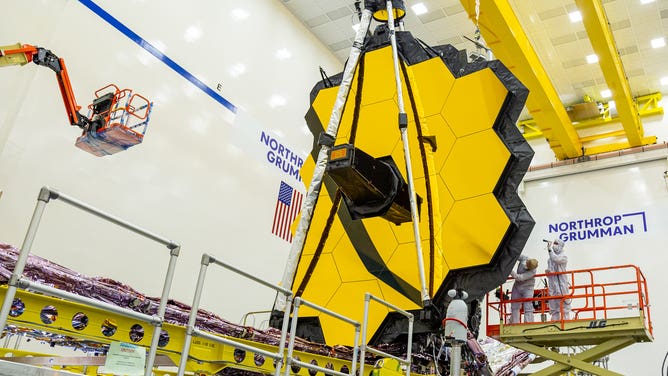
These images were captured during Webb’s final tests when the 6.5 meter (21 feet 4 inch) mirror was commanded to fully expand and lock itself into place, just like it would in space.
(Northrop Grumman)