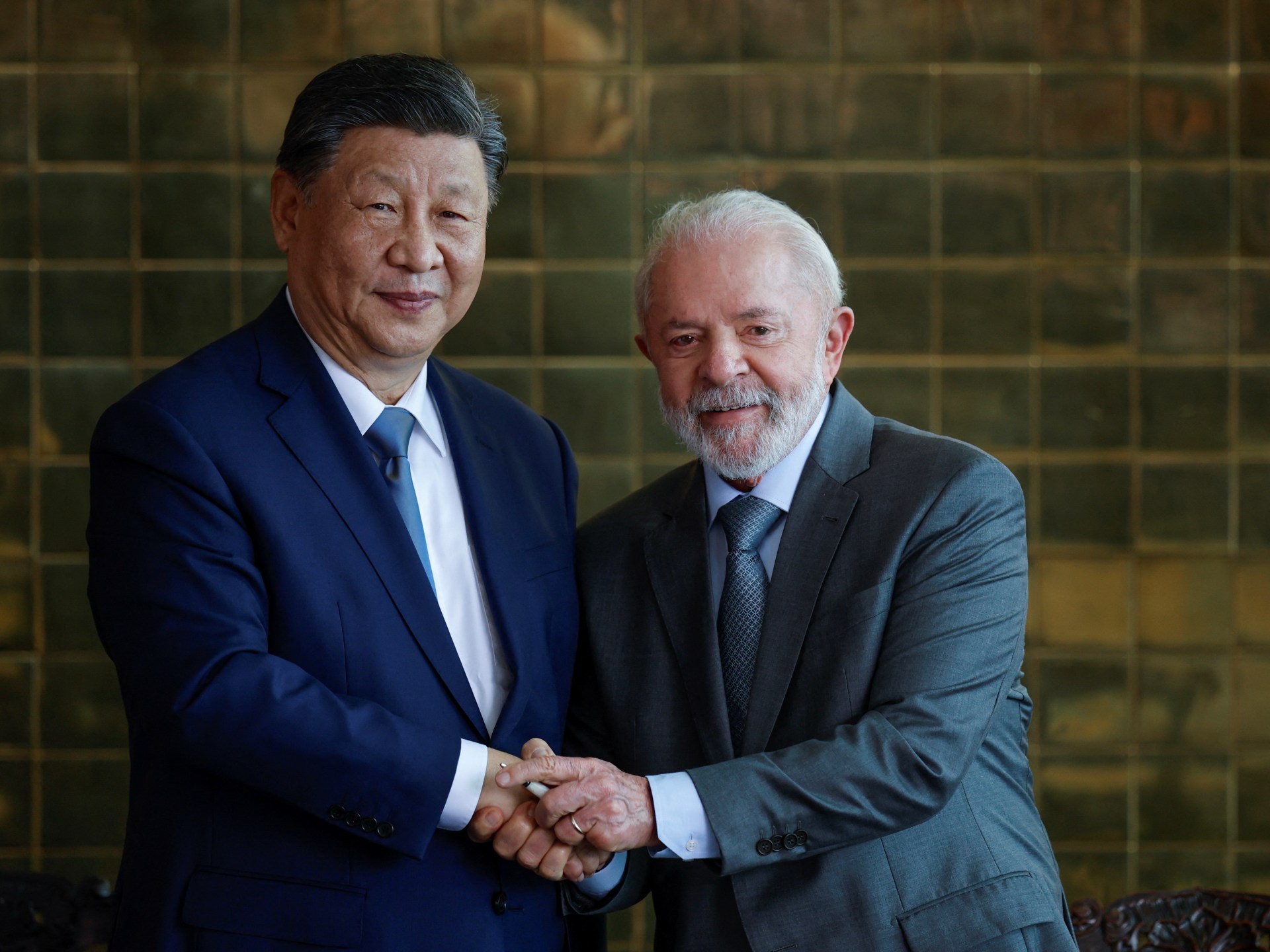
When Brazilian President Luiz Inacio Lula da Silva was in China earlier this year for his third meeting with Xi Jinping since returning to office in 2023, he hailed the relationship between the two countries as “indestructible”.
That proximity will likely increase even more following United States President Donald Trump’s announcement of a 50 percent tariff on Brazilian imported goods for overtly political reasons, experts say.
“The reality is that, today, the relation between Brazil and China is much more positive and promising than the one with the United States,” said Tulio Cariello, director of content and research at the Brazil-China Business Council (CEBC).
Trump’s pledge to inflict a 50-percent tariff on Brazil, due to come into effect on August 1, sent shockwaves throughout Brazil, especially since under the so-called “Liberation Day” tariffs that Trump had announced on April 2, Brazilian imports would be taxed at 10 percent.
That was also significantly less than percentages inflicted on other Brazilian competitors in the American market, prompting a sense of opportunity among businesses in South America’s most populous country.
Hence, the sudden decision of a 50-percent tariff was a rude shock, particularly for sectors that are big exporters to the US, such as aircraft, car parts, coffee and orange juice.
The 50-percent tariff came on the heels of the BRICS summit in Rio de Janeiro, where leaders of developing nations raised “serious concerns” about the increase of tariffs which it said were “inconsistent with WTO [World Trade Organization] rules.”
In a letter justifying the tariff, Trump directly tied the measure to former Brazilian President Jair Bolsonaro’s current predicament, which he called a “witch hunt”. Bolsonaro, often dubbed the “Trump of the tropics”, is facing trial for allegedly attempting to orchestrate a coup to remain in power despite his 2022 election loss to Lula.
Trump also erroneously claimed a trade deficit with Brazil. Brazil has a deficit of about $7.4bn with the US, and a surplus of about $31bn with China.
The political nature of the tariffs marked a sharp departure from Trump’s usual rationale, drawing widespread condemnation across Brazil’s political spectrum, and from China.
“Tariffs should not be a tool of coercion, intimidation, or interference,” a spokesperson for China’s Ministry of Foreign Affairs said in the aftermath.
By using tariffs for political leverage rather than economic reasons, Trump risks tarnishing the US’s reputation as a reliable trade partner, experts say, making China appear more stable and predictable by comparison.
“China, to date, has shown no indication of backtracking on decisions or making sudden changes,” said Mauricio Weiss, an economics professor at the Federal University of Rio Grande do Sul.
Strengthening Chinese ties
The Asian country overtook the US as Brazil’s biggest export market in 2009, and the two countries’ trade and investment ties have only grown stronger since then.
A notable signal of deepening ties came on Monday, when Brazil’s Ministry of Finance announced plans to establish a tax advisory office in Beijing. Brazil only has four other such offices globally – three in South America and one in the US.
“The motivation is not politically driven, but rather justified by the growing importance of bilateral trade relations and the need to deepen cooperation on fiscal and customs matters,” Brazil’s ministry said in a statement to Al Jazeera.
China has sought to fuel its own domestic growth through access to natural resources and raw materials, such as oil, iron ore, copper, lithium and agricultural products.
But since 2007, China has also invested more than $73bn in Brazil, according to CEBC. Much of those funds are pouring into strategic sectors such as energy, infrastructure, agribusiness and technology.
“The United States still invests more heavily in Brazil, but China’s investments are more targeted and coordinated between governments,” said Weiss.
Chinese products are also becoming increasingly common in Brazil. Electric cars made by Chinese manufacturer BYD are now a common sight, with seven out of 10 electric vehicles sold in Brazil coming from the company.
Particularly symbolic of China’s growing presence to the detriment of the US was BYD’s purchase of a massive factory previously owned by Ford in Brazil’s northeastern state of Bahia.
The two countries have also agreed to explore transportation integration. Those plans include a bi-oceanic rail corridor linking Brazil to the Chinese-built port of Chancay in Peru.
Xi’s inauguration in November of the mega-port – where total investment is expected to top $3.5bn over the next decade – put China’s regional influence on stark display.
Other Latin American nations, including Peru, Colombia, and Chile, have also signalled their rapprochement with China, amid fears of Trump’s intentions for the region. He has previously pledged to “take back” the Panama Canal, including by force.
But some have pointed out the deepening relation between China and Brazil does not mean the South American country will start exporting the goods it currently sends to the US to China, as the two countries buy very different products from Brazilian companies.
“Brazil isn’t going to export manufactured products to China. That doesn’t make much sense,” said Livio Ribeiro, a researcher at the Brazilian Institute of Economics at the Getulio Vargas Foundation.
Even then, Chinese investments could play a crucial role in enabling Brazil to boost its industrial capacity and diversify its economy, according to Weiss.
“Simply being able to produce more of these products domestically and for other South American partners will already be a significant growth opportunity,” Weiss said.
Speaking during a state visit in China in May, Lula said Brazil and China will be “indispensable partners” because “China needs Brazil and Brazil needs China.”
“Together, we can make the Global South respected in the world like never before,” Lula added.