HILO, Hawaii – Astronomers continue to track Comet 3I/ATLAS, the third-ever discovered interstellar object, passing through our solar system using ground-based telescopes to document this striking cosmic visitor.
The comet was first spotted on July 1 by the Asteroid Terrestrial-impact Last Alert System (ATLAS), which is how the object got part of its name.
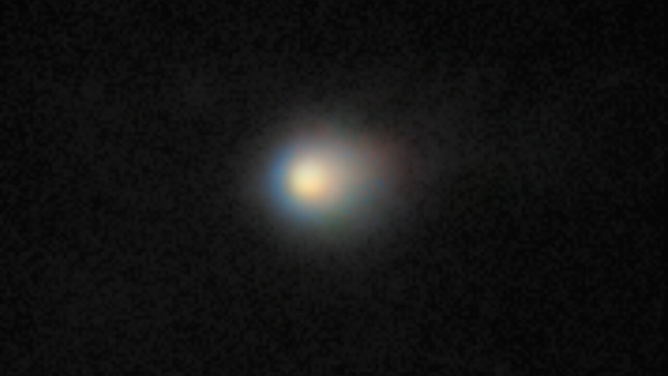
Comet 3I/ATLAS is captured in this image by the Gemini North telescope. The incredible sensitivity of Gemini North’s Multi-Object Spectrograph (GMOS-N) reveals the comet’s compact coma — a cloud of gas and dust surrounding its icy nucleus.
(International Gemini Observatory/NOIRLab/NSF/AURA/K. Meech (IfA/U. Hawaii) Image Processing: Jen Miller & Mahdi Zamani (NSF NOIRLab) / FOX Weather)
New images from the Gemini North Telescope in Hawaii show the comet’s compact coma, a cloud of ice and dust, as it continues zooming about 290 million miles from Earth. Astronomers said, at its closest, 3I/ATLAS will reach about 170 million miles from our planet on Dec. 19, and there is no danger to Earth.
ASTRONOMERS SPOT RARE INTERSTELLAR COMET SPEEDING THROUGH SOLAR SYSTEM
This comet is among a very small group of interstellar visitors discovered and tracked through our solar system, including 1I/ʻOumuamua in 2017 and comet 2I/Borisov in 2019. However, Comet 3I/ATLAS appears to be the largest yet, making it a better target for scientists to track and study. ʻOumuamua was about 200 meters in diameter, and Borisov was just over half a mile. Initial observations show 3I/ATLAS has an approximate diameter of 12 miles.
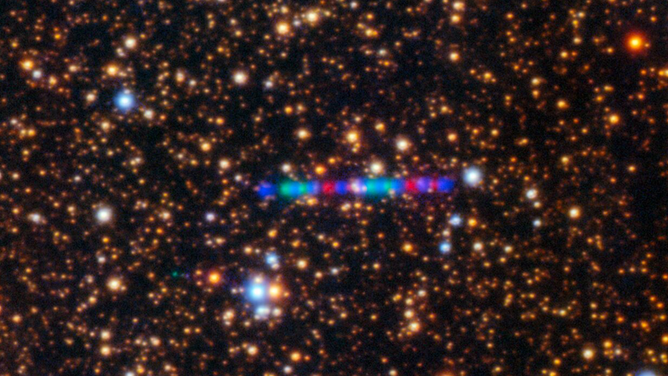
Comet 3I/ATLAS streaks across a dense star field in this image captured by the Gemini North telescope’s Gemini Multi-Object Spectrograph (GMOS-N). The left panel captures the comet’s colorful trail as it moves through the Solar System. The image was composed of exposures taken through three filters, shown here as red, green, and blue.
(International Gemini Observatory/NOIRLab/NSF/AURA/K. Meech (IfA/U. Hawaii) Image Processing: Jen Miller & Mahdi Zamani (NSF NOIRLab))
According to the National Science Foundation’s NOIRLab, which manages Gemini, this comet has an extremely eccentric orbit, meaning its orbit is not circular and will not come back around the Sun. 3I/ATLAS has an eccentricity of 6.2 – with 0 being a perfectly circular orbit – which means it came from interstellar space and will again leave our solar system.
While 3I/ATLAS is only the third cosmic visitor to be discovered in our solar system, the scientific community is excited about the potential for more discoveries with the new National Science Foundation’s Vera C. Rubin Observatory in Chile.
In a trial run earlier this summer, the observatory’s Legacy Survey of Space and Time camera found thousands of previously unknown asteroids in our solar system. As it repeatedly scans the Southern Hemisphere sky, Rubin will likely find a few hitchhikers cruising through our cosmic neighborhood.