Oscar-winning Israeli directors Yuval Abraham and Rachel Szor hit the Venice Film Festival on Thursday with bombshell late competition addition Naza.
Based on interviews with 24 Israeli intelligence officers and soldiers, the documentary exposes the AI, phone surveillance and crude points-based systems deployed by Israeli military in Gaza to decide targets, Hamas-related or otherwise, and then take them out in their homes regardless of whether children and other family members are likely to be killed in the strike as well.
The title Naza is taken from the Israeli military’s Hebrew acronym to describe each individual that could die when tallying up an estimated death-toll ahead of a strike.
The film follows and builds on Abraham and Szor’s No Other Land, winner of the Best Documentary Academy Award in 2025, co-directed with Palestinian filmmakers Basel Adra and Hamdan Ballal, documenting Israeli army-backed efforts to erase the West Bank Palestinian villages of Masafer Yatta, while painting a wider picture of Israeli occupation.
“Our film is showing that the basic targeting unit of the Israeli targeting systems is a family home in Gaza.,” Abraham tells Deadline ahead of the world premiere.
“That’s how it operates. Every building in Gaza, every home in Gaza has a number. The system is designed to locate targets. When they are in civilian spaces, when they go back home, that is one of, for me, one of the most striking revelations of the film. A revelation, of course, that I think should have been known to people by the fact that they should have listened to Palestinians in Gaza who are saying it. But to hear it from the inside for me was quite striking.”
The world premiere comes amid growing condemnation of Israel’s military campaign in the Palestinian territory – sparked by Hamas’s slaughter of 1,200 people in Southern Israel on October 7, 2023 – which has since killed more than 73,000 people and injured close to 175,000 others, while destroying key infrastructure and 90% of homes.
The film is based on investigative reporting carried out by Abraham in the wake of the October 7, 2023, Hamas attacks and the launch of Israel’s retaliatory military campaign on October 27 of that same year, the findings of which were previously published by The Guardian, which is a producer on the film, and Israeli news outlets +972 and Local Call.
“I had spent time already before October 7 with +972 magazine and local Call, and later with the Guardian, investigating the Israeli military, the Israeli targeting systems, Israel’s reliance on AI, on big data and mass surveillance of Palestinians,” he says, explaining how he had managed to connect with the interviewees in the film through a network built across years.
Co-director Szor, who is also cinematographer on the film, kept a low media profile during the festival run and awards campaign for No Other Land, but joins Abraham in the interviews for Naza in Venice
“It’s true with No Other Land, I was not vocal, it’s just my personality,” says Szor, when quizzed on how their partnership works.
“As directors, we just talk about everything, what exactly are we looking for; the questions that need to be asked… the structure, what story we will tell, and then, cinematically, where will we film the interviews and what else will we show beyond the interviews,” she says.
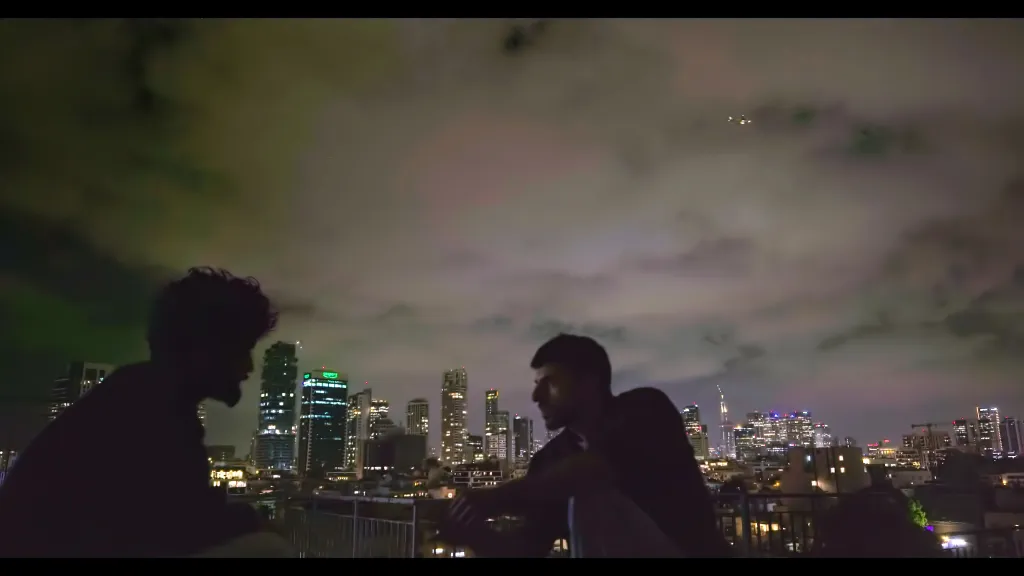
The anonymous silhouetted testimonies at the heart of the film are framed as rooftop interviews against the nighttime skyline of Tel Aviv, which aside from being one of the most liberal cities in the world is also the beating heart of Israel’s military apparatus and home to HaKirya HQ. The physical appearances and voices of the interviewees have been altered to hide their identities.
“As you can imagine, we went through a very rigorous process with The Guardian’s investigations desk which is an expert in that field… we’ve taken extraordinary measures,” says Abraham of the efforts to protect his sources, adding the aim was also to ensure the interviews did not come over as “robotic” as a result.
“That was important for us because we wanted the testimonies to land and to be impactful,” he explains.
The testimonies are chilling, with multiple interviewees explaining they are part of a system that they are powerless to challenge, evoking unspoken references to Adolf Eichman, who managed the logistics of the Holocaust, and Hannah Arendt’s coverage of his trial in Jerusalem in which she coined the phrase “banality of evil”.
“It’s something that came up from some of the soldiers themselves. It’s one of the things that surprised me. Of course, I think about Second World War and the Holocaust, and I think our obligation is to draw universal lessons from that, because when we say never again, how can we say that if we are not drawing the universal lessons, the universal opposition to dehumanization, to turning people into numbers,” says Abraham.
“I was surprised how much soldiers themselves sometimes, not all of them, but some of them, spoke about it too. I mean we have a soldier in the film who talks about how after being involved in the killing of so many civilians and seeing their humanity kind of evaporate, he thought about German society in the 30s and the 40s. He felt he could understand something about that, that he couldn’t understand before.”
“To me, in a world where so many people use the memory of the Holocaust in a way to justify what is happening in Gaza, and it is important to think about how can we draw from that period of time to oppose dehumanization, to oppose killing, no matter who the person is being killed, and that’s not to say that it’s the same, but it is to say that we are finding these similarities that exist throughout many cases of genocide.”
In between the interview segments, the documentary cuts to footage of the aftermath of Israeli strikes in Gaza as family members desperately try to dig out victims from underneath collapsed buildings, as well as shots into Tel Aviv homes as people serenely go about their lives in the evening.
Asked if this was meant as a deliberate parallel between the lives of people living in Tel Aviv and those in Gaza, some 40 miles to the south, Abraham says it goes beyond that and is more a comment on Israel’s bombing of civilian homes on the basis of intelligence that a person of interest is present.
“Our film shows, it could have been someone selected by AI, it would have been someone who the army decides is somehow related to Hamas, it could have been someone that they targeted for other reasons, mere fact they are physically present in a building, where there is no military activity, justifies bombing the building and killing everyone inside,” says Abraham.
“If you apply these kinds of standards to any place in the world, and especially Tel Aviv, that gives you an endless stream of justifications to bomb pretty much any civilian building, any shopping mall, any cinema… Houses are not bombed because Hamas are firing rockets from them, which is what we’ve consistently heard from intelligence officers. The houses are bombed because it’s easier to bomb people and to find them when they go home to sleep at night.”
Asked on how he got military personnel to speak so candidly, Abraham he filled a void, with his quest helped by the lack of coverage of what was going on in Gaza in Israel’s mainstream media.
“Mainstream Israeli media is totally uninterested in asking these questions, in asking soldiers about the actions that they’ve done, which have contributed to the mass killing of Palestinian civilians. A polite way to say it, would be to say that they ignored the atrocities in Gaza. But if I’m being honest, it’s not that they ignored it; it’s that they very often created the justification and normalized very genocidal, very scary ideas about the population in Gaza, and I really think they bear some of the responsibility for what happens,” he says.
“When you operate as an Israeli journalist in a space where the majority of the mainstream kind of legacy Israeli media are not asking these questions, then you have an advantage because when you start asking these questions, then slowly… you find the answers,” he continues.
Abraham says mainstream channels could equally connect with the subjects in his film, and confirm the revelations in Naza, but suggests they will not because in his view they are “complicit in the killing”.
Digging into that allegation he suggests that while a handful of Israeli news outlets such as Haaretz and +972 Magazine have been critical of the military campaign in Gaza they are the exception to the rule.
“The majority of the society watches the TV channels: Channel 13, Channel 12, Channel 11,” says Abraham, citing Israeli research into local TV coverage of the military campaign in Gaza.
“In the first six months of the onslaught in Gaza, this period of time when about 10,000 children are being killed by Israel, Channel 12, the mainstream Israeli channel, dedicated less than 0.5% of its news items and news coverage to talk about the civilian casualties in Gaza… there are journalists far more talented than us in Israel that have been asking these questions, but the majority of the media has ignored, justified, incited, and therefore is partially responsible, I think, for the killing in Gaza.”
As the film debuts in Venice both directors hope the exploration of Abraham’s previously published findings will travel wider on the big screen.
“There is something different about seeing it on screen and seeing people talking about it from reading it, so hopefully it will have a big impact. It will reach more people. I think we’re also using our privileges because we’ve done No Other Land, and it reached Oscar. That also was for us just a motivation to make another film because we hope that it will reach a big stage,” says Szor.
“It’s weird to be in a festival with this kind of film, which is so heavy and on such a hard topic, but it’s very important to show it in the biggest stage there is.”