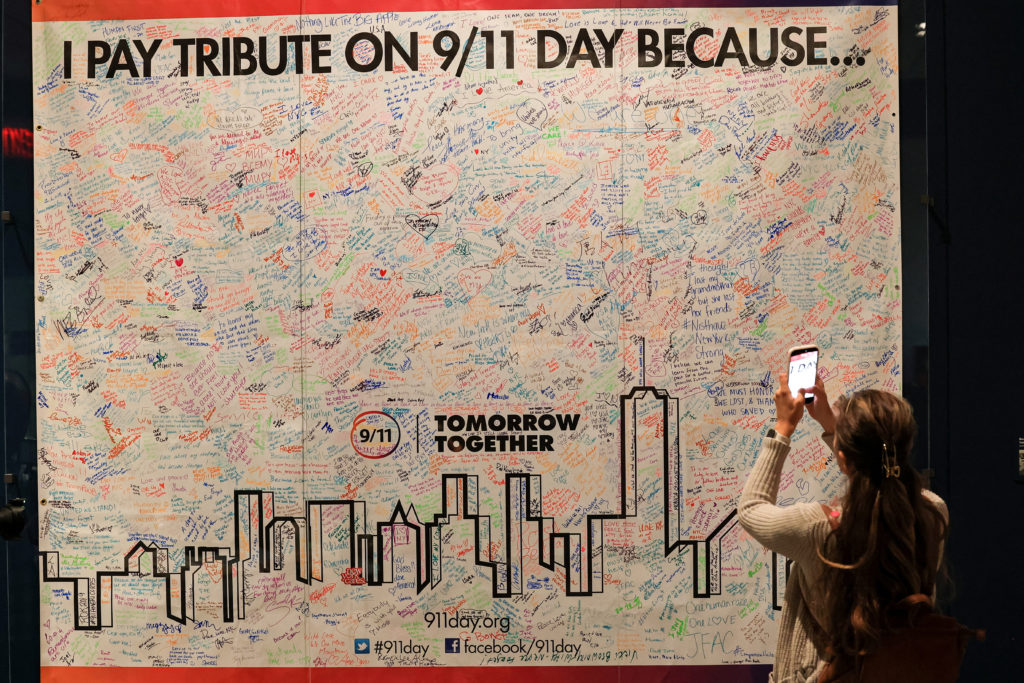
Every year, Americans across the country remember the Sept. 11 terrorist attacks. Flags are flown at half-staff. People observe moments of silence. Loved ones read the names of thousands of victims aloud.
Members of Congress have introduced several bills over the years in a push to mark the day as a federal holiday, but none have succeeded.
Here’s what to know about how federal holidays are established.
What is a federal holiday?
Even though people may refer colloquially to July 4th or Memorial Day as national holidays, they’re technically federal holidays, meaning they only apply to federal employees and the District of Columbia.
Each state can individually determine its own holidays, which may coincide or differ from federal holidays. For example, California recognizes Farmworkers Day on March 31, but the federal government does not.
There are 12 permanent federal holidays in the U.S., including Inauguration Day (held every four years after a presidential election), Labor Day and Thanksgiving Day. These were established the same way other laws are passed.
“In several instances, Congress created federal holidays after a sizable number of states created state holidays. In other instances, Congress took the lead,” according to a Congressional Research Service report.
Each holiday was designed to underscore a particular aspect of American heritage or to celebrate an event in American history, the report added.
“It’s a very high bar to get a holiday ensconced in the federal calendar, in terms of getting a day off,” Matthew Dennis, professor emeritus of history and environmental studies at the University of Oregon said. He cited the cost of paying federal employees and the disruption to businesses as major hurdles.
When did Congress last add a new federal holiday?
The last federal holiday, Juneteenth, was added in 2021 under President Joe Biden’s administration. Observed on June 19, the holiday marks when the last enslaved people in the U.S. learned they had been emancipated. Union soldiers arrived that day in 1865 in Galveston, Texas, and announced to enslaved Black people that they were free.
WATCH: The significance of Juneteenth, America’s first new federal holiday in decades
To mark the day as a federal holiday, there was a decades-long push. Country-wide protests over racism and police violence in the aftermath of George Floyd’s killing in 2020 served as a catalyst for the law establishing the holiday.
Juneteenth was the first federal holiday to be added since 1983, when Congress and President Ronald Reagan designated Martin Luther King Jr. Day to commemorate the civil rights leader’s birthday.
What is a day of remembrance?
Even though Sept. 11 is not a federal holiday, it is a day of remembrance.
Congress signed a resolution in 2001, designating Sept. 11 as Patriot Day.
The resolution requests the president to issue a yearly proclamation on Sept. 11 that mandates U.S. flags to be flown at half-staff, calls for a moment of silence to honor victims and asks state and local governments and the public to observe the day “with appropriate programs and activities.”
Dennis said the speed with which 9/11 was commemorated as a day of remembrance may help explain why there hasn’t been a bigger push to make it a federal holiday.
Family members of the victims read victim names at the podium during a ceremony marking the 24th anniversary of the September 11, 2001 attacks on the World Trade Center at the 9/11 Memorial and Museum in the Manhattan borough of New York City, Sept. 11, 2025. Photo by Kylie Cooper/Reuters
Unlike federal holidays, federal employees do not get the day off for days of remembrance.
Congress signed a law in 2009 that made Patriot Day a “National Day of Service and Remembrance.”
The designation in part allows the federal government to give grants to support community organizations “in planning and carrying out appropriate service, charity, and remembrance opportunities” in conjunction with the day.
Some municipalities give local government employees the day off. Since 2023, New Jersey’s Monmouth County – home to nearly 150 people who died that day – has declared Sept. 11 a holiday, despite it not being a state or federal holiday.
Why have attempts to make 9/11 a federal holiday not succeeded?
Over the years there have been several proposals, at times bipartisan, in the House and the Senate to make Sept. 11 a federal holiday, but none have advanced to a vote. Oftentimes, the members who have introduced the bills represented New York and Pennsylvania, two states directly affected by the attacks.
The members of Congress who have pushed to make Sept. 11 a federal holiday say it would keep the day’s memory alive.
“The Patriot Day Act is a reaffirmation of our national character, ensuring that the heroism, sacrifice, and unity of that day are never lost to time,” Rep. Brian Fitzpatrick, R-Pa., said in a 2025 statement. “Just as Memorial Day honors those who gave their lives in service and Independence Day marks the birth of our nation, September 11th deserves the same national recognition.”
WATCH: Fighter pilot reflects on order to sacrifice herself to stop Flight 93 on 9/11
Dennis said that even though the day is worthy of remembrance, it is “really unlikely” to become a federal holiday.
While the introduced legislation over the years mentions the bravery and heroism of first responders, he wrote in a Substack post last week that the commemoration is distinctive because most holidays “celebrate patriotism in ways that are inherent and obvious and do not need to call out their patriotic intent.”
For the most part, he added, the victims of 9/11 “simply went to work, lived their lives, and found themselves enveloped in a horrible catastrophe, a massive terroristic crime. They did not die for their country; they perished senselessly.”
Dennis wrote that the wars in Afghanistan and Iraq that came after 9/11 offer “little to celebrate.”
The anniversary of the attack on Pearl Harbor, observed annually on Dec. 7, is also commemorated as a day of remembrance rather than a federal holiday.
Like Sept. 11, the debate around how to mark Pearl Harbor Day also grappled with whether a tragedy should be remembered as a holiday, which “are traditionally celebrations,” said David Schultz, political science professor at Hamline University.
There may be concerns that if Sept. 11 is turned into a federal holiday, “it just becomes yet another day that people take off and they don’t think about what it really means, and it kind of gets lost in the oblivion of other holidays that we have,” he said.
There’s also an economic cost attached to federal holidays, Schultz added.
The National Taxpayers Union Foundation estimated that the creation of Juneteenth as a federal holiday would cost taxpayers $918 million. That includes $858 million in base pay to federal employees and $60 million in premium pay for necessary workers.
President Donald Trump has objected to the number of federal holidays, citing the cost.
“Too many non-working holidays in America. It is costing our Country $BILLIONS OF DOLLARS to keep all of these businesses closed,” he said in a Truth Social post last year. “The workers don’t want it either! Soon we’ll end up having a holiday for every once working day of the year.”